


Six Carrying Exercises for Muscle Strengthening
A therapist-authored article published Sept. 20, 2026, in The Epoch Times outlines six carrying exercises intended to strengthen the arms, shoulders, core, hips and legs. The article, written by Kevin Shelley, is the seventh installment in a series titled "The Science of Classic Exercises," which has covered planks, squats, lunges, hinges, push-ups and rows, according to the report.
Shelley writes that carrying items has therapeutic value and is rooted in human history. The article states that the six movements can strengthen a multitude of muscles, including those in the arms, shoulders, core, hips and legs, and that the exercises require little more than a person's own body and some open floor space in which to walk.
According to the article, the series documents time-tested movements that require minimal equipment yet deliver measurable gains. The report states that carrying activities are among the most basic human functions and that they remain widely performed outside formal gym settings, from grocery store trips to household chores. Independent fitness authors have made a similar case, describing carrying as "perhaps the most primitive exercise of all and also perhaps the least performed in the gym" [1].
Carrying as a Fundamental Human Activity
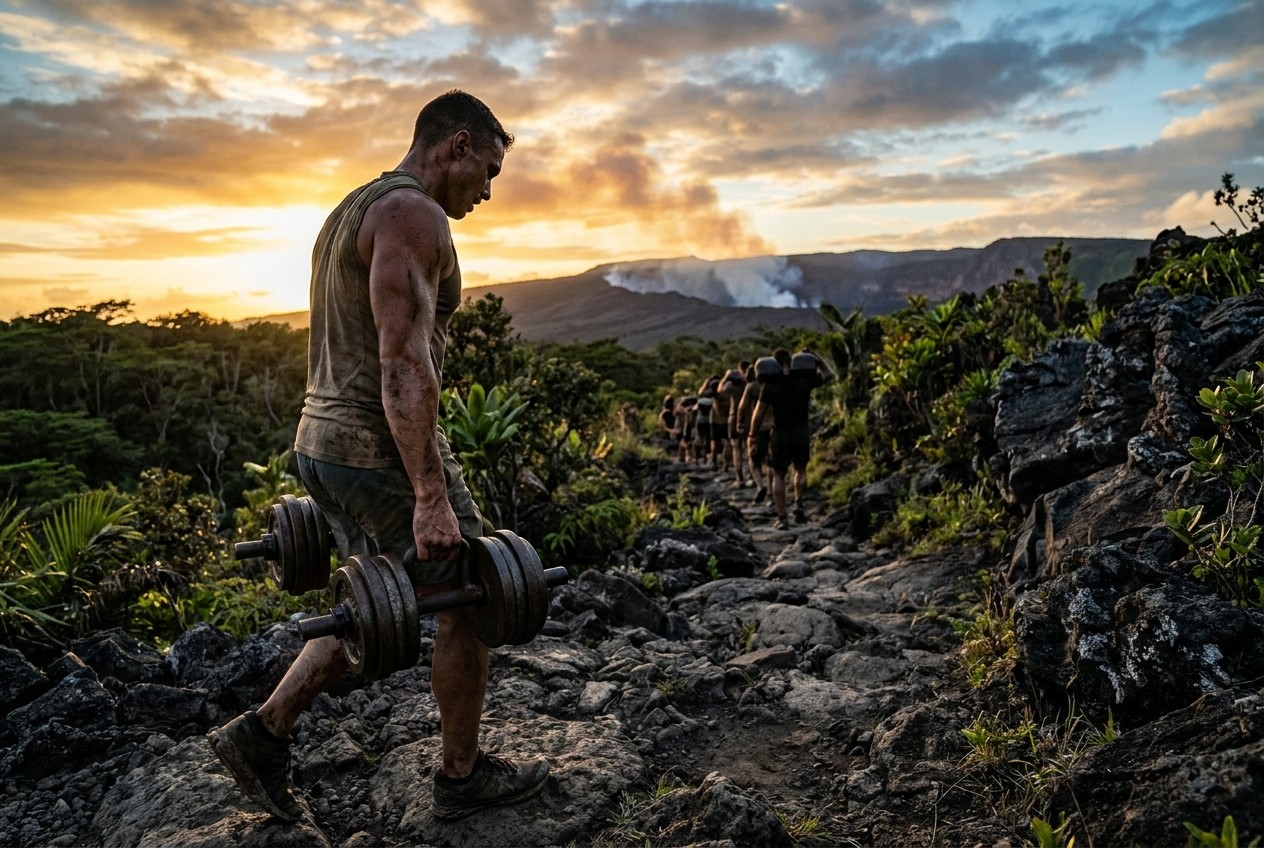
Shelley states that carrying is one of the most basic human functions and has been performed for thousands of years. He cites the example of sulfur miners at Mount Ijen in Indonesia, who carry heavy baskets of sulfur up the side of a volcano crater, as evidence of carrying's conditioning effects. Shelley writes that he watched video of a steady line of workers carrying baskets of sulfur nearly as heavy as themselves up a tortuous, steep route, and that the men were not out of breath when they reached the top.
The article identifies the specific muscle groups involved in carrying: the trapezius, rhomboids and shoulder stabilizers for the arms and shoulders; the rectus abdominis, transverse abdominis, obliques and erector spinae for the core; and the glutes, quadriceps, hamstrings and calf muscles such as the gastrocnemius, soleus and tibialis anterior for the hips and legs. Shelley writes that the arms provide the actual carrying, the core supports stability of the upper body, and the hip and leg muscles provide the balance and mobility to complete the item transport.
Other fitness authors have made comparable observations about the shoulder's role in load-bearing, noting that the shoulder girdle consists of the humerus, scapula and clavicle and is engineered for a remarkable range of three-dimensional movement [2]. A separate fitness text also describes carrying as helping reinforce proper posture and strengthen the grip, adding "finger and forearm strength is also paid very little attention" [3].
First Three Exercises: Farmer's Carry, Uneven Farmer's Carry, and Suitcase Carry
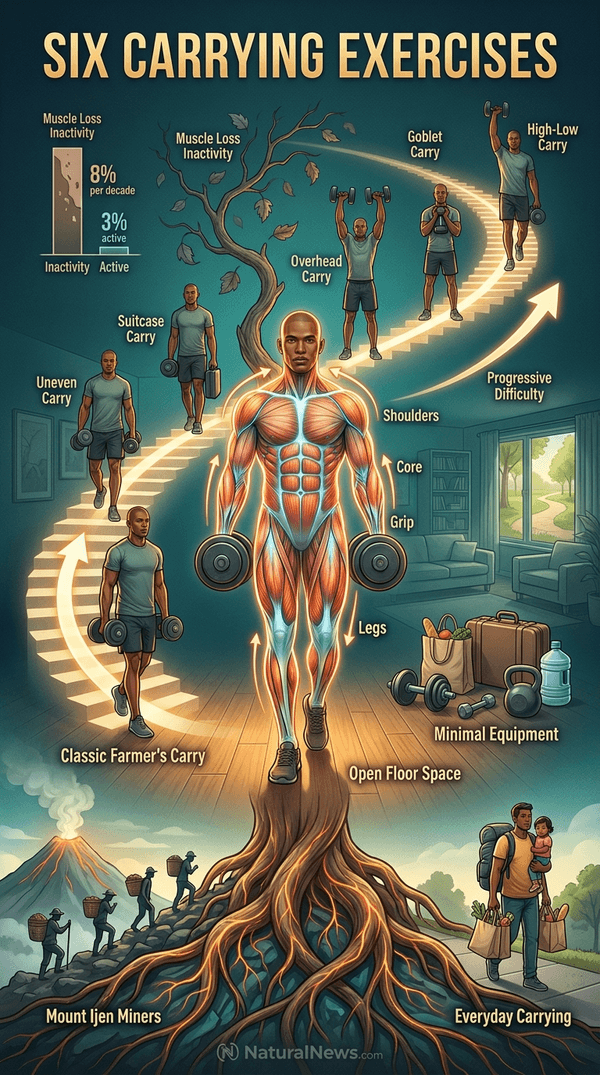
The first exercise, the classic farmer's carry, involves holding approximately equal weights in each hand while walking, according to the article. Shelley recommends standing with a 2-pound weight in each hand and walking about one step per second for several feet, then walking for one minute to count as one set and trying to perform three sets. He writes that the hands and forearms exert the power to hold, the shoulder muscles lock in to provide stability, and the hip and leg muscles coordinate to provide both mobility and balance.
The second exercise, the uneven weighted farmer's carry, uses different weights in each hand, such as 2 pounds in one hand and 4 to 6 pounds in the other, creating asymmetrical weight bearing that forces the core to compensate. Shelley advises walking for one minute before switching the weights around and performing another minute of walking, which counts as one set, with three sets recommended.
The third exercise, the suitcase carry, uses a weight in only one hand. Shelley states that asymmetrical weight bearing shifts focus to the non-weight-bearing side, requiring increased muscular action there to counter the weight on the other side. He recommends walking for one minute, pacing steps at approximately one step per second, then switching the weight to the other hand and walking another minute; walking one minute with a weight in one hand and then the other counts as one set, with three sets recommended. According to the article, these exercises are progressive, with the farmer's carry as a starting point and the other two adding asymmetrical challenges.
Remaining Exercises: Overhead Carry, Goblet Carry, and High-Low Farmer's Carry
The fourth exercise, the dumbbell overhead carry, involves holding weights overhead while walking, which the article states increases the trunk's need to provide ongoing postural corrections and forces careful balance control. Shelley recommends keeping the trunk and head upright, pushing the weights straight up toward the ceiling and walking for one minute at about one step per second, with three sets suggested. He writes that holding the weight overhead makes the body work harder to balance, especially on grass or other uneven surfaces, and cautions readers to use a weight they can safely control. As an option, he suggests holding the weights at shoulder level if they cannot be held straight up.
The fifth exercise, the goblet carry, places a weight in front of the body at chin level with the arms and elbows held off the body so the arms actively support the load. Shelley states that the position increases the challenge for the spinal erectors and stabilizers and also works the biceps and shoulder muscles. He recommends walking as in the other carries, taking one step per second for one minute, with three sets suggested, and encourages using the heaviest weight that can be comfortably controlled.
The sixth exercise, the high-low farmer's carry, combines one arm in the classic carry position and the other pushed straight up overhead. Shelley advises walking one step per second for one minute, then switching which arm is up and continuing; walking for one minute with each arm configuration counts as one set, with three total sets recommended. He writes that the exercise maximizes both the asymmetrical weight-bearing and balance components, and notes that the exercises can be modified by adjusting weight and duration.
References
- Paleo all-in-one for dummies by Flynn Patrick Fitness minimalist author
- Core performance essentials the revolutionary nutrition and exercise plan adapted for everyday. by Verstegen Mark 1969-Williams Pete 1969
- Paleo All-In-One for Dummies by Kellyann Petrucci, Melissa Joulwan, Patrick Flynn, Adriana Harlan
Explainer Infographic








Please contact us for more information.


