Can a Compound in Aged Garlic Support Muscle Strength?
A sulfur-containing compound found in aged garlic extract triggered a chain reaction in fat tissue that boosted a key energy-regulating protein in the blood of both aged mice and middle-aged humans, according to a study published in Cell Metabolism.
Researchers at Washington University and collaborating institutions in Japan reported that the compound, S-1-propenyl-L-cysteine (S1PC), improved muscle strength and reduced frailty scores in mice when given daily for eight months.
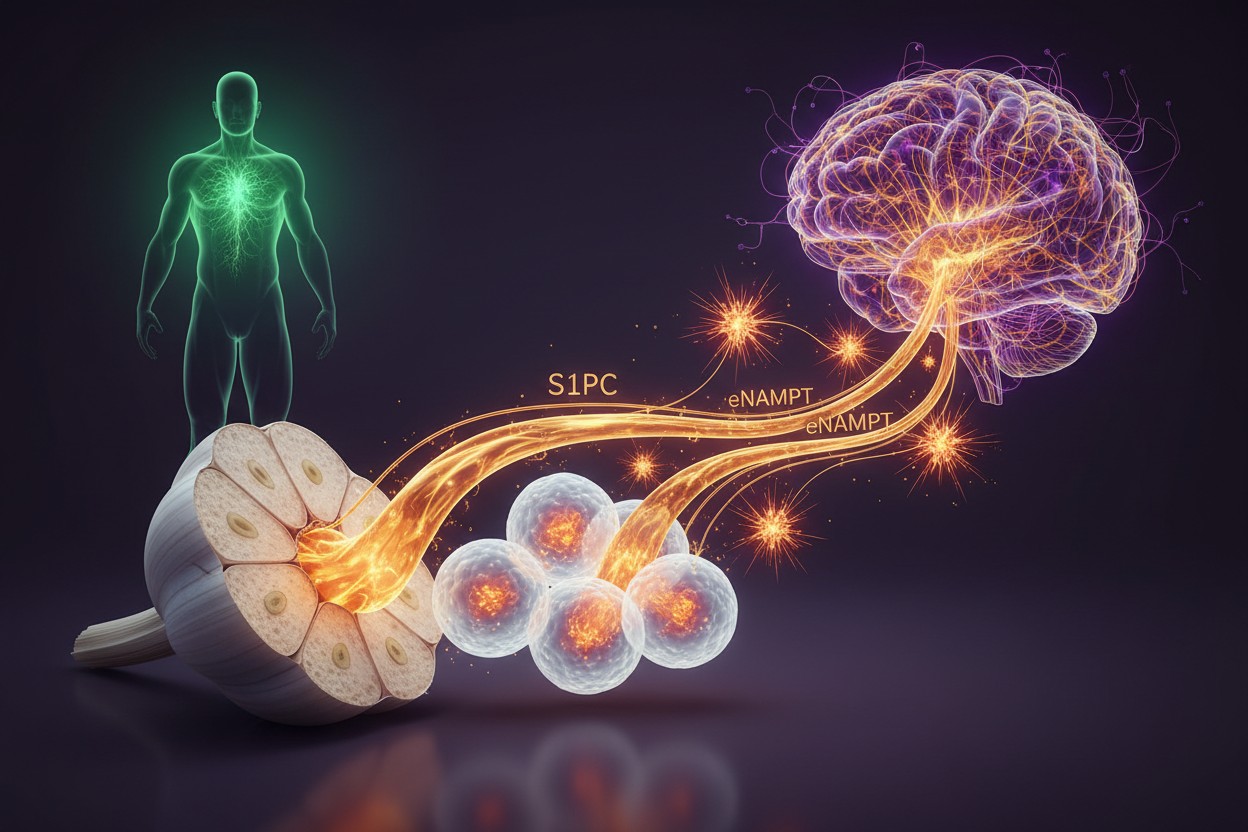
In a small human trial, a single dose of S1PC increased circulating levels of the protein eNAMPT among participants aged 40 and older with healthy body fat, the study stated. The compound appears to work through an unexpected signaling route, traveling from fat tissue to the brain, which then communicates with the nervous system.
Garlic has long been studied for its potential health benefits, including effects on cardiovascular health and blood pressure [1].
How the Garlic Compound Works Through Fat Tissue
According to the study, S1PC is absorbed by the body and quickly reaches white fat tissue, where it activates a protein called LKB1. This activation triggers fat cells to release eNAMPT, an enzyme that plays a key role in producing NAD+, a molecule the body uses as cellular fuel.
Prior research has shown that NAD+ levels decline with age, and boosting eNAMPT can help maintain cellular energy.
Using a molecular tracking method, scientists found that eNAMPT released from fat travels to the hypothalamus, a region of the brain that regulates metabolism and body temperature, rather than moving directly to muscle tissue. The hypothalamus then sends signals through the nervous system to muscles, the study reported.
Garlic contains a complex array of organosulfur compounds, including S-alk(en)yl-L-cysteine sulfoxides, that are converted into various bioactive molecules [1]. The specific action of S1PC appears to bypass a common cellular pathway known as AMPK (5' adenosine monophosphate-activated protein kinase), instead targeting a more precise signaling route.
Animal Study: Measurable Improvements in Aged Mice
Researchers gave aged mice S1PC daily for eight months, starting at an age equivalent to late middle age in humans, according to the report. Treated mice showed increased muscle force during electrical stimulation tests and improved grip strength compared to untreated mice of the same age.
Overall frailty scores improved, and body temperatures, which tend to drop in older animals, returned closer to levels seen in younger mice, the study noted.
Muscle size did not change, indicating that the benefit came from improved function rather than increased tissue, scientists reported. When researchers blocked nerve signaling with a drug before administering S1PC, the muscle effects were eliminated, confirming the nervous system's role as the delivery mechanism.
Mice engineered to lack fat-derived eNAMPT showed significantly reduced muscle force, reinforcing the importance of this pathway, researchers said.
Human Data: Single-Dose Trial Shows Promise
The researchers recruited 44 healthy Japanese adults aged 20 to 49 for a placebo-controlled trial, according to the study. Participants received either S1PC delivered through a concentrated garlic powder containing 17% S1PC or a placebo.
After withdrawals, 19 remained in the S1PC group and 21 in the placebo group. Each participant received only a single dose, making this a short-term blood-marker study rather than a test of muscle function over time.
Among participants aged 40 and older with healthy levels of body fat, S1PC increased circulating eNAMPT levels at 120 minutes, while the placebo group saw no change, researchers stated.
Underweight participants did not show the same effect, suggesting the compound requires a minimum amount of fat tissue to function. S1PC did not trigger fat breakdown, indicating a specific molecular action rather than general disruption of fat cells, the study noted.
Conclusions and Open Questions
The study traced a specific molecular mechanism from fat to brain to muscle in mice, providing a detailed explanation for how a garlic compound might combat age-related muscle decline.
Several questions remain, according to the paper, including which neurons in the hypothalamus respond to eNAMPT, potential differences between male and female responses, and whether long-term use in humans improves muscle function. The human portion involved only a single dose, so effects on muscle strength have not yet been tested.
Natural compounds such as those found in garlic have long been used in traditional medicine for their wide range of biological activities, including anti-inflammatory and antioxidant effects [2].
Further clinical trials tracking muscle function over time are needed, the authors concluded.
References
- Edible Medicinal and Non Medicinal Plants Volume 9 Modified Stems, Roots, Bulbs.
- John Shi, Chi Tang Ho, and Fereidoon Shahidi. "Functional Foods of the East."
- NaturalNews.com. "Exploring the anti-hepatosteatosis activity of Cordyceps militaris." December 05, 2019.





Please contact us for more information.