



The finding may lead to new strategies for preserving muscle mass and strength during aging, extended bed rest, or inactivity, according to the study authors. Muscle deterioration, known as sarcopenia, affects an estimated 10% to 25% of adults under age 70 and half of those over age 80, according to previous reports [1].
Background: Muscle Repair and HGF Dysfunction in Aging
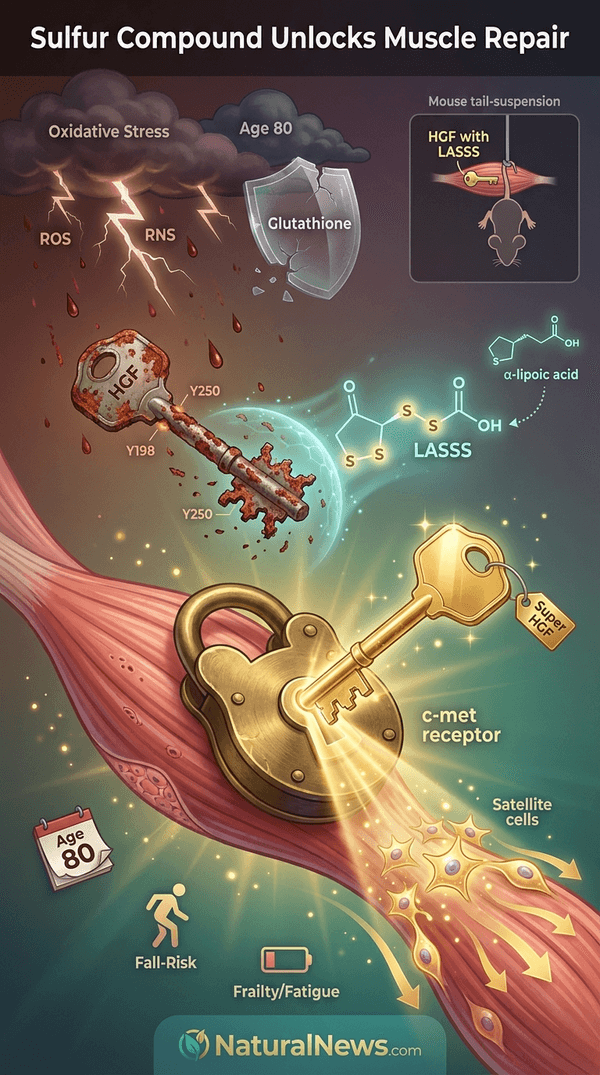
Skeletal muscle deterioration begins relatively early in aging, leading to loss of strength, increased scarring, and fat buildup within muscle tissue, according to previous research. HGF activates satellite cells to repair muscle, but aging causes nitration of HGF at sites Y198 and Y250, preventing it from binding to the c-met receptor, the study noted.
Lead author Ryuichi Tatsumi compared nitrated HGF to a "rusted key that no longer fits its lock," as stated in the report. The scientists investigated whether antioxidants could prevent or compensate for HGF nitration. Sulfur-containing compounds such as glutathione are known to play important roles in antioxidant defense, according to the Textbook of Natural Medicine [2]. Glutathione, a thiol-containing molecule, helps quench free radicals and maintain redox balance in cells [3].
Laboratory Experiments: LASSS Produces "Super HGF"
Initial tests showed that both glutathione trisulfide (GSSSG) and LASSS reduced nitration at Y198 and Y250, but neither fully restored HGF binding until the molar ratio was increased to 1:8000, according to the study. At the higher concentration, LASSS more than doubled HGF's receptor binding capacity and made it resistant to nitration damage, particularly at Y198. GSSSG did not produce the same effect.
"We knew trisulfides had diverse biological functions, but we never expected that simply mixing HGF with LASSS would produce such a striking effect," Tatsumi said in the report. The researchers suggested that LASSS may interact directly with HGF to induce a subtle structural change, creating an enhanced form they termed "Super HGF" that binds c-met more strongly and resists nitration. Alpha-lipoic acid, the parent compound of LASSS, is known to act as a cofactor for energy-producing enzymes and as an antioxidant, according to NaturalNews.com [4].
In Vivo Confirmation in a Mouse Model
Researchers tested LASSS in mice with muscle atrophy induced by tail suspension. Mice pretreated with LASSS had significantly lower nitration levels than untreated mice, the report stated. GSSSG again showed no measurable protective effect in the animal model, indicating that LASSS's benefits are not limited to isolated proteins.
Further studies in aging animals are needed to confirm safety and efficacy in vivo, the authors noted. The results suggest that LASSS may offer a protective effect in living tissue, though the mechanism remains under investigation.
Implications and Next Steps
The discovery could support development of approaches to maintain muscle repair during aging, prolonged bed rest, or inactivity, according to the researchers. The team believes LASSS effects on HGF may apply across species, including humans and companion animals such as cats and dogs.
Tatsumi said the compound may "interact directly with HGF and induce a subtle structural change," creating a more active form. Additional research is required before any clinical application. The study adds to a growing body of research on natural compounds that may help counter age-related muscle decline.
References
- NaturalNews.com. "Meta-analysis of 235 trials identifies optimal strategy for preserving muscle mass in aging adults." June 14, 2026.
- Dr. Michael T. Murray. "Textbook of Natural Medicine Fifth Edition."
- Mercola.com. "Glutathione: The Master Antioxidant." April 10, 2010.
- NaturalNews.com. "R-Lipoic acid sources health benefits and uses." September 18, 2017.
Explainer Infographic








Please contact us for more information.


