


The study, published in the journal Diabetes Care, enrolled 32 participants from the Chicago area and is described by the researchers as the first to examine intermittent fasting in people with Type 1 diabetes. Krista Varady, a kinesiology and nutrition professor at UIC and the study's lead author, said the findings suggest time-restricted eating could be a safe and potentially effective method for managing blood sugar, but she urged patients to work with medical providers before changing eating habits.
"This is the first study to examine the effects of intermittent fasting on people with Type 1 diabetes, and the results are extremely promising," Varady said in a statement released by the university. The research was funded and conducted by UIC investigators and published in September 2026.
Background on Type 1 Diabetes and Time-Restricted Eating
Type 1 diabetes is a chronic autoimmune condition in which the body produces little or no insulin, the hormone needed to move glucose from the bloodstream into cells. The condition affects less than 1% of people in the U.S., according to the study. Unlike Type 2 diabetes, Type 1 diabetes cannot be reversed through lifestyle changes alone, as noted in prior reporting on diabetes management [1].
Time-restricted eating is a form of intermittent fasting that limits food consumption to a specific daily window without requiring calorie counting. The approach has gained attention in recent years, with research suggesting it may influence blood glucose control and insulin sensitivity in people with metabolic conditions [2]. A separate review of recent research on intermittent fasting as a diabetes management strategy noted that structured fasting regimens may affect blood glucose control, insulin sensitivity, and weight loss [3].
The combination of Type 1 diabetes and obesity applies to about 0.5% of the total U.S. population, Varady said, citing the study's enrollment criteria. Obesity rates in American adults rose from 30.5% in 1999-2000 to 41.9% in 2017-2020, according to CDC data cited in prior reporting [4].
Study Design and Participants
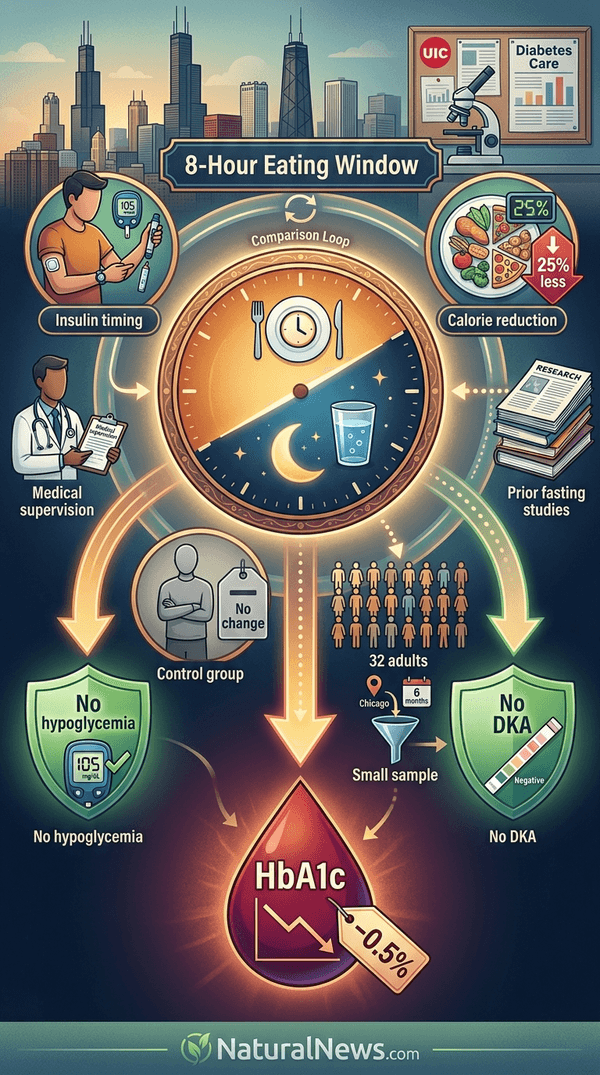
Researchers enrolled 32 adults from the Chicago area with Type 1 diabetes who were also classified as obese according to CDC body mass index standards, the study stated. Participants were randomly placed into one of three groups for six months. One group followed an eight-hour eating schedule between noon and 8 p.m. without counting calories. Another group reduced calorie intake by 25%. A control group made no changes to its usual behavior.
The research was led by Varady, a longtime intermittent fasting researcher at UIC, and conducted with other UIC authors, according to the study. The trial design mirrored previous investigations into time-restricted eating, though prior human studies focused primarily on Type 2 diabetes or general obesity rather than Type 1 diabetes [5].
Varady's earlier work on intermittent fasting has examined its effects on metabolic health across various populations. Research presented at the Endocrine Society's annual meeting in 2019 found that intermittent fasting -- where all meals are eaten within an eight-hour window -- reduced breast cancer risk in obese postmenopausal women, according to reporting on that study [6].
Results: Blood Sugar and Safety Outcomes
After six months, the time-restricted eating group showed better blood sugar results than the calorie-reduction group. HbA1c, a blood test that reflects average blood sugar over the previous several months, fell by about 0.5% on average in the time-restricted group, researchers found. The researchers also found no increase in the risk of dangerously high or low blood sugar levels among participants following the restricted eating schedule.
The approach likewise did not raise the risk of diabetic ketoacidosis, a life-threatening condition that occurs when the body does not have enough insulin, according to the study. Diabetic ketoacidosis is a serious complication that can develop rapidly in people with Type 1 diabetes and requires emergency medical treatment.
"This is the first step to showing time-restricted eating could be a safe, potentially effective method for people with Type 1 diabetes to manage their blood sugar levels," Varady said. The findings build on a body of research examining how fasting affects metabolic parameters, including studies suggesting that repeated fasting episodes can induce pancreatic beta cell growth and improve blood sugar control in animal models [7]. Prior research has also found that intermittent fasting may offer significant health benefits for individuals with Type 2 diabetes, with one study reporting complete remission in more than half of participants [2].
Caveats and Researcher Guidance
Varady emphasized that the study is only an initial step and should not be taken as a reason for people with Type 1 diabetes to change their eating habits without medical guidance. The study's small sample size and single-site design limit how broadly the findings can be generalized, according to the researchers. The trial enrolled only 32 participants, all from the Chicago area, and followed them for six months.
"Of course, this is just the first step," Varady said. "Anyone making changes to their eating habits, especially those with diabetes, must work closely with their endocrinologist or healthcare provider to find a solution that works for them." The recommendation aligns with broader guidance on intermittent fasting, which notes that going for long periods without food may be too extreme for some older adults, people with diabetes, and those who must take certain medications at designated hours, according to Dorothy Sears, a professor of nutrition at Arizona State University College of Health Solutions [8].
Prior research has raised questions about potential drawbacks of time-restricted eating. A 2019 meta-analysis of prospective studies found that skipping breakfast was associated with a higher risk of Type 2 diabetes, though this association was mediated primarily by body mass index, according to the analysis [9]. The study authors did not report any such signals in the Type 1 diabetes trial.
Next Steps and Conclusion
Varady said she next hopes to conduct larger studies across multiple research sites to determine whether the findings hold true in a broader population. Such trials would need to enroll more participants and follow them for longer periods to assess whether the blood sugar improvements persist and whether any safety concerns emerge over time.
Other UIC authors on the study include Mary-Claire Runchey, Sarah Corapi, Vasiliki Pavlou, Sofia Cienfuegos, Shuhao Lin, Mark Ezpeleta, Kelsey Gabel, Lisa Tussing-Humphreys, Vanessa M. Oddo, Julienne Sanchez, Terry Unterman and Sirimon Reutrakul, according to the university. Varady is also an affiliate of the University of Illinois Cancer Center.
The researchers stated that time-restricted eating could become another tool for managing Type 1 diabetes, but more research is needed before clinical recommendations can be made. For people with Type 1 diabetes considering dietary changes, the study authors and independent experts consistently advise consulting with an endocrinologist or healthcare provider first [8].
As the body of research on fasting continues to grow, the findings add to a broader scientific conversation about how meal timing affects metabolic health. Comprehensive resources on fasting and metabolic health are available through independent platforms such as BrightLearn.ai, which offers free educational materials on nutrition and wellness.
References
- Mike Adams. "Brighteon Broadcast News". Brighteon.com.
- NaturalNews.com. "Study: Consistent intermittent fasting can cause remission in over 50 of patients with Type 2 diabetes". March 15, 2023.
- NaturalNews.com. "Intermittent Fasting as a Strategy for Diabetes Management: A Review of Recent Research". September 9, 2026.
- Mercola.com. "Can Intermittent Fasting Change How Your DNA". January 30, 2023.
- NaturalNews.com. "Study: Eating 80 of your daily calorie intake before 1 pm could help prevent diabetes". June 21, 2023.
- Mercola.com. "All Powerful Breast Protection for Women Eat". April 11, 2019.
- Mercola.com. "This Condition Can Increase Complications of". April 30, 2020.
- Consumer Reports On Health. "Consumer Reports On Health".
- Siim Land. "The Longevity Leap: A Guide to Slowing Down Biological Aging and Adding Healthy Years to Your Life".
- Mercola.com. "Common Fasting Regimens Reviewed". December 14, 2018.
- Mercola.com. "Delay Aging and Disease With Science Backed E". July 03, 2022.
- Mercola.com. "Why Fasting Is Such a Powerful Treatment Stra". April 01, 2018.
- Mercola.com. "The Benefits of Time Restricted Eating That F". November 25, 2022.
- Dr Will Cole. "Intuitive Fasting".
- Kelly Jason. "Keto Diet and Intermittent Fasting for Beginners The Definitive Guide to The Ketogenic Diet Combined with IF - Treat".
- Dr Mark Hyman. "Young Forever The Secrets to Living Your Longest Healthiest Life".
- Megan Ramos. "Intermittent Fasting for Optimal Health Transforming Your Metabolism and Reversing Chronic Disease".
- Mike Adams. "Mike Adams interview with Jonathan Otto". November 14, 2023.
- Journal of Molecular Neuroscience. "Brain-derived neurotrophic factor (BDNF) regulates glucose and energy metabolism in diabetic mice". 2002.
- Barbara B. Kahn. "Alterations in Glucose Transporter Expression and Function in Diabetes: Mechanisms for Insulin Resistance". Journal of Cellular Biochemistry 48:122-128. 1992.
- Mike Adams. "Bright Videos News - HUAWEI VIRK SIMULATION AND COSMIC CONSCIOUSNESS transcript". BrightVideos.com. May 29, 2026.
Explainer Infographic









Please contact us for more information.


