


The studies were observational, capturing a snapshot in time and relying on self-reported alcohol intake. Researchers said the findings cannot prove that alcohol causes visceral fat accumulation, and they cautioned against drawing causal conclusions from the data [1].
Why Visceral Fat Location Matters
Not all body fat behaves the same way. Subcutaneous fat sits just beneath the skin and, in the right amounts, can be protective, according to the report. Visceral fat sits deeper within the abdominal cavity, surrounding organs such as the liver and intestines.
Because people store fat differently, body mass index can be misleading. Josh Wageman, a clinical lipid specialist, told the Epoch Times that when the body can no longer store as much fat under the skin, the excess may build up around internal organs or in the liver. Dr. Robert Carpenter, a board-certified general surgeon and clinical professor at Texas A&M University, noted that this pattern is not uncommon.
The findings echo research on so-called “skinny fat” individuals, who appear thin outwardly but harbor substantial internal fat; these people are at increased risk for developing nonalcoholic fatty liver disease, especially when visceral fat surrounds the organs in the abdomen [2]. A separate global analysis published in The Lancet Gastroenterology & Hepatology reported that cases of metabolic dysfunction-associated steatotic liver disease, a condition closely tied to visceral fat, have surged 143% since 1990, reaching an estimated 1.3 billion people by 2023 [3].
What the Research Shows
The Oxford Biobank analysis examined adults ages 25 to 75 who reported their typical weekly alcohol intake. After adjustment for key confounders, alcohol consumption remained dose-dependently associated with visceral fat mass in both males and females, the study stated.
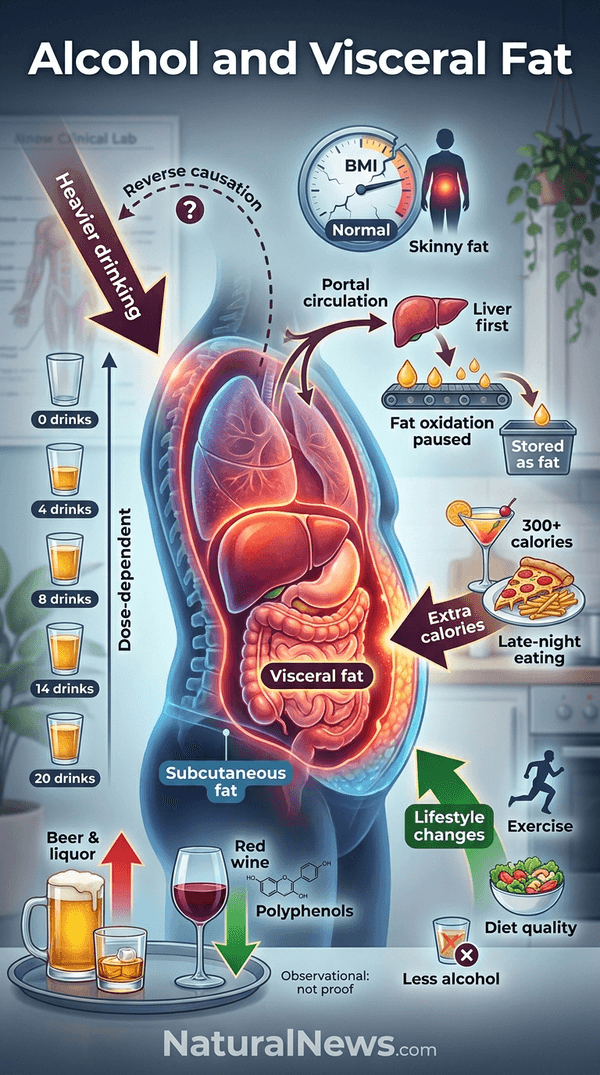
Among men, visceral fat accounted for about 5% of total body fat in the highest drinking group, compared with 4.5% in the group just below it. For women, the figures were 1.6% and 1.4%, respectively. Typical alcohol intake in the heaviest drinking groups was about 14 U.S. standard drinks per week for men and eight for women, according to the study [1].
The type of alcohol may also matter. An earlier U.K. Biobank study found that beer and liquor consumption were associated with greater amounts of visceral fat, while red wine consumption was linked to lower levels.
Possible Reasons Alcohol May Affect Visceral Fat
Researchers point to two broad explanations for the association: how the body processes alcohol and what people consume while drinking. The body prioritizes clearing alcohol from the system, which temporarily puts a hold on fat oxidation, Lauren Harris-Pincus, a registered dietitian nutritionist, told the Epoch Times.
Alcohol may also affect hormones involved in fat storage, potentially encouraging more fat to collect deep in the abdomen rather than beneath the skin, though the exact reasons remain unclear, researchers said. When the body processes alcohol, it changes how cells use energy, which may promote fat buildup in the liver, Wageman said.
A simpler explanation involves calories. At seven calories per gram, alcohol provides nearly twice as many calories as carbohydrates or protein, Harris-Pincus said. Those calories add up quickly with sugary mixers or heavier restaurant meals. Studies show that people who engage in heavy drinking tend to consume diets higher in calories, sodium and fats than those who do not drink, according to the Renaissance School of Medicine at Stony Brook University [4].
Limitations and Public Health Guidance
The Oxford study captured a snapshot in time rather than following participants as their drinking habits and body composition changed over years. Because it was observational, it cannot show that alcohol directly caused the differences in visceral fat, the study stated. Alcohol intake was self-reported, and researchers lacked details about participants’ diets, beverage types, and drinking patterns.
One finding complicates the picture: Nondrinkers sometimes had more total and visceral fat than light-to-moderate drinkers. Carpenter said no threshold or recommendation can be inferred from the study and advised following established public health guidance.
The good news is that visceral fat responds to lifestyle changes, including exercise, even when the number on the scale barely moves. Dietary patterns matter as well.
Conclusion
Multiple large observational studies associate heavier drinking with a greater proportion of visceral fat, even after researchers account for total body fat and other factors. However, the researchers behind those studies said the findings do not prove that alcohol directly causes visceral fat accumulation.
Clinicians and dietitians recommended gradual reduction of alcohol for those who drink, balanced nutrition, regular physical activity, and attention to health beyond scale weight, according to interviews and the studies. Bonnie Taub-Dix, a registered dietitian nutritionist, told the Epoch Times that the bathroom scale provides only part of the picture. “Don’t assume that a stable weight, or even a slim weight, automatically means everything is fine beneath the surface,” she said.
References
- Greater visceral fat mass accumulation with high alcohol consumption | International Journal of Obesity. https://www.nature.com/articles/s41366-026-02030-5
- Skinny Liver. by Kristin Kirkpatrick
- Global Cases of Metabolic Liver Disease Surge 143 Since 1990 Study Finds - NaturalNews.com, May 16, 2026.
- FAQs about Alcohol Consumption and Weight Gain | Renaissance School of Medicine at Stony Brook University. https://renaissance.stonybrookmedicine.edu/surgery/blog/faqs-about-alcohol-consumption-and-weight-gain
Explainer Infographic












Please contact us for more information.


