



Compound movements such as squats are multi-joint exercises that involve flexion and extension at more than one joint and work multiple muscle groups at the same time, according to trainers Sydney Miller and Scott Thompson in a report published by NaturalNews.com [1]. Hip mobility exercises can help ease lower back pain, according to an article on NaturalNews.com [2]. The new findings add to that picture by focusing on the ankle as a factor in squat mechanics, the report stated.
Study Design and Methods
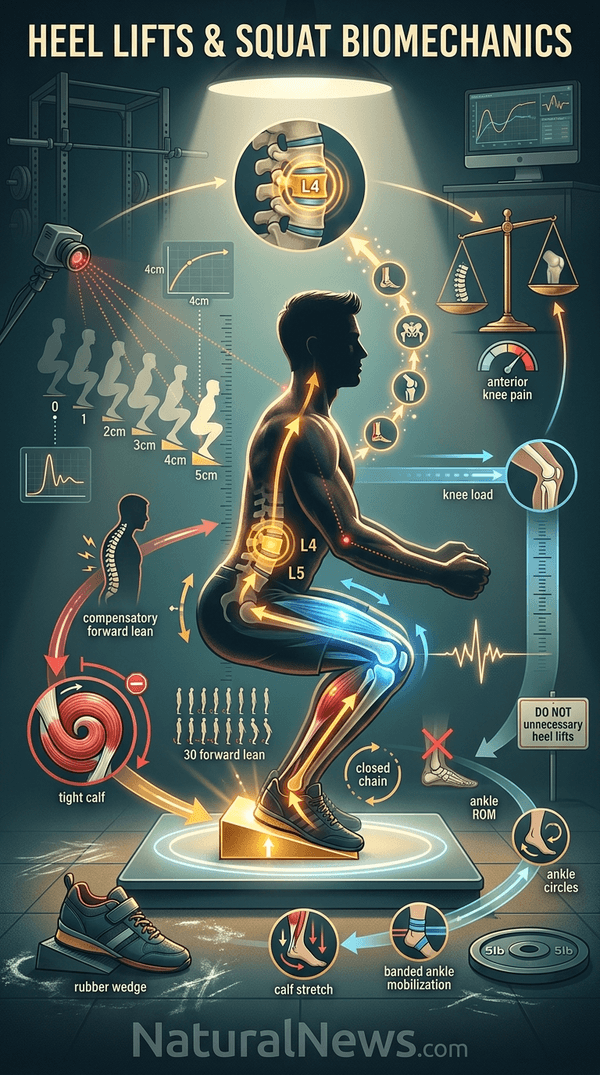
Researchers recruited 30 men with restricted ankle mobility, according to the report. Each participant performed loaded squats at heel heights of 0, 1, 2, 3, 4, and 5 centimeters. The protocol was designed to track how each centimeter of elevation changed squat mechanics, the report stated.
The study used motion capture, force plates, and surface muscle activity sensors to measure posture, joint load, and muscle activation, according to the report. Motion capture records how the body moves in three dimensions, force plates measure force traveling through the feet and into the ground, and surface sensors track muscle engagement, the report stated.
Rehabilitative weight-training exercises fall into two broad categories: closed kinetic chain exercises and open kinetic chain exercises, according to Marc Darrow, MD, in "The Knee Sourcebook" [3]. Heel elevation changes the position of the foot relative to the ground and alters the chain of load through the ankle, knee, and spine, according to the report.
Findings: Upright Squat and Reduced Spinal Stress
As heel height increased, participants leaned forward less and squatted deeper, the report stated. That shift in posture produced less stress on the lower back, specifically across the L3 through L5 vertebrae, with the largest reduction at L4, according to the report.
At the same time, load on the knee extensor muscles increased with each additional centimeter of heel elevation, according to the study data. The report stated that heel elevation does not simply help a lifter stand more upright; it actively redistributes load across the lower body and spine in a measurable, incremental way.
Knee pain is a common complaint that affects both men and women, as well as younger and older adults, according to an article on NaturalNews.com [4]. The redistribution of load toward the knees is the reason researchers said the technique should be used with moderation, the report stated. Bob Glover's "The Competitive Runner's Handbook" notes that lower-back problems are most frequent and that the sciatic nerve begins in the lower back and extends all the way down the leg to the ankle [5].
Practical Applications and Limitations
The report said small heel lifts, including 5-pound plates, heel wedges, or lifting shoes with a built-in raised heel, may help people with limited ankle mobility achieve a more upright squat. According to the report, users should start with the smallest elevation that feels comfortable and reduce it if knee strain increases.
The calf muscles consist of two main muscles, the gastrocnemius and the soleus, which manipulate the Achilles tendon, according to an article on NaturalNews.com [6]. To address underlying mobility, the report recommended calf stretches, ankle circles, and banded ankle mobilizations. Hip mobility exercises can help ease lower back pain, according to NaturalNews.com [2].
The study was limited to men with restricted ankle mobility, and researchers said those with normal ankle mobility may not benefit and could add unnecessary knee load, according to the report. Deep squatting exercises, with or without weights, place the knee joint in hyperflexion, which tends to "wedge it open, stretching the ligaments, irritating the synovial membrane," according to an exercise science text [7]. This suggests heel height should be selected carefully, the report stated.
Takeaway
For people with limited ankle mobility, a small heel lift may reduce lower back stress during squats, according to the report. The effect is not a more-is-better situation, researchers said, because knee demand rises with each centimeter of elevation.
Moderation is advised. Experts recommend incorporating daily mobility work as a strategy for preserving the ability to perform everyday activities without assistance, according to a report by NaturalNews [8]. The report concluded that heel elevation is a tool to help people move better, not a permanent workaround.
References
- NaturalNews.com. "Five Quad Exercises Beyond Squats, According to Physical Therapists". NaturalNews.com. August 5, 2026.
- NaturalNews.com. "9 Hip Mobility Exercises That Can Help Ease Lower Back Pain". NaturalNews.com. June 10, 2020.
- Marc Darrow, MD. "The Knee Sourcebook".
- NaturalNews.com. "5 Low-Impact Exercises to Help Ease Knee Pain". NaturalNews.com. September 25, 2020.
- Bob Glover. "The Competitive Runner's Handbook".
- NaturalNews.com. "Hey Guys, Doing Your Calf Raises?". NaturalNews.com. May 10, 2016.
- Corbin Charles B., Lindsey Ruth. "Concepts of Fitness and Wellness".
- NaturalNews.com. "Mobility Training Linked to Longevity and Independence, Researchers Say". NaturalNews.com. May 11, 2026.
Explainer Infographic











Please contact us for more information.


