


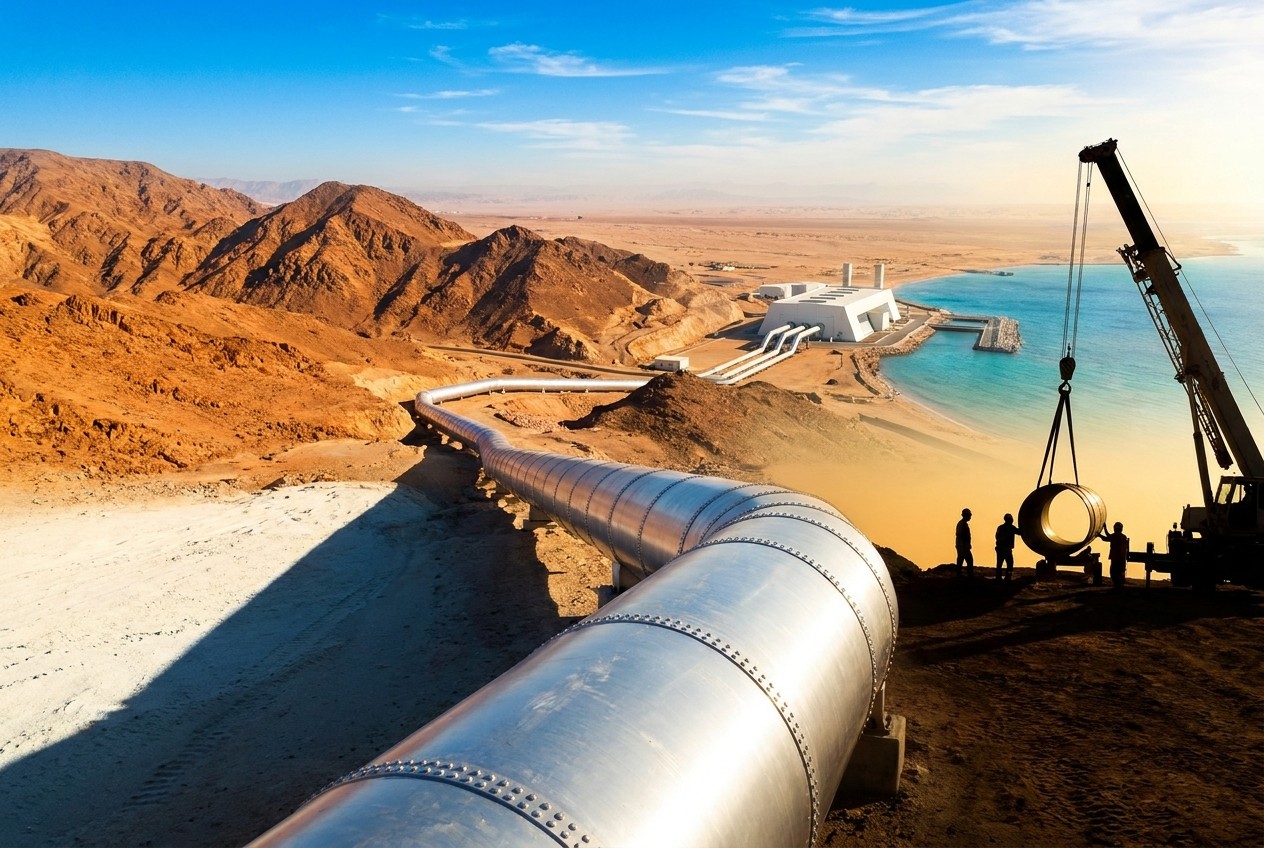
The announcement places the project among the region's largest water infrastructure undertakings. The Green Climate Fund described the launch as marking the start of one of the world's largest desalination initiatives [2].
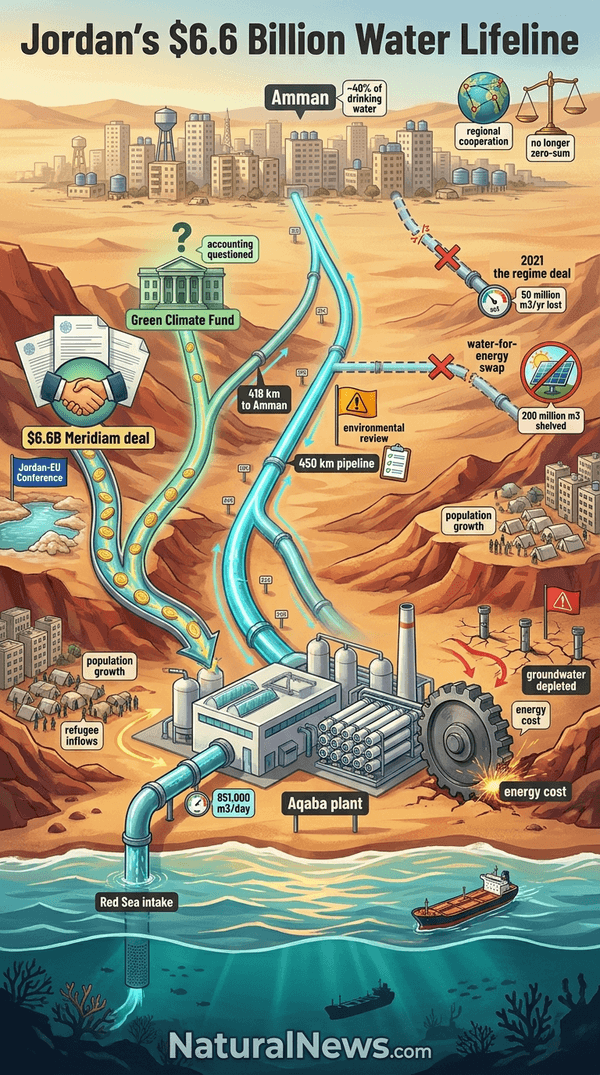
Officials said the project is intended to move desalinated water from Aqaba to Amman and to reduce Jordan's reliance on Israel for water. The Cradle reported that Israel has refused to renew a 2021 supply deal, leaving Jordan without 50 million cubic meters of additional water per year to meet future demands [3]. Jordan's decision to shelve a water-for-energy arrangement with Israel preceded the launch, according to reporting by The Jewish Edition [4].
Project Scope and Financing
The plan includes a desalination plant on the Red Sea coast and a pipeline running north to Amman and other parts of the country, according to officials cited in reporting by i24NEWS [5]. The engineering plan calls for pumping 300 million cubic meters of water a year through a 450-kilometer pipeline, i24NEWS reported [5]. Smart Water Magazine reported that approximately 418 kilometers of pipelines will carry the water to Amman and that the Aqaba plant's design capacity is 851,000 cubic meters a day, citing SUEZ [6]. Ynetnews reported that the project is designed to meet approximately 40% of Jordan's drinking water needs [7].
The financing structure has been reported with differing figures. Jordan's official Petra news agency reported that Jordan signed a $6.6 billion agreement with lead developer Meridiam to launch executive works on the project during the Jordan-EU Investment Conference at the Dead Sea [8].
Government officials have not released a complete procurement schedule for the project. According to The National, King Abdullah had been scheduled to lay the cornerstone but Prince Faisal presided instead [9].
Water Scarcity and Reliance on Israel
Jordan is among the world's most water-scarce countries, according to officials and the report. A 1997 study published in Applied Energy by J.O. Jaber, S.D. Probert and O. Badr found that industrialization, as well as agricultural and commercial activities in Jordan, had caused increases in both energy demand and water consumption, and that available renewable fresh-water resources were insufficient to meet these demands [10]. According to the report, demand is driven by population growth and refugee inflows. Mercy Corps said in a report quoted by author Jeff Nesbit that Jordan faces a perfect storm of pressures, with refugee demands layering over long-standing challenges of scant supply, unsustainable management and out-of-date infrastructure [11].
Jordan has received water under arrangements with Israel, and officials said the new project is meant to curb that dependence. The Cradle reported that Israel refused to renew a 2021 supply deal, leaving Jordan without 50 million cubic meters of additional water per year [3]. According to reporting by The Jewish Edition, the project follows Jordan's decision to shelve a water-for-energy deal under which Jordan would have built solar capacity to supply electricity to Israel in exchange for 200 million cubic meters of desalinated water annually [4].
The report stated that the project is being framed as a strategic water-security measure rather than a temporary supply fix. A paper in the volume Society - Water - Technology noted that prospects for Jordan's water security will depend on politics and regional cooperation, citing Yorke's 2015 assessment [12]. According to a volume edited by Jean Axelrad Cahan, the new ability to inexpensively produce water through desalination means that water politics no longer needs to be perceived as a zero-sum game [13].
Statements From Officials and Stakeholders
Jordanian officials have described the project as a strategic national priority, according to remarks cited in the reports. At the Dead Sea, Jordan signed the agreement with lead developer Meridiam during the Jordan-EU Investment Conference, according to Petra [8]. The Green Climate Fund said Prince Faisal bin Al Hussein presided over the official launch in Aqaba [2].
Analysts and stakeholders have raised questions about cost, financing and environmental review. Jaber, Probert and Badr noted in their 1997 study that over-extraction from ground-water and non-renewable sources had already occurred and that the rest, if present trends persisted, would run dry within a few decades [10]. Writing in Water, Steven Solomon observed that water efficiency is necessary but not sufficient for water-famished regions like the Middle East and that new water supplies are also needed, noting that desalinization had historically been prohibitively expensive because it required vast amounts of energy [14].
Separate reporting on the UN Green Climate Fund, which is involved in the financing, has questioned the fund's accounting. A Watts Up With That commentary published in August 2026 argued that the fund has received and spent over $20 billion to date and that it funds water supply systems in dry countries under the label of climate change adaptation [15]. These characterizations are presented as commentary and are not endorsed here.
References
- Jordan launches $6.6bn desalination project amid push to .... https://thecradle.co/articles/jordan-launches-66bn-desalination-project-amid-push-to-curb-reliance-on-israel
- Green Climate Fund joins official launch of landmark Aqaba-Amman water .... https://www.greenclimate.fund/about/news-and-updates/green-climate-fund-joins-official-launch-landmark-aqaba-amman-water-project
- Jordan launches $5.8bn desalination project amid push to curb reliance on Israel. https://thecradle.co/articles-id/41150
- Jordan Launches $6.6 Billion Desalination Mega-Project to Curb Reliance .... https://thejewishedition.com/news/middle-east-levant/2026/11/19/jordan-launches-6-6-billion-desalination-mega-project-to-curb-reliance-on-israeli-water/
- Jordan's water crisis deepens as Israel supply deal expires and desalination project faces hurdles - i24NEWS. https://www.i24news.tv/en/news/middle-east/levant-turkey/artc-jordan-s-water-crisis-deepens-as-israel-supply-deal-expires-and-desalination-project-faces-hurdles
- Jordan breaks ground on US$6.7bn Aqaba-Amman desalination and conveyance project – Smart Water Magazine. https://smartwatermagazine.com/news/newsroom/jordan-breaks-ground-on-us6-7bn-aqaba-amman-desalination-and-conveyance-project
- Jordan's $6.6 billion water revolution: why it matters for Israel. https://www.ynetnews.com/article/hy2wn112cfe
- Jordan Signs $6.6 Billion Water Desalination, Conveyance Project .... https://petra.gov.jo/cartargine/index.php/en/news/jordan-signs-66-billion-water-desalination-conveyance-project-agreement-with-meridiam
- Jordan embarks on $5.8 billion water project to reduce shortages | The National. https://www.thenationalnews.com/news/mena/2026/11/18/jordan-israel-aqaba-water/
- Water Scarcity: A Fundamental Crisis for Jordan. by Acrobat 3.0 Capture Plug-in. Applied Energy Vol. 57 No. 2/3 pp. 103-127 1997
- This Is the Way the World Ends. Jeff Nesbit
- Society - Water - Technology A Critical Appraisal of Major Water Engineering Projects. Reinhard F Huettl
- Water Security in the Middle East Essays in Scientific and Social Cooperation. Edited by Jean Axelrad Cahan
- Water. Steven Solomon
- The UN Green Climate Fund is a wasteful fraud. https://wattsupwiththat.com/2026/08/12/the-un-green-climate-fund-is-a-wasteful-fraud/
- Rystad Energy Report Details Rising $58 Billion Repair Costs from Middle East Conflict. https://www.naturalnews.com/2026-04-18-rystad-energy-report-details-rising-repair-costs.html
- War on Iran leaves $58 billion repair bill across region – report. https://www.rt.com/business/638519-iran-war-billion-energy-repair/?utm_source=rss&utm_medium=rss&utm_campaign=RSS
Explainer Infographic










Please contact us for more information.


