



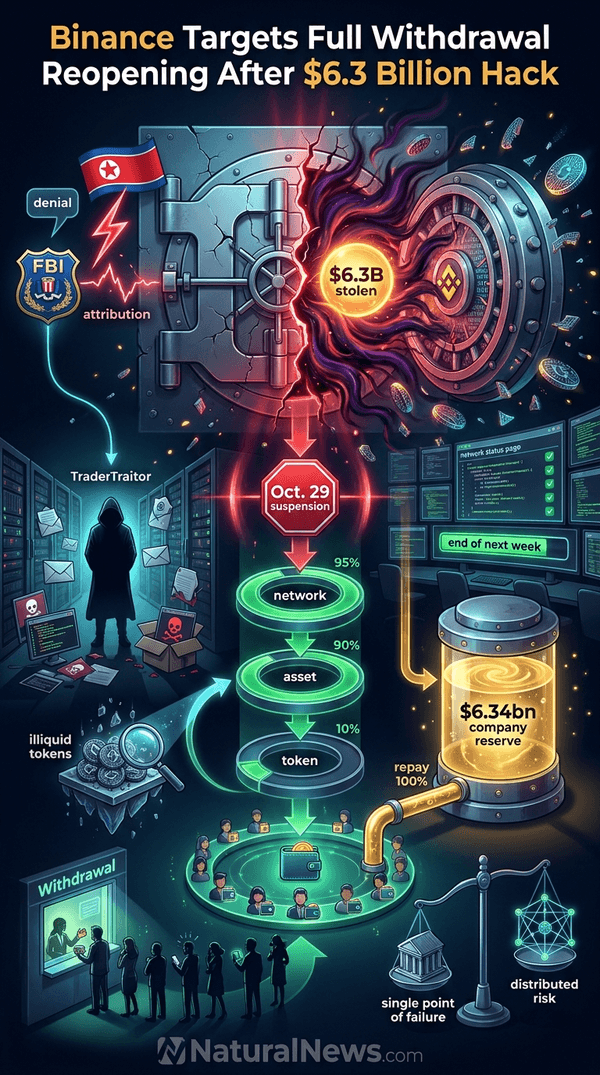
The exchange suspended all deposits and withdrawals on Oct. 29, the day the breach was disclosed, according to a recovery update published Nov. Binance subsequently resumed withdrawals in phases earlier this month, after covering 95% of the stolen tokens, the company said [2].
The FBI and Binance have stated that North Korea was responsible for the hack, while Pyongyang has denied involvement, according to statements from both parties [3].
Attribution and Timeline of the Breach
The FBI and Binance have attributed the theft to North Korea, while Pyongyang has denied responsibility, according to officials and company statements [3]. The FBI said in a cyber alert that North Korea "was responsible for the theft of more than $6 billion USD in virtual assets" from Binance [4]. Kim Yo-jong, a top Democratic People's Republic of Korea official and the sister of leader Kim Jong Un, said the accusations are an "absurd rhetoric" and a "sinister attempt" by the United States to damage the country's public image [3].
Blockchain investigation firms have attributed the hack to a North Korean group known as "TraderTraitor," according to the report [4]. Binance said in its initial report that the multistage hacking endeavor began in June and culminated in the theft on Oct. The company said hackers gained access to its systems through a "sophisticated, multi-stage campaign" using techniques such as malicious software downloads to compromise the computers of Binance engineers [5].
North Korea has a documented history of cryptocurrency heists, including a $500 million theft from Japanese exchange CoinCheck that an unidentified South Korean lawmaker claimed was the work of North Korean hackers, though the source notes no actual evidence has been uncovered to confirm North Korea's involvement [6]. Centralized exchanges remain vulnerable to such attacks, a reality noted by industry observers who distinguish them from decentralized alternatives.
Phased Reopening of Withdrawals
Binance resumed withdrawals in phases earlier this month after covering 95% of the stolen tokens, the company said [2]. In earlier recovery updates, Binance said it had replaced 90% of the $6.3 billion in stolen assets and pledged to cover the remaining 10%, consisting of less liquid tokens that may take longer to source in required amounts [7].
Binance has vowed to repay customers in full, according to company statements [8]. The company said it has set aside more than $6.34bn in company funds to cover 100% of the losses [9]. Binance said on Saturday (Nov 14) that it aims to reopen withdrawals for all remaining networks and assets by the end of next week, as operations normalize for the world's biggest cryptocurrency exchange after a security breach linked to North Korea saw US$6.3 billion stolen from the platform in October [10].
Leadership Change and Company Response
The company has not provided a specific date for full restoration beyond the end-of-week target cited in its post [11].
Binance's operational targets are commitments to restore access, not confirmation that every customer can already move every asset, as noted in recovery tracking reports [12]. The exchange continues to provide updates through its network status page and official announcements [11].
Outlook and Implications
The hack comes amid broader scrutiny of centralized cryptocurrency exchanges, which provide custodian services and know-your-customer compliance, distinguishing them from decentralized exchanges that allow direct trading between buyers and sellers [13]. While centralized platforms offer sophisticated asset management solutions and flexible fee structures, they also concentrate risk in single points of failure [13].
References
- Binance targets full reopening of withdrawals by next week. https://www.reuters.com/legal/government/binance-targets-full-reopening-withdrawals-by-next-week-2026-11-14/
- Binance targets full reopening of withdrawals by end of this week. https://nypost.com/2026/11/15/business/binance-targets-full-reopening-of-withdrawals-by-end-of-this-week/
- North Korea denies being behind record $6.3bn Binance hack. https://bbc.com/news/articles/c6rey4v53exgo
- FBI Says North Korea Behind $6 Billion Binance Heist. https://www.zerohedge.com/ai/fbi-says-north-korea-behind-6-billion-binance-heist
- Binance says fake job interviews used as part of $6.3bn crypto hack. https://bbc.com/news/articles/ck5ynwz9gy67o
- Bitcoin hacks are funding North Koreas nuclear missile program; Cryptos now LESS secure than conventional money - NaturalNews.com, February 16, 2018.
- Binance Says It Has Covered 90 Percent of Losses From $6.3 Billion Hack. https://www.ntd.com/binance-says-it-has-covered-90-percent-of-losses-from-6-3-billion-hack_1182682.html
- Binance targets full reopening of withdrawals by next week. https://economictimes.indiatimes.com/markets/commodities/news/binance-targets-full-reopening-of-withdrawals-by-next-week/articleshow/135828102.cms
- Crypto firm Binance covers 90% of losses after $6.3bn hack. https://bbc.com/news/articles/ckpdg3ql4169o
- Binance targets full reopening of withdrawals by next week following largest-ever crypto hack. https://www.businesstimes.com.sg/wealth/crypto-alternative-assets/binance-targets-full-reopening-withdrawals-next-week-following-largest-ever-crypto-hack
- Recovery Update: Withdrawals Reopened for More Networks (2026 ... - Binance. https://www.binance.com/en/support/announcement/detail/432646a7f7c34c2a85b69db99af32c16
- Binance Targets Full Withdrawal Reopening After Restoring 87 Networks .... https://optimisus.com/news/crypto-news/binance-targets-full-withdrawal-reopening-after-87-networks-restored-november-2026/
- Crypto Economy: How Blockchain, Cryptocurrency, and Token-Economy Are Disrupting the Financial World. Aries Wanlin Wang
Explainer Infographic










Please contact us for more information.


