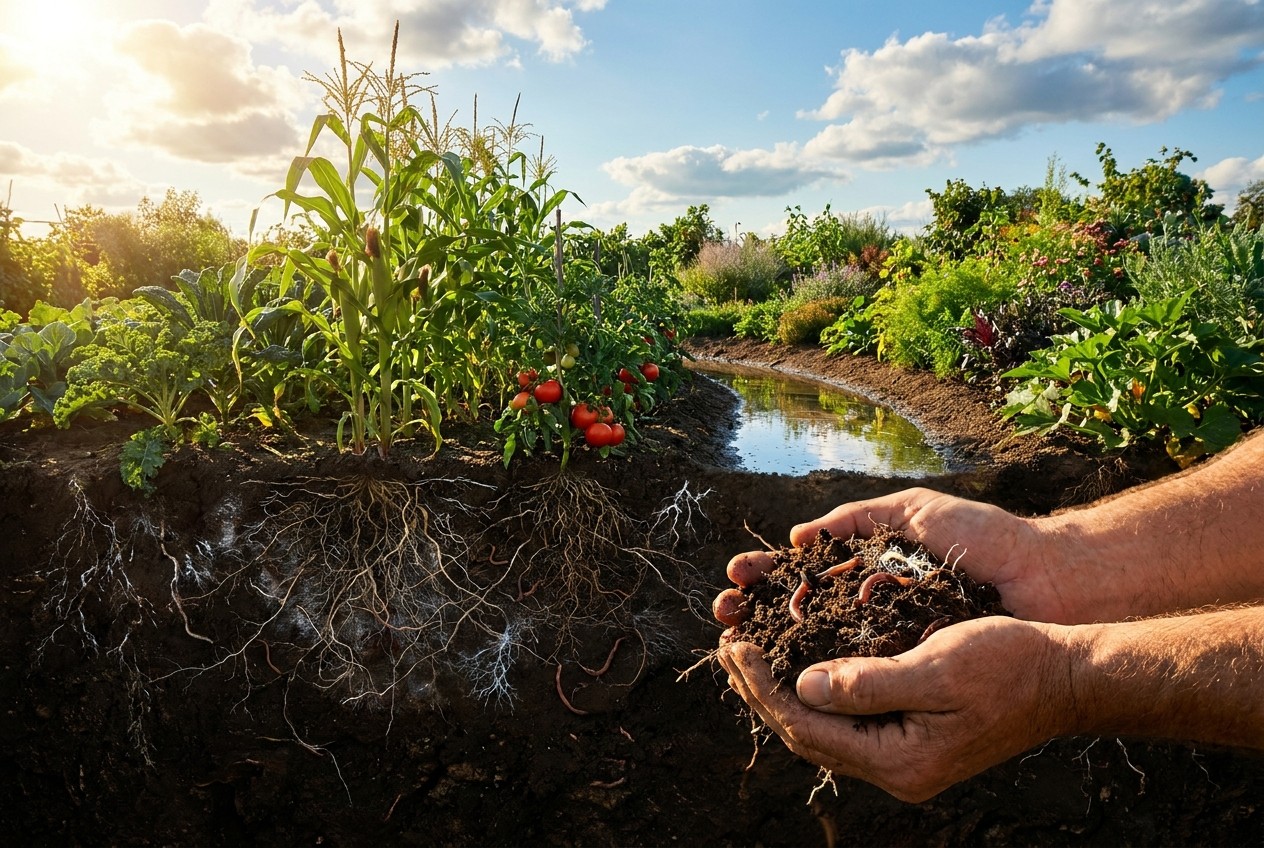
The Interview That Made Me Rethink Gardening
On a recent Decentralize TV episode, my co-host and I sat down with William Bond for an interview that I expected to be filled with the usual gardening tips -- how deep to plant, when to water, which fertilizer to buy, and so on. What I got instead was a fundamental reframing of the entire enterprise. Bond's core message hit me with profound wisdom: soil is the base building block, not the act of gardening itself. If the soil is good, he explained, everything else benefits -- fertility, animals, harvests, and the resilience of the whole system. And you don't have to "garden harder" to get results.
That single idea dismantled my assumptions. For years I had focused on plants, seeds, and chores -- the visible work of gardening. Bond's approach forces a different question entirely: what is happening beneath the surface? In my experience, most home growers obsess over the above-ground drama while ignoring the underground ecology that actually determines success. We treat soil as an inert medium to hold roots and pour chemicals into, when it is in fact a living network of fungi, bacteria, and organic matter that feeds plants for free. For a full explanation on this topic, I encourage you to watch the full interview at Decentralize.TV [1].
William Bond's message reframed my entire approach: stop being a gardener who happens to have soil, and become a soil steward who happens to grow food.
Dirt Is Dead; Soil Is Alive -- and That's the Secret That Really Matters
Bond's practical demonstration of composting stripped away all the mystique and expensive inputs that the garden industry sells. His two-ingredient compost -- leaves plus grass clippings -- and his chop-and-drop technique show how to speed up nature in place. You do not need a degree in soil science or a truckload of purchased amendments. You need organic matter, moisture, and the patience to let biology do its work.
This aligns with what I have long argued: the key to soil fertility is increasing its carbon content, which can be done by topping it with abundant organic matter and letting nature take over [2].
The act of applying chemical fertilizers assumes we know exactly what plants need. That may be a costly oversight. Soil microbes actually do know what they need, and they work for free, around the clock, without requiring a purchase order. When you pour synthetic nitrogen onto dead dirt, you are force-feeding a plant while starving the ecosystem that would otherwise nourish it sustainably. The microorganisms that Bond describes are constantly replenished with soluble nutrients each year, holding onto these vital elements without releasing them, storing them in a form akin to a pantry for the plant's future use [3]. This is how nutrients are managed in nature -- an incredibly clever and miraculous system that humans have spent a century trying to replace with chemistry.
If you build biology -- fungi, bacteria, predators -- you fire yourself as fertility manager and get drought-proof, pest-resistant crops in return. The soil food web becomes your workforce.
My takeaway from Bond is simple: stop measuring success by how much you garden; measure it by how much soil life you feed. Every leaf you leave on the ground, every clover you let grow, every handful of compost you spread is an investment in the living infrastructure beneath your feet. That is the infrastructure that matters.
Stop Pulling Weeds: Let Soil Biology Decide What Grows
Bond leaves a completely weedy garden, and that initially struck me as sloppy (but also familiar). His reasoning is sound: in living soil, the only real competition is for sun, not water. Weeds are not enemies to be eradicated; they are temporary placeholders that nature sends in to heal disturbed ground. As fungal networks increase and soil structure improves, the weed regimes that thrive in compacted, lifeless dirt become less hospitable. The plants we want -- the crops that feed us -- can outcompete them when the soil supports their full expression.
When you stop poisoning the soil, something remarkable happens: the land naturally produces without artificial intervention. A friend of mine stopped using herbicides and pesticides for over a decade and found food everywhere on his property [4]. He made the same decision to avoid poisoning both the front and backyards, and his front yard -- now just grass and plants -- looks as good as anyone else's. He wondered if the whole chemical approach was a scam. It is. They're simply applying water, while he stopped using poisons.
Pulling weeds is often a symptom of dead soil, not a gardening virtue. The presence of aggressive weeds tells you what your soil is missing, not what you need to attack. If you build the biology, the weed pressure diminishes because the system finds balance. This does not mean you never touch a weed, but it shifts the mindset from warfare to stewardship. The goal is not a sterile garden bed but a functioning ecosystem where crops thrive because the soil supports them, not because you eliminated every competitor with chemicals.
Water Management Starts with Soil, Not Hoses and Sprinklers
Bond's approach to water confirmed my own understanding of irrigation. Swales and berms on contour slow, spread, and sink rainwater into the soil, recharging groundwater instead of letting it run off into creeks and storm drains. He makes the case that this kind of earthwork can recharge aquifers like the Ogallala -- the massive underground water reserve that industrial agriculture has been depleting for decades. The idea is simple: catch water where it falls, hold it in the soil, and let gravity and biology do the distribution.
The mechanism is not mystical. Organic matter and soil aggregates create gels that hold water through drought. When you have properly functioning soil, it acts like a sponge, releasing moisture to plants as they need it. Bond points to Zaytuna Farm, which stayed green through a 100-year drought -- not because of some miracle technology, but because the soil was built to retain water. I have seen similar results on my own land.
Every property should capture water in the soil first. Irrigation is a backup, not a foundation. Gardening asks 'how do I water?' Soil building asks 'how do I make the land drought-proof?' That is a profound shift in thinking. One approach focuses on managing scarcity. The other focuses on creating abundance. When you build soil that holds water, you are building resilience against drought, against erratic weather, and against the fragility of systems that depend on pumps, pipes, and power grids. Water stored in soil is decentralized, free, and immune to infrastructure collapse.
Resilience and Real Economics: Soil Is Infrastructure
Bond's Hurricane Helene relief work demonstrated something that should be obvious but is routinely ignored: preparedness fails without community and local supply. You can have all the freeze-dried food and ammunition in the world, but if your neighbors are desperate and your local supply chains are broken, you are not prepared. Soil-based systems kept producing through the crisis because they did not depend on trucks, fuel, or centralized distribution. The food was in the ground, and the ground was healthy.
The economic opportunities Bond outlines -- grazing solar farms, collecting food waste, selling local food -- all rest on healthy soil. None of them work if the land is dead. This is not just about growing food; it is about building a local economy that cannot be shut down by a distant regulator or a supply chain disruption. True food security requires a robust, decentralized domestic food system [5]. A significant portion of U.S. agriculture does not produce food for domestic consumption -- roughly half of our soybean crop is exported, half of our corn is diverted to ethanol production [5]. When the majority of agricultural output is not intended for human sustenance, we have a structural vulnerability that no amount of stockpiling can solve.
I think the smartest prepper move right now is building a compost pile and living soil now. It's important to store heirloom seeds, of course, but soil built over a decade will produce food indefinitely. Decentralized food starts with decentralized soil fertility: no ships, no Strait of Hormuz, no chemical dependency, no reliance on a system that could collapse tomorrow. The most radical act of preparedness is to make your land capable of feeding you without any external input. That is what soil building achieves.
Conclusion: Build Soil First, and the Garden Takes Care of Itself
I think William Bond is right: you can be bad at gardening and still grow food if you focus on soil. The skills that matter are not planting techniques or pest control strategies. They are the willingness to leave organic matter on the ground, to stop poisoning the biology, and to let natural systems do the work they are designed to do.
Start tomorrow by leaving leaves on the ground (you don't need to rake them up), mulching, composting, stopping poisons, and slowing water. Then plant when you are ready. The soil will reward you. It will feed your crops, hold moisture through drought, resist pests, and build fertility year after year. You will find, as I have, that the garden becomes less work, not more, because you are working with nature instead of against it. The plants almost become an afterthought when the soil is alive.
This is not just gardening advice. It is a strategy for freedom, resilience, and food sovereignty. When you control your soil, you control your food supply. When you control your food supply, you cannot be starved into compliance. When you cannot be starved into compliance, you are free in a way that most people cannot imagine. Build soil, not just gardens -- and you will grow more than food; you will grow independence.
Explore these ideas even more at BrightLearn.ai, where free books on permaculture, soil health, and regenerative agriculture are available to anyone, and to use BrightAnswers.ai for uncensored research that the mainstream gatekeepers would rather you never find.
References
- Healthy Soil Is the Secret to Food Forests, an interview with William Bond. 2026-10-13T20:13:19.892Z. "
- Urban Permaculture Maximizes Garden Productiv - Mercola.com, March 07, 2015. by Mercola.com
- Brighteon Broadcast News. by Mike Adams - Brighteon.com
- Mike Adams interview with Jim Gale Bob - March 25 2025. by Mike Adams
- Bright Videos News - Interview with Joel Salatin for BrightU - Mike Adams - BrightVideos.com, September 23, 2026. by Mike Adams - BrightVideos.com
- Mike Adams interview with John Bush - May 8 2024. by Mike Adams
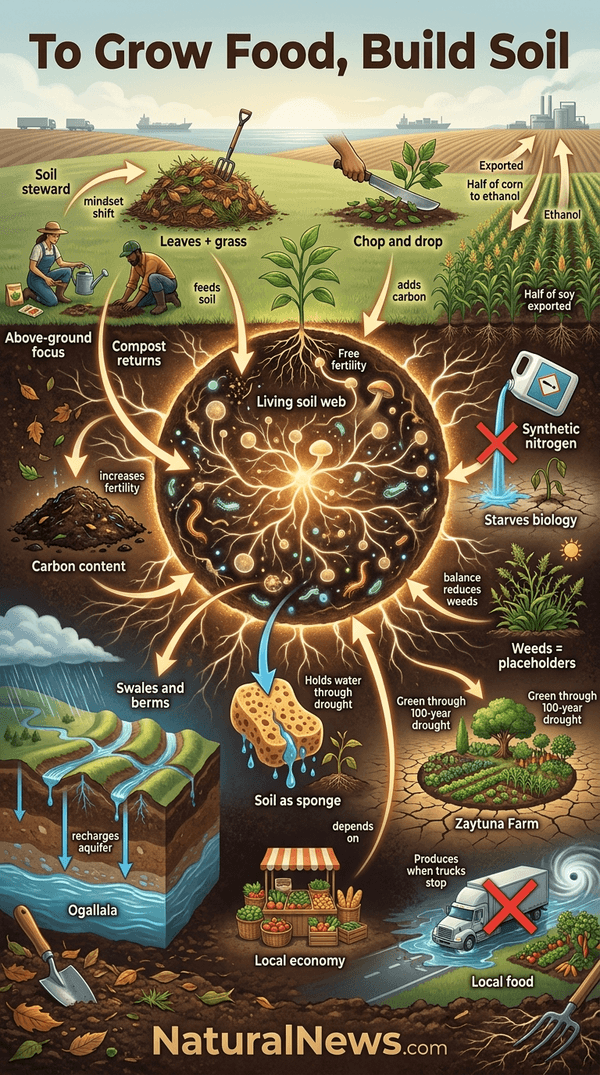
Explainer Infographic
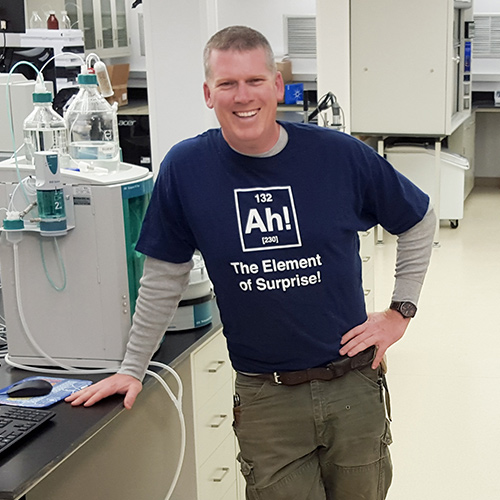
Mike Adams (aka the "Health Ranger") is the founding editor of NaturalNews.com, a best selling author (#1 best selling science book on Amazon.com called "Food Forensics"), an environmental scientist, a patent holder for a cesium radioactive isotope elimination invention, a multiple award winner for outstanding journalism, a science news publisher and influential commentator on topics ranging from science and medicine to culture and politics.
Mike Adams also serves as the lab science director of an internationally accredited (ISO 17025) analytical laboratory known as CWC Labs. There, he was awarded a Certificate of Excellence for achieving extremely high accuracy in the analysis of toxic elements in unknown water samples using ICP-MS instrumentation.
In his laboratory research, Adams has made numerous food safety breakthroughs such as revealing rice protein products imported from Asia to be contaminated with toxic heavy metals like lead, cadmium and tungsten. Adams was the first food science researcher to document high levels of tungsten in superfoods. He also discovered over 11 ppm lead in imported mangosteen powder, and led an industry-wide voluntary agreement to limit heavy metals in rice protein products.
Adams has also helped defend the rights of home gardeners and protect the medical freedom rights of parents. Adams is widely recognized to have made a remarkable global impact on issues like GMOs, vaccines, nutrition therapies, human consciousness.






Please contact us for more information.