


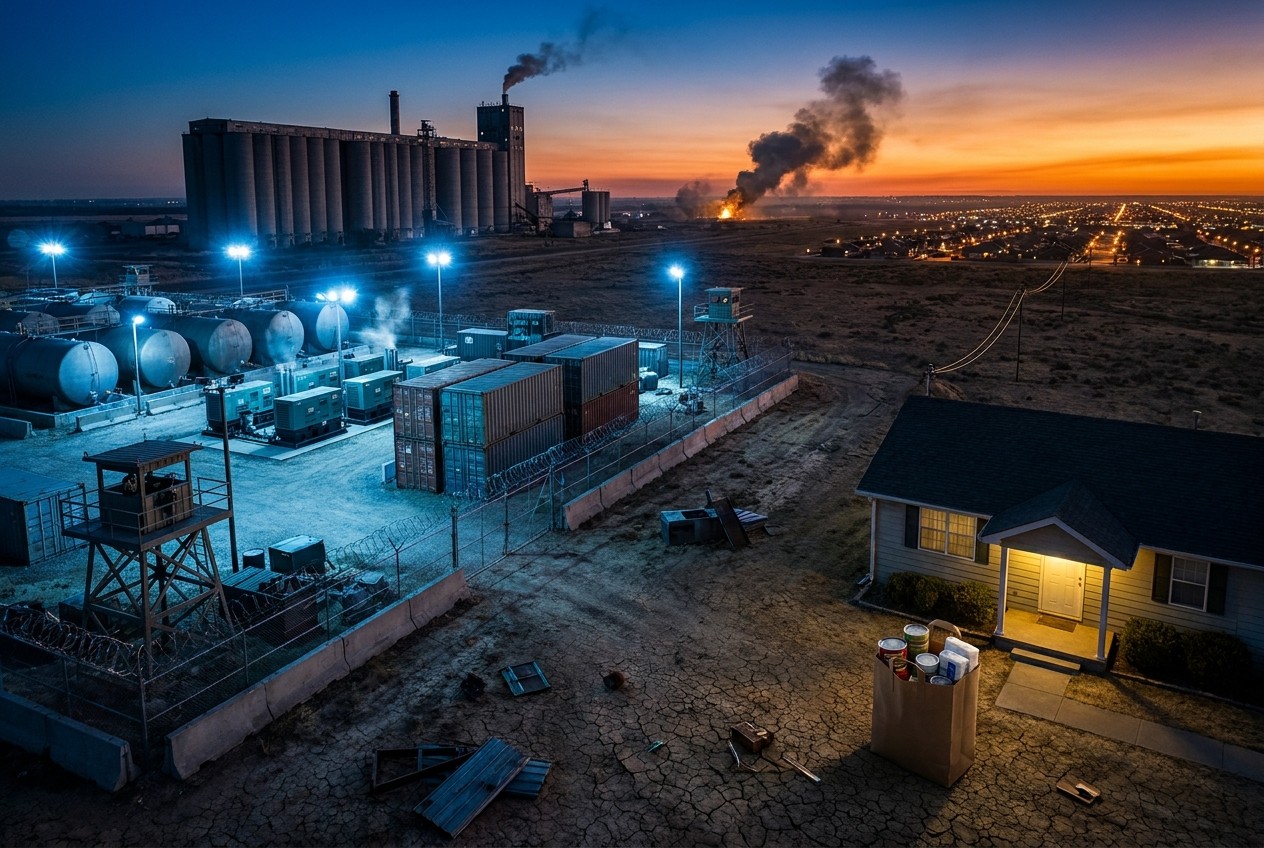
What's Behind the Pentagon's 90-Day Doomsday Plan
The people who run the system are not preparing for the same future they are selling to the rest of us. This week, that truth stopped being a theory. The Pentagon has reportedly told U.S. military bases that they must be able to operate completely off-grid for 90 days, according to reporting by Fox News. [1] Meanwhile, the UK government's "Be Ready" campaign is telling British households they should prepare for roughly three days of disruption. [2] Ninety days for the military. Three days for you.
That contrast is the story I want you to sit with, because it tells you more about what the people in charge actually believe than any press briefing ever will. When the agencies that own the satellites, the classified briefings, and the contingency plans decide they need 90 days of independent fuel, power and supply, that is not a drill. That is a read on the near future. And when the same class of officials hands the public a weekend-survival shopping list, they are not informing us -- they are managing us.
I am not writing this to frighten you into paralysis. I am writing it to make you understand that the gap between what they know and what they tell you is the most important fact in your life right now. The people preparing for a 90-day grid-down scenario are not doing it for a weekend of bad weather.
What the Fortress Program Is Really Telling Us
According to media reports, Pentagon spokesperson Sean Parnell framed the program in stark terms, saying that relying on civilian municipal infrastructure for national defense is an intolerable risk. [1] That is a remarkable admission. It means the Department of Defense has concluded that the grid, the water systems, the fuel networks and the communications infrastructure that every American depends on cannot be trusted to stay online during a crisis.
The program reportedly includes stockpiling fuel, generators, medical supplies, spare parts, critical minerals and electronic components. [1] Notice what that list tells you. It is not about defending against a hurricane or a wildfire. It is about operating for a quarter of a year without any help from the civilization around the base. That is not storm preparation; that is siege preparation. And remember that military bases in Virginia and across the country draw their power from the same regional grids as the rest of us. PJM grid operators have already warned about reliability margins, [3] which means the military's own power supply is not guaranteed either.
When the people with access to every threat briefing on the planet decide that their own facilities must be able to survive for 90 days without outside help, I do not treat that as routine procurement. I treat it as an admission. Major disruptions are being planned for, budgeted for, and stocked for. The only question is whether the public is being told what those disruptions might be. Based on what I have seen, the answer is no -- and the British government is hilariously telling the public to buy wet wipes and canned beans.
The UK's 'Be Ready' Campaign Is a Masterclass in Insult
The British government's "Be Ready" campaign is being sold as preparedness education, but the actual checklist gives the game away. Households are advised to stock tinned goods, wet wipes, a torch and some cash to get through a few rocky days. [2] Wet wipes. That is what a government tells the public to buy when it does not actually want them to survive anything serious.
This is not preparation; it is pacification. A real preparedness campaign would teach people how to store water for weeks, how to purify it, how to grow and preserve food, how to generate power off-grid, how to treat common infections with real medicine, and how to defend themselves and their families if the systems fail. Instead, they hand out a nursery-school supply list and call it readiness. It treats adults like children who need to be calmed rather than citizens who need to be equipped.
The asymmetry is impossible to ignore. The same governments that tell citizens to prepare for 72 hours are quietly rebuilding their own military installations to function for 90 days without the grid. If the crisis were genuinely only a short disruption, why would the Pentagon spend enormous sums hardening bases for a full quarter of a year? The only rational explanation is that officials expect something longer and more severe than what they are telling us -- and that they intend to manage the public through it rather than empower us to get through it on our own.
The Quaker Oats Explosion Fits a Bigger Food-Supply Pattern
The explosion at the Quaker Oats plant in Cedar Rapids, Iowa, should be read in this same context. According to the reporting covered by Natural News, that facility is described as the world's largest milling facility, processing over two million pounds of oats per day. [4] [5] When a single facility that central supplies a staple food to the national diet is knocked out, the consequences ripple through grocery shelves and supply chains almost immediately.
That kind of centralization is exactly what makes the food system fragile. One plant, one rail line, one power feed, one just-in-time distribution network -- and a disruption at any single point can empty shelves across a multi-state region within days. The military's answer is to stockpile its own food and fuel. The public's answer is supposed to be wet wipes. That asymmetry tells you everything about how seriously different populations are being treated.
I do not accept that these disruptions are all random. Energy markets are being squeezed, critical minerals are being fought over, supply chains are being strained on purpose, and food-processing infrastructure is being pushed to the limit. The pressure points line up too consistently to be coincidence. When a centralized food supply meets an unstable energy grid and a government that is quietly hardening its own bases, you do not need a formal announcement to understand the direction of travel. You only need to look at what they are buying -- and then at what they are telling you to buy.
What I'm Doing to Prepare -- and What You Can Do Now
I am not waiting for a government bulletin to tell me when to prepare. I am building resilience now, on my own terms. That means long-term food storage -- grains, legumes, freeze-dried meals, canned goods -- rotated regularly so nothing goes to waste. It means garden seeds, a working knowledge of home food production, and enough water filtration capacity to treat water from uncertain sources. It means backup power: a solar setup, a generator with stored fuel, and the spare parts to keep them running.
I also stock medical supplies, herbal medicines and the practical knowledge to use them. I keep satellite communications gear because when the cell towers and internet go down, ordinary radio and satellite links are the only thing left. Where the law allows, I practice self-defense and I build relationships with community members who are likewise prepared. Community preparedness matters, because no agency is going to arrive fast enough when a grid goes down, and the people closest to you are your real first responders. [6]
My health-focused research consistently shows that the strongest medicine cabinet is built before the emergency arrives. The same principle applies to everything else. Panic buys nothing; preparation buys time, options and autonomy. Decentralized preparation -- your own food, your own water, your own power, your own community -- is far more trustworthy than any centralized promise of help that may never arrive. I have written extensively about self-reliance and survival skills, and the message is always the same: the ability to take care of yourself is the most honest form of security there is.
For expert-level sustainable living interviews and advice, see all the episodes of my popular show Decentralize.TV
Conclusion: They Know Something. Act Like It.
The Pentagon is preparing its bases for 90 days off-grid. The UK is handing out 72-hour checklists to the public. A central food-processing plant just exploded. Those three facts, taken together, tell a coherent story about what the people in charge expect. I believe the responsible conclusion is that elites are preparing for disruptions they are not fully explaining to the public -- and that they have already decided the public should be managed through those disruptions rather than equipped for them.
You do not need to predict the exact crisis to get ready for one. You need food, water, medicine, power, communications and community. You need to start now, not when the news bulletin tells you it is safe to panic. The people who run the system are stocking up for 90 days. The least you can do is refuse to be left with three days' worth of canned goods and wet wipes.
Hope for the best, but prepare like the people who already know something is coming.
References
- Fox News Digital. Inside the Pentagon’s doomsday plan to keep America fighting if global war erupts. Reporting on FORTRESS, the 90-day self-sufficiency requirement, Sean Parnell’s comments and strategic reserves. https://www.foxnews.com/politics/inside-pentagons-doomsday-plan-keep-america-fighting-global-war-erupts
- UK Government. Be ready for emergencies. Official three-day household checklist, including water, non-perishable food, wet wipes, a torch, cash, medication and communications supplies. https://beready.campaign.gov.uk/be-ready-for-emergencies/
- PJM Interconnection. PJM Capacity Auction Procures 138,318 MW of Generation Resources as Work Continues To Address Growing Electricity Demand. July 14, 2026. Reports a 6,831 MW shortfall against the reliability requirement for the 2028/2029 delivery year; this is a reserve-margin warning, not a prediction of a specific outage. https://www.pjm.com/-/media/DotCom/about-pjm/newsroom/2026-releases/20260714-pjm-capacity-auction-procures-138318-mw-of-generation-resources.pdf
- The Associated Press, via ABC News. Explosion and fire erupt at Quaker Oats plant in Cedar Rapids, Iowa; no injuries. October 24, 2026. Reports the incident and the facility’s daily processing volume; the cause remained under investigation. https://abcnews.com/Business/wireStory/fire-breaks-quaker-oats-plant-cedar-rapids-iowa-137544207
- Fox Business. Explosion, fire blast through Iowa Quaker Oats plant. October 25, 2026. Additional reporting on the fire, emergency response and processing capacity; it does not establish deliberate sabotage or nationwide supply disruption. https://www.foxbusiness.com/economy/explosion-fire-blast-through-iowa-quaker-oats-plant
- British Red Cross. Why are we being asked to prepare for 72 hours at home? Updated October 22, 2026. Explains the three-day recommendation, household planning, and neighbours’ and communities’ role as first responders. https://www.redcross.org.uk/stories/disasters-and-emergencies/uk/why-are-we-being-asked-to-prepare-for-72-hours
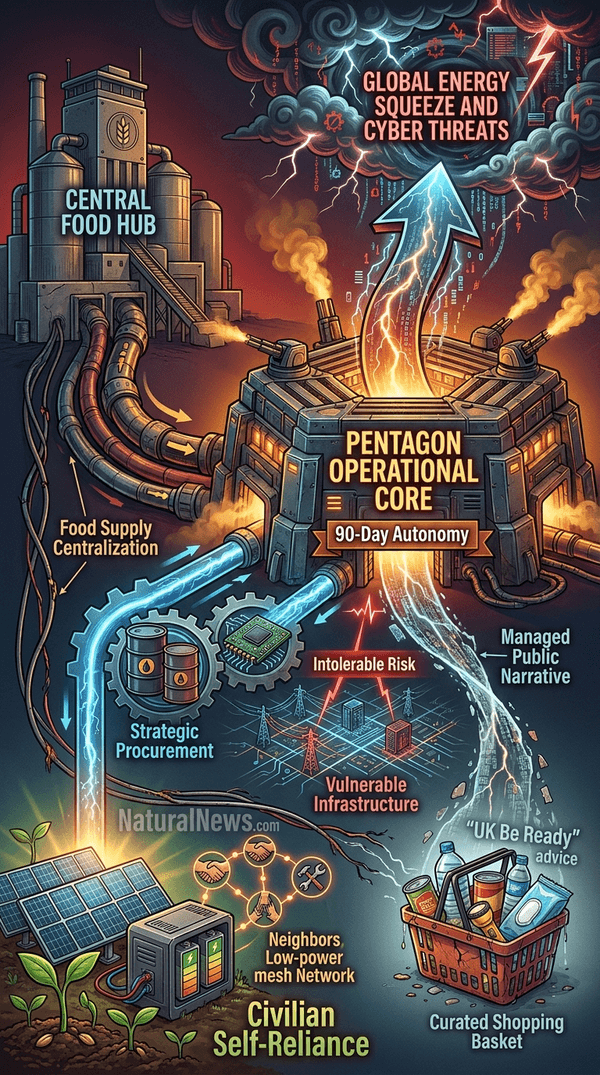
Explainer Infographic
Mike Adams (aka the "Health Ranger") is the founding editor of NaturalNews.com, a best selling author (#1 best selling science book on Amazon.com called "Food Forensics"), an environmental scientist, a patent holder for a cesium radioactive isotope elimination invention, a multiple award winner for outstanding journalism, a science news publisher and influential commentator on topics ranging from science and medicine to culture and politics.
Mike Adams also serves as the lab science director of an internationally accredited (ISO 17025) analytical laboratory known as CWC Labs. There, he was awarded a Certificate of Excellence for achieving extremely high accuracy in the analysis of toxic elements in unknown water samples using ICP-MS instrumentation.
In his laboratory research, Adams has made numerous food safety breakthroughs such as revealing rice protein products imported from Asia to be contaminated with toxic heavy metals like lead, cadmium and tungsten. Adams was the first food science researcher to document high levels of tungsten in superfoods. He also discovered over 11 ppm lead in imported mangosteen powder, and led an industry-wide voluntary agreement to limit heavy metals in rice protein products.
Adams has also helped defend the rights of home gardeners and protect the medical freedom rights of parents. Adams is widely recognized to have made a remarkable global impact on issues like GMOs, vaccines, nutrition therapies, human consciousness.







Please contact us for more information.


