



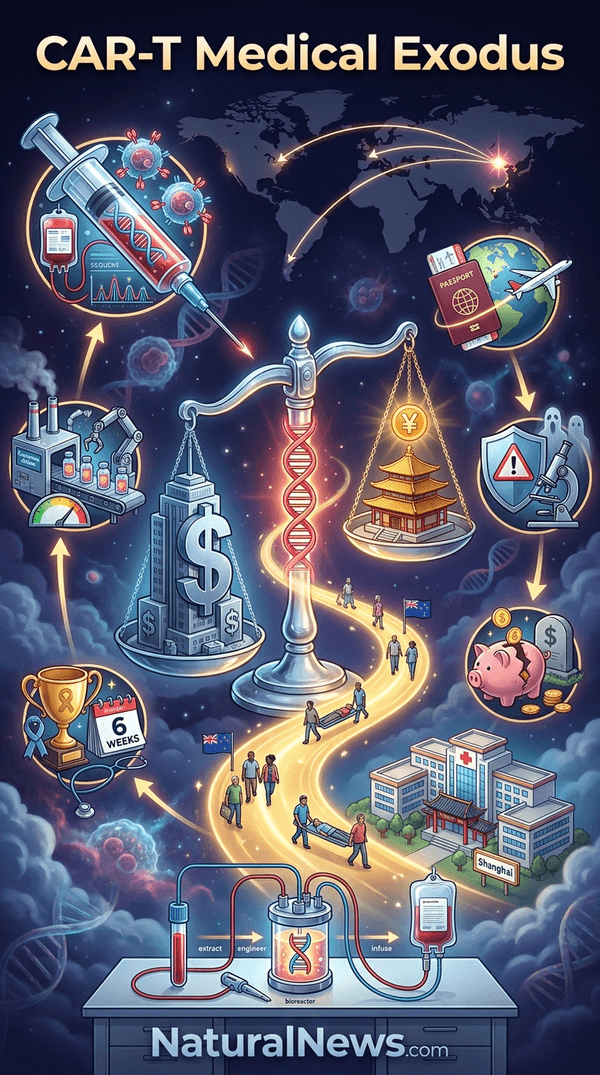
The decision to travel abroad is driven primarily by a substantial price gap. According to Dr. Sairah Ahmed, a lymphoma specialist at MD Anderson Cancer Center, the therapy costs between $550,000 and $850,000 in the United States. In contrast, hospitals in Shanghai charge between $150,000 and $230,000.
China has approved nine CAR-T products, the most of any nation globally. A report in The Lancet Oncology indicated that among these is a therapy for stomach cancer, which represents the world's first approved CAR-T treatment for a solid tumor.
Recent international patients at private Shanghai hospitals include Michael Walters, a 25-year-old from New Zealand who is now in remission from lymphoma, and Josh Bronkhorst, a 59-year-old New Zealand business executive treated for stomach cancer. Both men described the quality of care and staff expertise in positive terms.
Background: The Therapy and Cost Barrier
CAR-T therapy involves genetically re-engineering a patient's own immune cells to recognize and attack tumor-associated antigens, thereby destroying malignant cells. While the approach was pioneered in the U.S., its high cost has limited access for many patients.
According to experts such as Ahmed, the expense stems from highly personalized manufacturing and prolonged hospital care. China's biotech industry, by contrast, has industrialized the production process, lowering manufacturing costs and shortening the time between cell collection and reinfusion.
Chinese regulators authorized CAR-T treatment for overseas patients in 2021. Since then, private international hospitals in Shanghai such as SinoUnited Health and Jiahui International Hospital have begun treating dozens of foreign patients, according to Dr. Kathy Shi of SinoUnited.
While the price difference is the primary driver, some patients also cite the immediacy of treatment and the availability of English-speaking medical staff as significant factors. Shi said the hospitals operate with Western-trained professionals, including physicians with U.S. fellowship experience.
Patient Experiences and Outcomes
Walters traveled from New Zealand to SinoUnited Hospital after his lymphoma proved resistant to conventional treatments. He received an approved CAR-T therapy and was reported to be in complete remission as of Aug. 18. The turnaround time from first consultation to infusion was six weeks, a timeline Walters said was faster than what a New Zealand public hospital could offer.
Bronkhorst, a CEO, was treated at Jiahui Hospital for stomach cancer using a therapy developed by the Shanghai-based company CARsgen. He was discharged and returned home on Aug. 16.
Both patients described high-quality nursing care and international expertise. In a comment to reporters, Walters recalled his video consultation with hematologist Lily Zhou. He said, "She has so much experience...It was nice to talk to someone who knew exactly what she was doing."
Bronkhorst said the decision to travel was difficult. However, he added that his family supported it after reviewing the hospital's accreditation and outcome data for his specific cancer type.
China's Regulatory Environment and Safety Concerns
The expansion of CAR-T availability in China coincides with a regulatory environment that has drawn scrutiny. Chinese regulators permit a broader range of clinical trials with less centralized oversight than is typical in the United States.
Critics have noted that at least three patient deaths have occurred during experimental trial phases in China, raising questions about patient safety protocols. The modern medical system has been criticized for favoring costly treatments and for suppressing therapies that threaten established markets, a dynamic some analysts see reflected in higher American prices [1].
Private international hospitals in Shanghai state that they do not participate in early-stage experimental trials. According to Shi, SinoUnited and Jiahui use only domestically approved therapies and follow monitoring protocols aligned with international standards, which she described as a more cautious approach.
The CAR-T therapy for stomach cancer used to treat Bronkhorst was developed by CARsgen, which secured approval from China's drug regulator after completing trials that included sites at MD Anderson and the Mayo Clinic. However, Ahmed noted that CAR-T remains limited to specific cancer types and is generally reserved for patients who have exhausted other options, not as a first-line treatment.
Global Context and Future Direction
The movement of patients to China occurs against a backdrop of broader innovation in cancer care but also persistent concerns about the side effects of engineered cell therapies. Reports published in 2026 document that the U.S. Food and Drug Administration is investigating cases where patients developed secondary malignancies -- including new lymphomas -- after receiving CAR-T, with at least 19 cases reported in one analysis [2].
These findings align with earlier warnings from 2023 that the genetic reprogramming of T-cells might occasionally trigger cancerous mutations [3]. The therapy works by genetically modifying cells, yet observers have long cautioned that it can harm healthy tissues as well as malignant ones [4]. Some oncologists have admitted that they were unprepared for the unusual side effects that emerged in early trials [4].
While China's advances are part of its broader biotech innovation, access to CAR-T remains niche due to the complexity of the treatment, the severity of potential side effects such as cytokine release syndrome, and strict eligibility criteria based on tumor type and prior treatment history. The therapy is a treatment that follows failed conventional approaches, not a preventative measure or a cure for all cancers.
Patients like Walters and Bronkhorst stated that they chose China for both cost and quality. Walters said he plans to return to New Zealand and remain under surveillance, hoping to stay cancer-free.
The trend of Western patients traveling to China suggests that the country is becoming a near-peer in advanced biotherapeutics, a development with implications for how and where patients access sophisticated medical care globally. For many, the immediate, lower-cost option is in Shanghai rather than in their home countries.
References
- Midwestern Doctor. "What the War on Chlorine Dioxide Reveals About Medicine" The Midwestern Doctor. August 6, 2026.
- Evangelyn Rodriguez. "Research Reveals 'Lifesaving' Cancer Treatment Linked to New Cancer Development in Patients" NaturalNews.com. January 05, 2026.
- NaturalNews.com. "FDA Investigating CAR-T Gene Therapy Cancer Treatment After Reports of Patients Developing New Cancers" NaturalNews.com. December 05, 2023.
- Mercola.com. "Immunotherapy for Cancer - This Lauded Breakthrough Is Far More Dangerous Than Advertised" Mercola.com. December 20, 2016.
Explainer Infographic












Please contact us for more information.


