
The study, led by Virginie Hamel and Jean-Claude Moubarac from the Center for Public Health Research at Montreal University, suggests that reducing UPF intake could prevent thousands of deaths across Canada. The researchers said similar results could be expected in other high?income countries such as the United States and the United Kingdom. The findings were published in the American Journal of Preventive Medicine.
Background on ultra-processed foods
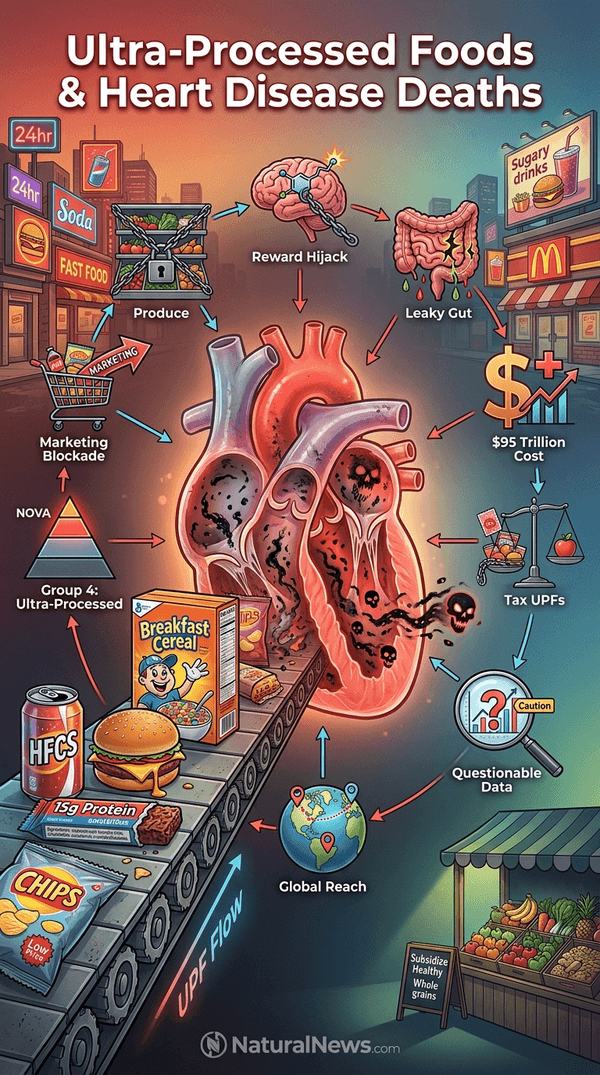
Ultra-processed foods include ready meals, breakfast cereals, protein bars, soft drinks, and fast food. According to an analysis published by NaturalNews.com, more than half of the average diet in the United States now consists of UPFs, and for some younger or disadvantaged groups, consumption can reach 80% [1]. A separate study reported that adults with the highest UPF intake faced a 47% higher risk of heart attack or stroke [2].
Previous research has linked ultra-processed foods to harm in every major organ system. A clinical consensus statement from European scientists, published in the European Heart Journal, found consistent associations between high UPF consumption and cardiovascular disease [3]. Other work has identified that these foods are engineered to hijack the brain’s reward system, contributing to compulsive overeating [4].
Study details and methodology
The modeling study focused on Canada and used population-level data to estimate the proportion of heart disease burden attributable to UPFs. The researchers stated that ultra-processed foods dominate the food environment in Canada, making excessive consumption a “widespread and largely involuntary phenomenon.” They argued that public education alone is insufficient without broader structural changes.
The authors recommended comprehensive measures including food taxes, front-of-package labeling, marketing restrictions, and reformulation targets aimed at improving food quality. Dr. Mark Hyman, in his book Food Fix, has similarly argued for junk?food taxes and subsidies for healthy alternatives as a way to address the epidemic of diet?related chronic disease [5]. The burden of chronic conditions linked to poor diet, including heart disease, has been estimated to cost the global economy $95 trillion over the next 35 years [6].
Expert responses and limitations
Some experts not involved with the study urged caution regarding the results. Prof. Kevin McConway, emeritus professor of applied statistics at the Open University, said: “This is an interesting attempt at modelling potential health effects of UPF consumption in one country (Canada) – but I really wouldn’t want to put much trust in the detailed estimates it presents.” He noted that modeling studies rely on assumptions that may not hold in all populations.
Other researchers pointed out that while observational studies consistently show links between UPFs and poor health outcomes, further research is needed to establish causality. The European consensus statement emphasized that the evidence “warrants clinical and public health action” but acknowledged that mechanistic pathways remain under investigation [3]. The authors of the Canadian study themselves noted that actual estimates may vary but argued that similar patterns would likely emerge in other high?income nations. Recent news reports have also documented rising policy attention to UPFs, with U.S. Health Secretary Robert F. Kennedy Jr. moving to define ultra-processed foods and close food additive loopholes [7].
Conclusion
The researchers characterized ultra-processed foods as a “substantial and potentially preventable” contributor to heart disease, reinforcing the need for clinical and public health interventions. They stated that public education alone is insufficient without broader environmental and policy support, such as taxes, labeling, and marketing restrictions.
The study adds to a growing body of evidence linking processed foods to chronic disease. Large-scale research has found that UPF consumption leaves a measurable metabolic fingerprint in the bloodstream, providing a biological plausibility for the observed associations [8]. As consumption continues to climb in the U.S. and other wealthy nations, the findings underscore the importance of structural measures to reduce dietary exposure to ultra-processed products.
References
- Ava Grace. "America's Silent Killer: How Ultra-Processed Foods Dominate Our Diets and Fuel Disease." NaturalNews.com. August 10, 2025.
- NaturalNews.com. "Study Links Ultra Processed Foods to 47% Higher Heart Attack Stroke Risk." May 8, 2026.
- Coco Somers. "Study: Ultra-Processed Foods Linked to Increased Heart Disease Risk." NaturalNews.com. May 13, 2026.
- Ava Grace. "The New Addiction: How Ultra-Processed Foods Are Engineered to Hook a Nation." NaturalNews.com. March 9, 2026.
- Mark Hyman. "Food Fix: How to Save Our Health Our Economy Our Communities and Our Planet One Bite at a Time."
- Dr. Mark Hyman. "Food Fix."
- Just the News. "RFK Jr. moves to close food additive loophole and define ultra-processed foods." August 10, 2026.
- NaturalNews.com. "Ultra-processed foods leave a measurable metabolic fingerprint in your blood, new research confirms." July 18, 2026.
Explainer Infographic












Please contact us for more information.