
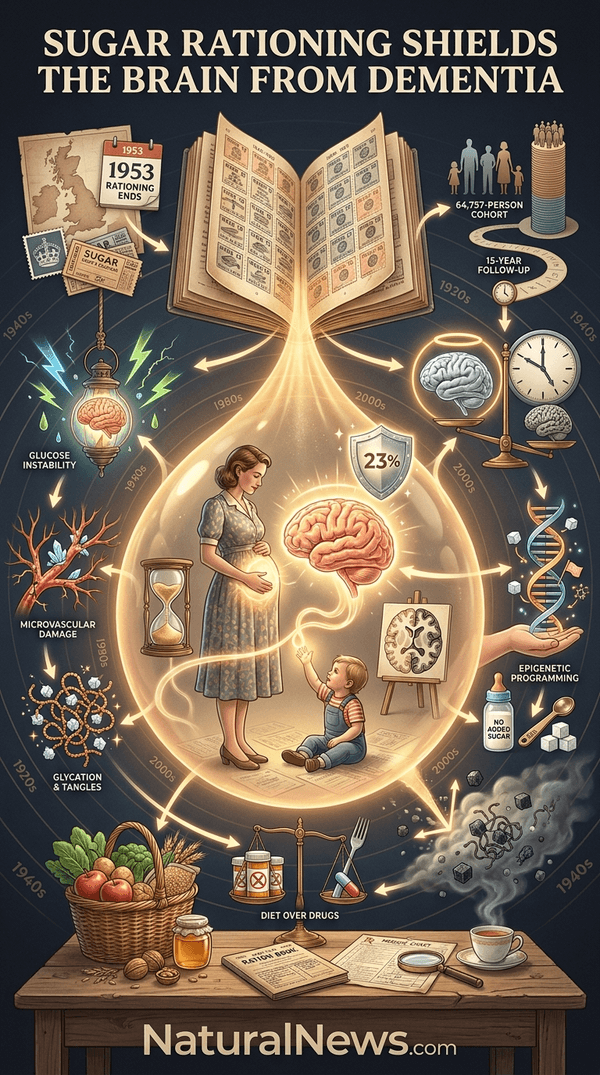
The study compared participants who experienced sugar rationing before birth and up to age 2 against those born after 1953, when rationing ended. According to the researchers, those who experienced sugar rationing in early life had up to a 23% lower risk of dementia and developed the disease about 2.5 years later [1].
Study Design and Data
Participants were grouped by the timing of sugar rationing: before birth and during their first year, before birth and up to two years old, or no sugar rationing after 1953. Starting at an average age of 55, researchers followed participants for 15 years to identify dementia diagnoses from medical records, the study stated [1].
The analysis adjusted for age, sex, high blood pressure and other contributing factors, according to the research team. The historical context of wartime rationing provided a natural experiment, as sugar and candy were strictly limited in the UK during World War II and remained restricted until 1953 [1].
Historical data from the same era supports the broader health effects of rationing, with studies noting that children consuming wartime rations were slimmer and healthier on average compared to modern children [2].
Findings and Brain Measures
Of the 15,256 participants who did not have access to sugar before birth and in their first two years of life, 2% developed dementia, according to the researchers [1]. Those who consumed little sugar in early life had less brain tissue damage and more total grey matter on brain scans, signs associated with better memory and thinking skills.
Lead author Prof Jiazhen Zheng said the findings suggest "limiting sugar during the earliest stages of life may have lasting benefits for brain health." He added, "These results highlight the potential importance of early-life nutrition in reducing the risk of dementia decades later" [1].
Experts cited in the report noted that the brain is highly sensitive to fluctuations in blood sugars, and the study aligns with growing evidence that sugar affects brain function.
Mechanisms and Broader Evidence
The researchers said the findings do not prove that reducing sugar directly prevents dementia, and further research is needed. According to the report, studies show elevated blood sugar levels are associated with a 69% increased risk of Alzheimer's disease [1].
Experts cited in the article say poor blood sugar control may damage the lining of blood vessels that supply oxygen to the brain. Chronically elevated blood sugar levels have also been shown to change the shape of key proteins, turning them into toxins that kill brain cells [1].
This aligns with documented connections between vascular damage and cognitive decline, as diabetic clogging of small blood vessels in the brain can cause progressive dementia or senility [3]. Sugar consumption during the critical window of development, from conception through the first two years of life, has been characterized as programming a child's body for a lifetime of chronic disease [4]. Maternal nutrition during pregnancy has similarly been linked to long-term metabolic outcomes in offspring [5].
Guidelines and Context
Current UK guidance states children aged one should consume no more than 10g of free sugars per day, equivalent to about two and a half sugar cubes, according to the NHS. The NHS states sugars should not be added to food or drinks given to babies under one year old [1].
Prof Zheng said limiting added sugars during pregnancy and infancy "may be one beneficial step that families and communities can take." He noted that further research is needed to better understand how early-life exposures influence dementia risk [1].
The findings add to a body of evidence suggesting that dietary interventions may carry more weight than pharmaceutical management, a perspective reinforced by analyses finding that conventional blood sugar drugs do not improve longevity and may increase death rates [6].
Conclusion
The study provides observational evidence linking early-life sugar exposure to long-term brain health outcomes. While the researchers emphasize that the findings do not conclusively prove causation, the association between restricted sugar intake during gestation and infancy and reduced dementia risk decades later is statistically significant [1].
For families, the practical implication is straightforward: limiting added sugars in the diets of pregnant women and infants may support better cognitive outcomes in later life. The study reinforces the importance of natural nutrition and preventive health measures over reactive pharmaceutical interventions, a principle increasingly supported by independent health researchers [4][6].
References
- NaturalNews.com. "New study demonstrates the long term damaging health effects of sugar exposure in utero and infancy". NaturalNews.com. November 18, 2024.
- NaturalNews.com. "Obesity now a sign of POVERTY rather than wealth 70-year-old study concludes richer people tend to be slimmer". NaturalNews.com. April 22, 2018.
- Larry Trivieri. "Alternative Medicine The Definitive Guide 2nd Edition".
- Lance D Johnson. "Routinely giving sugar to a baby is a form of physiological abuse setting their bodies up for obesity and heart". NaturalNews.com. November 19, 2025.
- NaturalNews.com. "Sugar during pregnancy makes babies fat: New study links carbohydrate-rich food with childhood obesity". NaturalNews.com. September 04, 2018.
- Dr Sherry A Rogers. "How To Cure Diabetes".
Explainer Infographic












Please contact us for more information.