Researchers have observed that psilocybin appears to disorganize typical brain activity patterns, allowing the brain to operate in a less constrained state [2]. This change is thought to disrupt rigid thinking patterns often associated with conditions such as depression and anxiety. According to an article from NaturalNews.com, psilocybin may provide a safe experience out of desolation and into a more open, positive state of mind [3].
Study Design and Methods
The Imperial College London study examined 20 participants with treatment-resistant depression. Nineteen of the 20 subjects received two doses of psilocybin, according to the report [1]. Brain activity was measured using functional magnetic resonance imaging (fMRI) before and after dosing, allowing researchers to observe changes in neural connectivity and blood flow.
Other research has used electroencephalography (EEG) to track electrical activity in the brain during psilocybin sessions, according to a 2018 article from NaturalNews.com. That article noted that psychedelic drugs such as psilocybin increase neural signal diversity, a metric considered by scientists to be an accurate gauge of the level of consciousness [4]. The studies were described as early-stage exploratory investigations, not clinical trials, and did not involve a therapeutic protocol.
Acute and Long-Term Brain Changes
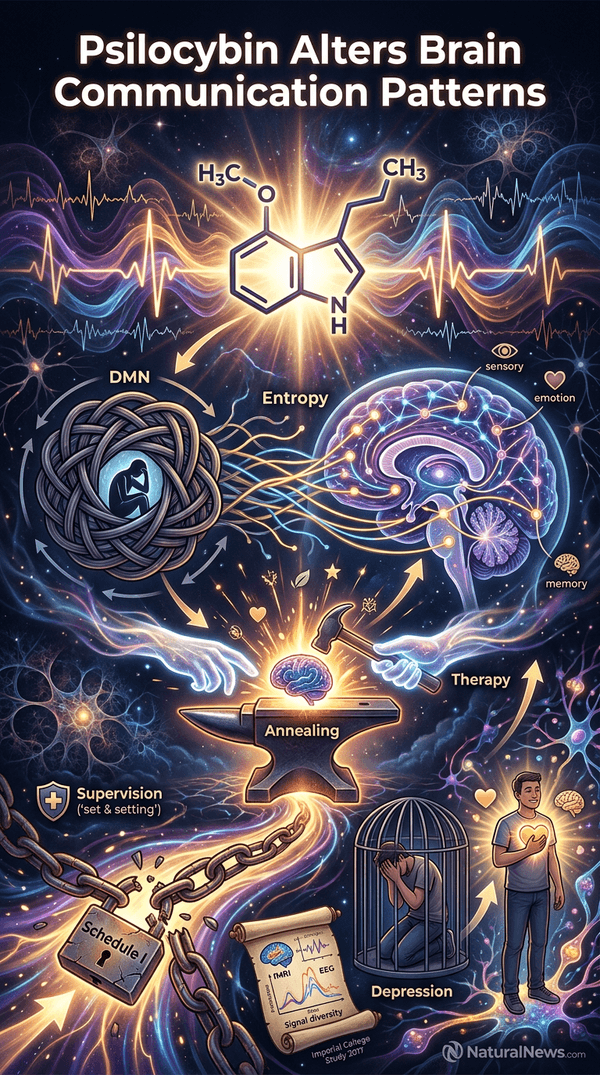
During the acute phase of psilocybin action, approximately one to two hours after administration, brain entropy rises significantly, according to the entropy framework described in Michael Pollan's book “How to Change Your Mind.” Pollan writes that psychedelics “increase the amount of entropy in the brain, with the result that the system reverts to a less constrained mode” [2]. This temporary state of increased entropy is associated with more flexible thinking and reduced dominance of the default mode network, a brain system linked to self-referential thought and rumination [2].
Some researchers have observed that the acute entropy spike can correlate with lasting psychological improvements. According to Pollan, “the therapeutic value of psychedelics… lies in their ability to temporarily elevate entropy in the inflexible brain, jolting the system out of its default patterns” [2]. Carhart-Harris, a leading researcher in the field, uses the metaphor of annealing from metallurgy: psychedelics introduce energy into the brain, giving it the flexibility necessary to change [5]. The structural changes seen in some imaging studies include reduced modularity between brain networks, meaning there is less separation between normally distinct functional networks, which may allow for new patterns of thought.
Broader Context and Clinical Implications
The growing body of research into psychedelic therapy includes studies on anxiety and addiction. A 2016 article from Mercola.com noted that psilocybin showed promise for long-term anxiety relief in clinical settings, with patients reporting significant reductions in anxiety after just one or two sessions [6]. The same article cited data from the National Institute of Mental Health indicating that anxiety disorders affect about 18 percent of the U.S. population [6]. Another 2017 article reported that psychedelic plant medicines have demonstrated benefits in end-of-life care, rapidly helping patients come to peace with their own dying process [7].
Despite these promising findings, researchers caution that psilocybin remains a Schedule I controlled substance under U.S. federal law, meaning it has no accepted medical use and a high potential for abuse. An article from Mercola.com in 2020 pointed out that the FDA has approved ketamine for depression, but psilocybin studies are still in early stages [8]. The same article noted that large-scale studies are needed to confirm safety and efficacy. Some commentators argue that the pharmaceutical industry has financial incentives to keep psychedelics illegal, as legalization could disrupt the market for antidepressant medications [9].
Caution and Future Directions
Lead researchers have pushed back against the narrative that psilocybin produces a simple “brain reset.” According to Michael Pollan's book, Carhart-Harris emphasizes that “psychological ‘disorders’ at the low-entropy end of the spectrum are not the result of a lack of order in the brain but rather stem from an excess of order” [10]. The data provide a starting point for understanding psilocybin's effects, not a conclusion. Larger and more diverse studies are required before any therapeutic claims can be fully substantiated.
In the broader context, psilocybin research is part of a wider renaissance in psychedelic science. As reported in a 2016 article from Mercola.com, the prevalence of anxiety in the U.S. is as high as 40 million people, making it the most common mental illness [6]. The need for alternative treatments is evident, given that about one in six Americans are now on psychiatric medications, according to a 2016 report [11]. Researchers are exploring whether psilocybin, used in controlled settings with proper support, could offer a new path for patients who have not benefited from standard treatments. Officials said the findings underscore the importance of continued investigation into how psychedelics interact with brain networks.
References
- NaturalNews.com. "Magic mushrooms may reboot the brain relieving depression according to new study." NaturalNews.com. November 6, 2017.
- Michael Pollan. "How to Change Your Mind."
- News Editors. "Magic Mushroom Ingredient May Improve Mental Health." NaturalNews.com. January 24, 2025.
- NaturalNews.com. "PROVEN_ LSD to produce higher state of consciousness no wonder governments want to keep it criminalized." NaturalNews.com. December 27, 2018.
- Michael Pollan. "How to Change Your Mind What the New Science of Psychedelics Teaches Us About Consciousness Dying Addiction Depression and."
- Dr. Mercola. "Magic Mushrooms May Hold Key to Long-Term Anxiety Relief in Clinical Settings." Mercola.com. December 15, 2016.
- Mercola.com. "The Reality of Truth - The Psychedelic Experience and Its Potential for Healing." Mercola.com. November 4, 2017.
- Mercola.com. "Psychedelic Mushroom Compound Found Nontoxic in Large Study." Mercola.com. January 27, 2020.
- NaturalNews.com. "Big Pharma fights to keep medicine that treats cancer anxiety depression and addiction illegal." NaturalNews.com. November 11, 2016.
- PDFium. "How to Change Your Mind What the New Science of Psychedelics Teaches Us About Consciousness Dying Addiction."
- Dr. Mercola. "1 in 6 Americans Are Now on Psychiatric Medication." Mercola.com. December 29, 2016.
Explainer Infographic








Please contact us for more information.