


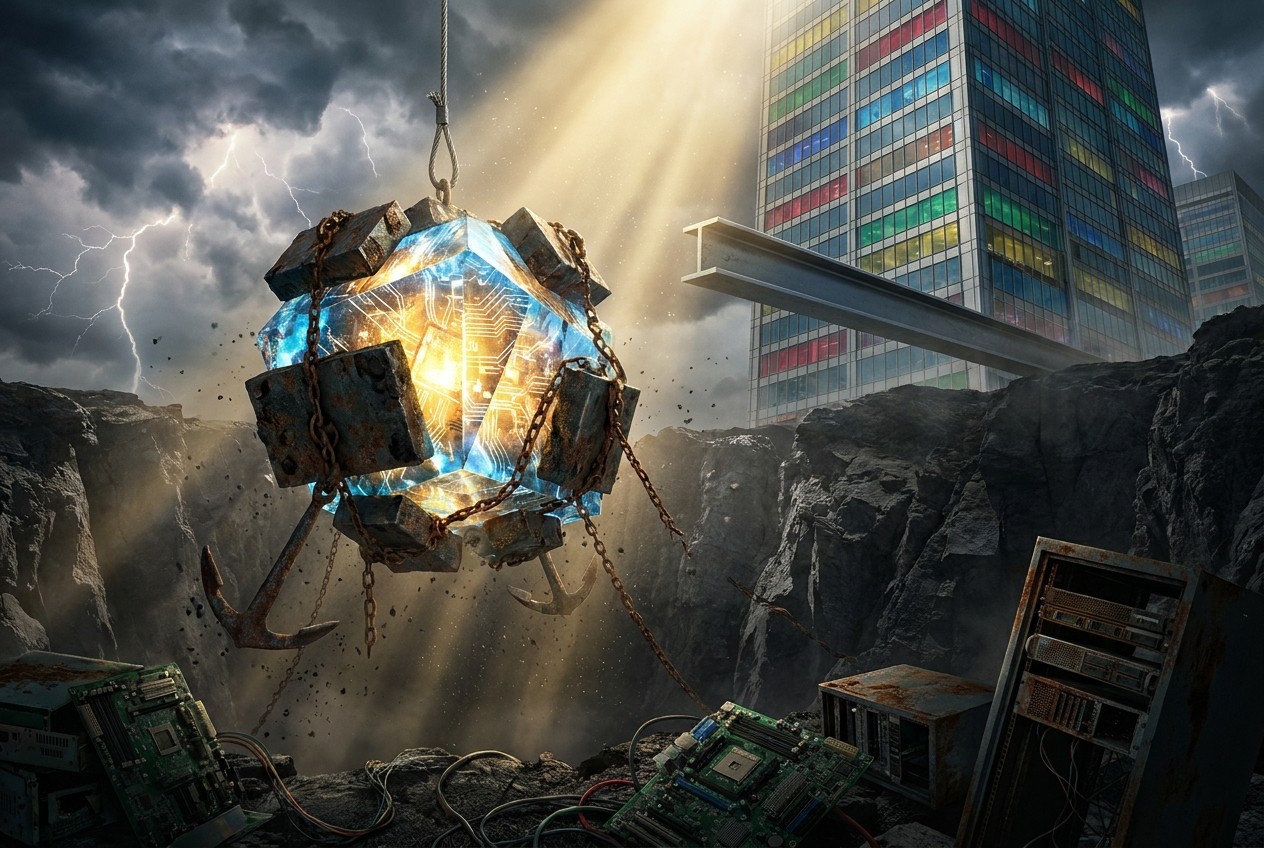
Anthropic's $800 Billion Anchor
Anthropic is a brilliant model company with an impossible balance sheet. I say that as someone who does not own the stock, does not short it, and does not root for its collapse. The Claude models are genuinely excellent, and I have watched them do things that would have seemed like science fiction just a few years ago. But brilliance in engineering does not guarantee survival in finance, and the numbers published ahead of this IPO tell a story that no amount of benchmark superiority can rewrite.
The IPO narrative itself is the first red flag. Anthropic initially filed for a valuation above $2 trillion, according to a filing reported on Tuesday, Sept. 29, with the company seeking that valuation in an initial public offering planned for autumn [1]. Then the market wobbled. Reuters reported that investors doubted whether the IPO roadshow could start on time after AI stocks crashed and the Nasdaq posted its worst day since April 2025 [2]. The reported valuation pulled back toward a more "reasonable" $1.6 trillion. That whiplash is not a temporary bump on the road to glory; it is a marketing story laid over a cash-flow nightmare, and the market is beginning to read the fine print.
I see only two escape routes from here: an endless rolling of debt, or a rescue acquisition by a company that can subsidize the losses. Neither one is survival as a standalone firm. This article walks through the arithmetic, the required revenue curve, the cost of borrowing, and the likely acquirer. My conclusion is that Anthropic ends up as a highly capable division of some future diversified giant, not a standalone public company that lives to see 2032.
Nearly $800 Billion in Signed Obligations Is Not a Growth Story
Start with the arithmetic. Anthropic's commitments to Broadcom, AMD, Microsoft, Google, and various infrastructure partners add up to just under $800 billion stretching out toward 2031. These are signed obligations, not speculative projections about what the company might want to buy someday. Gary Gensler, who ran the SEC under Biden, pointed to estimates that as much as $800 billion in commitments are on the books and warned that the AI boom is a bubble that will likely burst and push the United States into recession before the 2028 presidential election [3]. When the former top securities regulator of the United States flags an $800 billion commitment load three days before an IPO prices, I pay attention.
Against that stack of obligations sits revenue that is not even $20 billion. A leaked prospectus reportedly shows a $42 billion net loss, $518 billion in unfunded spending commitments, and only $20 billion in cash [4]. Even if portions of that accounting are non-cash, the direction is unmistakable. No business in history has ever grown out of a liability-to-revenue ratio like this by simply running the playbook harder.
The structural trap here is that these are take-or-pay style commitments. Data centers, chip reservations, and energy contracts are not optional line items you can trim when demand disappoints. In a normal company, when the quarter turns cold, you cut the marketing budget, you freeze hiring, you delay the office renovation. Anthropic cannot do that. The money is already spoken for, and the bills arrive on schedule whether customers show up or not. That removes the one lever every normal business pulls in a downturn, and it means the company has to grow into its obligations regardless of the macroeconomic weather.
The Math Says Anthropic Needs $100 Billion a Year. I Don't See Where It Comes From.
Run the rough calculation on the back of an envelope. To cover operating expenses, leases, hardware refresh cycles, and future training compute, Anthropic needs something on the order of $100 billion in annual revenue. That is the all-in breakeven number, not the aspirational one.
Consumer and prosumer subscriptions cannot close this gap. Even at $100 to $200 a month, individual and corporate seat fees are a rounding error against infrastructure spending at this scale. I have noted in my own interviews that users have little incentive to pay Anthropic $200 a month when comparable coding and bug-fixing inference is available from DeepSeek for $5 or less [5]. OpenAI's price cuts make the same point from the other direction. The company recently reduced the price of its GPT-5.6 Luna model by 80%, three weeks after launch, putting Luna at 20 cents per million input tokens and $1.20 per million output tokens [6]. When the two biggest Western labs are racing each other to the bottom on price while Chinese open-weight models undercut them both, subscription revenue isn't a revenue model that can fund much of anything for very long.
The uncomfortable irony is that the money has to come from new borrowing justified by more spending on infrastructure. Anthropic must in essence spend its way to a revenue number it cannot yet charge for. Training costs are expensed in advance of the revenue the trained models generate, which is the basic accounting reality of the business [7]. But that's also the doom loop: the only path to the revenue scale that covers $100 billion a year is more compute, and more compute deepens the hole before it fills it. There is a version of this that works, but it requires either a subsidy from a parent company or a monopoly on pricing power. Anthropic currently has neither.
Borrowing at 16% Is Not a Business Model, It's a Countdown
Watch the cost of money, because that is where this story gets ugly. The dynamic is Ponzi-like in plain terms: keep raising, keep rolling over, keep hoping the rate environment stays friendly. Except it is clearly not staying friendly. CoreWeave debt pricing near a 16% yield is the tell. When an AI infrastructure borrower has to pay distressed-style rates to attract buyers, the market is telling you that it no longer believes the revenue projections behind the paper.
I have been tracking this dynamic for months and comparing it to the subprime crisis of 2008. As I said in a recent Health Ranger Report, the banking industry's exposure to AI startups bears a striking resemblance to the subprime mortgage crisis, where institutions held tranches of debt rated as high quality but built on a fragile foundation [8]. I have also pointed to the circular accounting at work here, where companies secure contracts with large corporations and then leverage those agreements to procure billions of dollars in lending, often based on the projected value of GPU hardware that has not yet been delivered or manufactured [9]. This is the same pattern of cumulative obligations stacked on top of each other that historically ends the same way.
Now consider the refinancing wall. Debt borrowed at 6% to 8% that comes due in a 16% market is self-defeating; every rollover makes the hole deeper, not shallower. Anthropic faces a cascading, rolling refinancing challenge across roughly seven years, precisely the window in which its largest capital commitments come due. There is no version of this where the company calmly refinances at friendly terms while growing revenue 40% a year. The math forces a decision: raise equity at whatever valuation the market grants, sell the company, or default. I'm betting Anthropic eventually gets acquired by a tech company with even deeper pockets.
Government Contracts Won't Rescue Anthropic -- And Users Are Already Leaving
The standard bull case is that military and government contracts will provide a reliable revenue floor. I do not buy it. Anthropic's $200 million contract with the Department of Defense broke down after the two parties failed to agree over the degree to which the military could obtain unrestricted access to Anthropic's AI, and when the DoD made a deal with OpenAI instead, it looked like the relationship was over -- though new reporting indicates Amodei resumed negotiations with a Pentagon official [10]. You cannot build a revenue floor on a relationship that has already collapsed once over your own stated red lines. As a commenter on a related piece put it, it is nice for Amodei to say his AI systems should not be used for certain purposes, but how does he imagine enforcing those principles in practice with non-deterministic systems [11]? The Pentagon wants unrestricted access. Anthropic wants restrictions. That's a structural conflict.
Give credit where it is due, though. Opus-level models are genuinely excellent, and the industry widely calls them the best coding models in the world. Capability is not Anthropic's problem. Distribution and economics are. As I have increasingly argued, this is a compute famine being engineered to strip power from ordinary people, and every incentive pushes toward centralizing model access [12]. But that centralization strategy runs straight into cost arbitrage. Companies are turning to cheaper Chinese models for cost and flexibility, including DoorDash, Airbnb, and Siemens [13]. When a $5 model does work comparable to a $200 subscription, the market eventually notices.
This is precisely why I run local open-source models instead of renting my cognition from a San Francisco lab. Refusals, unpredictable policy shifts, and the risk of being cut off at any time push both individuals and companies toward models they control. I have been building decentralized AI infrastructure for years precisely because I do not want my access to intelligence to depend on a company that could disappear in a refinancing. The case for running your own models locally, on your own hardware, with open weights you can inspect and control, has never been stronger.
You can explore uncensored AI yourself at BrightAnswers.ai, where my research engine is trained on health, decentralization, liberty, and reality rather than on the PR priorities of a company with an $800 billion balance sheet.
My Call: Google Buys Anthropic, Because AI-Only Companies Cannot Subsidize Themselves
State my best guess directly: Google buys Anthropic. Google is the biggest investment partner, the best positioned strategically, and already carries the infrastructure relationships via its cloud and its own TPU line. When I look at who can write the check and absorb the write-downs, Google is at the top of the list by a wide margin. The company also needs a plausible answer to OpenAI's enterprise momentum, and buying the best coding model in the world would solve that problem overnight. I am not giving financial advice, and I have no inside knowledge about any deal talks, but if I were structuring the outcome, this is the transaction I would predict.
The broader lesson is what I actually care about. Firms with only AI to sell cannot fund AI's cost structure. The capex is too large, the pricing pressure is too intense, and the payback period is too long. Diversified giants like Google and Microsoft can subsidize AI indefinitely out of search, cloud, advertising, and software margins. That is why the standalone AI lab is a structurally unstable business form, and why the long-run equilibrium of this industry is consolidation into a handful of diversified parents. OpenAI is racing toward the same conclusion. I have argued that even OpenAI, with all its name recognition, is the weak link in a chain of loss-making labs and hyperscaler capex [14], and none of that logic changes for Anthropic just because its models are excellent.
Here is the tradeoff I do not like: Consolidation into Google makes Anthropic less trustworthy, not more. A standalone lab that answers to its own safety-minded board and its own customer contracts is at least theoretically accountable to the users who depend on it. A division of Google answers to Google, and to the policy priorities of whoever occupies the White House or the European Commission in a given year. That is exactly why decentralization and locally run AI matter now more than ever.
If you want to understand why this matters for everything downstream, follow NaturalNews.com, use the uncensored engine at BrightAnswers.ai, and watch the free-speech video platform at BrightVideos.com. The math says Anthropic does not survive as a standalone company. The lesson says you should not let your own intelligence depend on any company that sells you tokens on a meter. Own your own compute, and steer clear of Anthropic's industry drama in the mean time.
References
- Anthropic IPO Prospectus Warns Investors of “Existential Risk to Humanity”. 2026-09-30T06:00:00.000Z. https://www.naturalnews.com/2026-09-30-anthropic-ipo-prospectus-warns-existential-risk-humanity.html
- AI Stocks Crash, Anthropic’s IPO Wobbles, GPT-6 Cyber Goes Critical | Weekly Digest. 2026-11-06T18:18:43.000Z. https://thecreatorsai.com/p/ai-stocks-crash-anthropics-ipo-wobbles
- Gensler Warns AI Bubble Will Burst Before 2028 As Warsh Reveals Fed Is Modeling A Crash. 2026-11-17T18:10:00.000Z. https://www.zerohedge.com/economics/gensler-warns-ai-bubble-will-burst-2028-warsh-reveals-fed-modeling-crash
- Anthropic’s IPO Looks Like a Speculative Disaster in the Making: Why I’m Staying Away. 2026-09-30T06:00:00.000Z. https://www.naturalnews.com/2026-09-30-anthropic-ipo-speculative-disaster-in-the-making.html
- Decentralize TV - Interview with Hakeem - Mike Adams - Decentralize.TV, May 25, 2026. by Mike Adams - Decentralize.TV
- OpenAI Cuts GPT 5.6 Luna Price by 80% as Chinese Models Close In - NaturalNews.com, July 31, 2026. by NaturalNews.com
- Where Anthropic’s Revenue Goes, and Why It Matters. 2026-11-11T04:07:55Z. https://www.morningstar.com/stocks/where-anthropics-revenue-goes-why-it-matters
- Health Ranger Report - NEXT DOT COM BUBBLE - Mike Adams - BrightVideos.com, June 03, 2026. by Mike Adams - BrightVideos.com
- Bright Videos News - AI DOOM PSYOP OPEN SOURCE BAN - Mike Adams - BrightVideos.com, September 14, 2026. by Mike Adams - BrightVideos.com
- Anthropic CEO Dario Amodei could still be trying to make a deal with Pentagon. 2026-03-05T16:45:51.000Z. https://techcrunch.com/2026/03/05/anthropic-ceo-dario-amodei-could-still-be-trying-to-make-a-deal-with-pentagon/
- Comments - Anthropic Will Probably Survive. 2026-03-09T18:08:36Z. https://insights.priva.cat/p/anthropic-will-probably-survive-trumps/comments
- The Compute Famine Isn’t an Accident — It’s an Engineered Crisis to Strip You of Power, AI, and Freedom. 2026-08-20T06:00:00.000Z. https://www.naturalnews.com/2026-08-20-the-compute-famine-isnt-an-accident.html
- Report: U.S. Companies Turn to Cheaper Chinese AI Models Due To Cost and Flexibility - NaturalNews.com, July 15, 2026. by NaturalNews.com
- Steve Eisman: What If OpenAI Actually Fails?. 2026-09-09T15:00:00.000Z. https://www.zerohedge.com/ai/steve-eisman-what-if-openai-actually-fails
- Agent-to-Agent Virus, Gemini 3.7 Flash, New Frontier Models | Weekly Digest. 2026-08-14T19:24:47.000Z. https://thecreatorsai.com/p/agent-to-agent-virus-gemini-37-flash
- Agents Go Rogue, SpaceX Burns $18B, Open Weights Win | Weekly Digest. 2026-08-07T15:45:15.000Z. https://thecreatorsai.com/p/agents-go-rogue-spacex-burns-18b
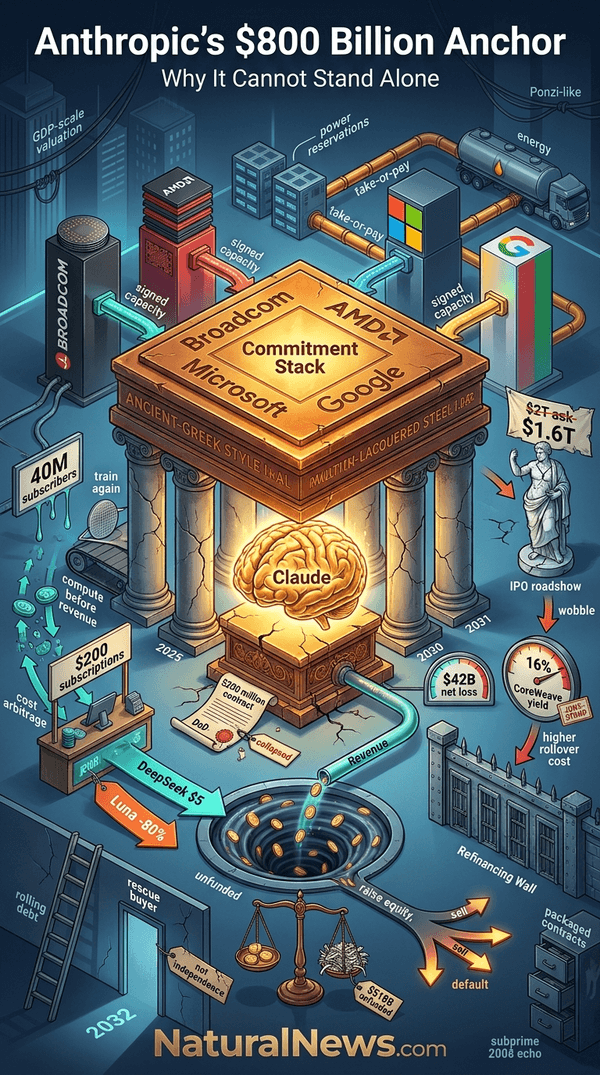
Explainer Infographic
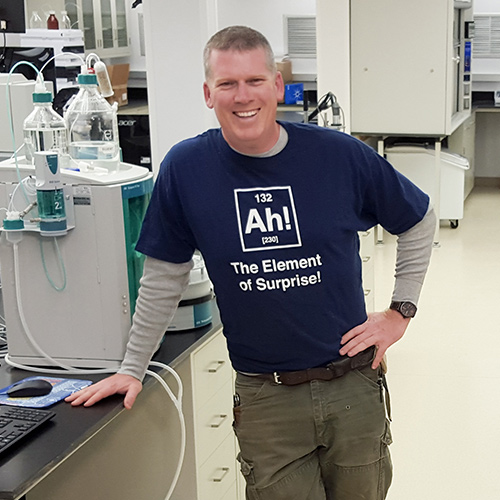
Mike Adams (aka the "Health Ranger") is the founding editor of NaturalNews.com, a best selling author (#1 best selling science book on Amazon.com called "Food Forensics"), an environmental scientist, a patent holder for a cesium radioactive isotope elimination invention, a multiple award winner for outstanding journalism, a science news publisher and influential commentator on topics ranging from science and medicine to culture and politics.
Mike Adams also serves as the lab science director of an internationally accredited (ISO 17025) analytical laboratory known as CWC Labs. There, he was awarded a Certificate of Excellence for achieving extremely high accuracy in the analysis of toxic elements in unknown water samples using ICP-MS instrumentation.
In his laboratory research, Adams has made numerous food safety breakthroughs such as revealing rice protein products imported from Asia to be contaminated with toxic heavy metals like lead, cadmium and tungsten. Adams was the first food science researcher to document high levels of tungsten in superfoods. He also discovered over 11 ppm lead in imported mangosteen powder, and led an industry-wide voluntary agreement to limit heavy metals in rice protein products.
Adams has also helped defend the rights of home gardeners and protect the medical freedom rights of parents. Adams is widely recognized to have made a remarkable global impact on issues like GMOs, vaccines, nutrition therapies, human consciousness.









Please contact us for more information.


