


Miners reliant on new data centers for metals demand face risks from Jensen Huang's exit from Nvidia, which raises concerns about AI leadership, according to Mining.com [1].
Market Reaction and Analyst Assessment
A leadership transition could remove distractions but wanted clarity on a successor before reassessing his position. Those forecasts concern chip and related technology sales, not metal purchases, but show that a sharply lower share-price target can coexist with expectations for substantial business growth.
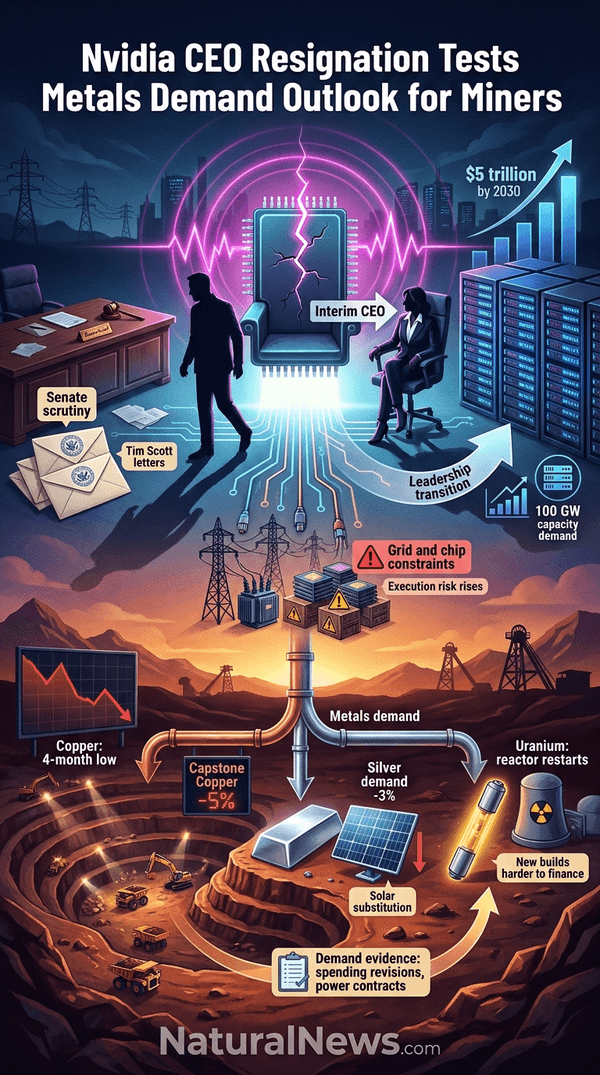
Traders moved on from the leadership shock by the following morning, with U.S. futures higher as the market digested the transition, according to a ZeroHedge market report [2]. The Reuters coverage noted that concerns over the AI outlook also spilled into metals, with London copper prices hitting a four-month low in the previous session on fears of weaker demand, while shares of Australian-listed Capstone Copper Corp. fell more than 5% on Friday, Nov. 13 [3].
Miner Exposure Tied to Data-Center Spending
Those forecasts predate Huang's departure and could still be revised. About three-quarters of Microsoft's quarterly spending went to shorter-lived assets, mainly processors, including higher memory and storage costs.
Nvidia's exposure to financing structures has already drawn scrutiny. The company reduced the size of a planned guarantee of up to $250 billion for data center financing tied to OpenAI, according to people familiar with the matter, and neither company had publicly commented on the change as of that report [4]. Separately, industry projections cited in trade reporting suggest AI-related infrastructure spending could exceed $5 trillion by 2030, with data center capacity demand reaching 100 gigawatts [5].
Metals Impact Varies by Commodity
Silver offers a warning against treating AI as the whole market: total industrial silver demand fell 3% in 2025 as solar manufacturers reduced silver use and adopted substitutes, even though AI infrastructure supported consumption, the Silver Institute said in April, citing Metals Focus research [6].
For uranium, the link runs through decisions to restart, expand or build nuclear reactors. A prolonged investment slowdown could make speculative new nuclear projects harder to finance, but would not by itself remove the needs of operating reactors.
Policy, Financing and Next Indicators
U.S. Senate Banking Committee Chairman Tim Scott (R-SC) sent letters on Thursday to Commerce Secretary Howard Lutnick and Huang asking them to testify over recent developments at Nvidia, Reuters reported [3].
Constraints in grids, energy equipment and chip supply were also identified, meaning Huang's departure adds another potential execution risk to a buildout already facing physical limits. For metals producers, subsequent revisions to customer spending, construction schedules and power contracts would provide stronger evidence of a demand change than the first stock-market reaction.
Conclusion
The resignation of Huang places the leadership of the artificial intelligence buildout under scrutiny at a moment when miners had counted on data-center construction to support copper, aluminum, silver and uranium demand.
Evidence of a physical demand break is not yet established. The clearest signals will come from customer spending revisions, construction schedules and power contracts in the weeks ahead.
References
- Nvidia turmoil tests metals demand boom - MINING.COM. https://www.mining.com/nvidia-turmoil-tests-metals-demand-boom/
- Futures Rise As Wall Street Moves On From Jensen, Microsoft Outage Drags Into Day Two. https://www.zerohedge.com/markets/futures-rise-wall-street-moves-jensen-microsoft-outage-drags-day-two
- Stocks recover from Nvidia whiplash, dollar climbs with US yields By Reuters. https://www.investing.com/news/economy-news/stocks-recover-from-nvidia-whiplash-dollar-climbs-with-us-yields-5023929
- Nvidia Scales Back $250 Billion Guarantee for OpenAI Data Center, Sources Say - NaturalNews.com, August 18, 2026.
- AI Data Center Expansion Faces Grid Constraints as Power Demand Surges - NaturalNews.com, July 01, 2026.
- Nvidia turmoil tests metals demand boom | Limpid Markets. https://limpidmarkets.co.uk/article/135315-nvidia-turmoil-tests-metals-demand-boom
Explainer Infographic








Please contact us for more information.


