



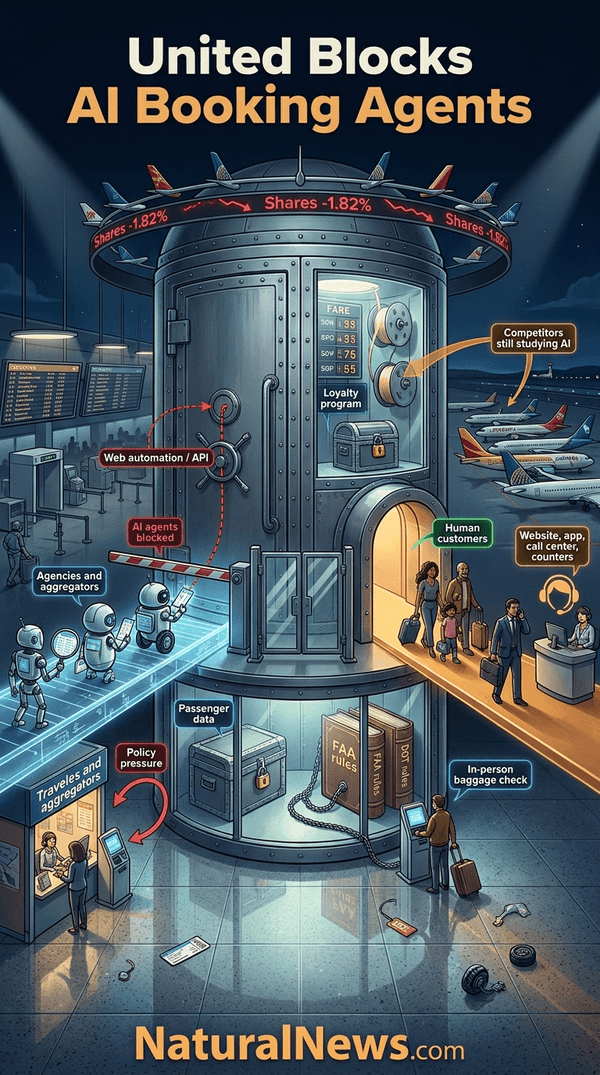
The carrier said the policy applies to automated AI agents, not to human customers using standard booking channels such as its website, mobile app, call center or airport counters. United Airlines shares fell 1.82% following the announcement, according to market data reported by the Wall Street Journal [1]. The airline did not provide a detailed timeline for enforcement, officials said.
The move, announced ahead of the holiday travel season, places United at odds with competitors that are still studying how agentic AI tools might be integrated into ticket sales [2] [3]. United said the restriction is intended to protect system integrity and customer data [4].
What United Announced
United stated that AI bots are prohibited from accessing its reservations systems to search, hold or purchase tickets. The carrier added Rule 6. A company statement said the restriction is intended to protect system integrity and customer data [4].
The carrier also said that using an AI agent to check in for a flight, for example, could violate federal regulations, including rules requiring travelers to verify in person that their luggage does not contain banned substances [5]. United cited the risk of exposing customer data, unintended purchases, and possible breaches of Federal Aviation Administration (FAA) and Department of Transportation (DOT) rules [6]. The airline said AI agents can still display United's flights and fares but cannot transact on its website [6].
How AI Booking Agents Operate
Third-party AI assistants often use web automation or application programming interfaces to search fares, compare options and complete purchases on behalf of users, according to developers. Airline terms of service commonly prohibit scraping, automated access and unauthorized use of reservation systems. United's own notice describes the new policy as covering booking, changing or servicing of tickets both on its own website and app and through travel agencies and aggregators [7].
Some AI travel tools act as personal agents, while others operate as browser extensions or standalone apps, industry reports stated. The wording of United's policy is broad enough that it could also affect award-search tools that query the airline's systems on a user's behalf [8]. Because these agents typically authenticate with a traveler's own credentials, any automated activity can be difficult to separate from legitimate account access.
Industry and Regulatory Context
Airlines have long guarded reservation systems and customer data, and automated access can create costs and security risks, industry officials said. Deregulation in the United States produced dramatic changes in the marketing of airline services, affecting nearly all members of the travel-distribution system, including competing airlines, travel agents, other suppliers of travel services and travelers, according to research on the airline operating environment [9].
The same body of research noted that the costs of direct dealing may eventually prove greater than the benefits gained, because travel agents still possess the ability to retaliate against airlines that bypass them [9].
DOT rules require clear disclosure of fares and fees, but they do not specifically address AI booking agents, according to regulatory filings. United cited compliance with FAA and DOT requirements among its reasons for the policy [10]. The airline also cited data security for sensitive passenger information and its loyalty program [4].
Other carriers are monitoring how United enforces the policy, analysts said. The announcement comes as AI tools expand into travel planning, payments and customer service, according to technology reports.
Reactions From AI and Consumer Advocates
Some AI developers said the restriction limits consumer choice and could slow innovation in travel booking, according to statements. United said its policy is consistent with existing terms and is not aimed at any single AI provider, according to an airline representative.
A spokesperson for an AI travel tool said the company was reviewing United's statement and had no immediate comment. United's announcement drew a range of commentary in the travel press, with at least one analysis noting the broad wording could reach beyond booking to award searches [8].
Access, Control and Travel Booking
The policy highlights a dispute over who controls automated access to airline reservation systems, according to industry observers. The same dynamic now applies to airline accounts and payment information, according to the airline.
Travelers using AI assistants may need to complete bookings directly with United, according to the carrier's statement. Whether similar restrictions spread depends on how competitors read consumer demand for AI-mediated booking, analysts said. Further details are expected as other airlines and regulators respond, analysts said.
References
- United Airlines Is Banning AI Bots From Booking Flights. https://www.wsj.com/tech/ai/united-airlines-is-banning-ai-bots-from-booking-flights-5b514b38
- United Airlines just made a big change to flight bookings. Here's why Delta and American aren't following - Fast Company. 2026-11-11T23:13:09Z. https://www.fastcompany.com/91640548/united-airlines-just-made-a-big-change-to-flight-bookings-heres-why-delta-and-american-arent-following
- United Airlines Blocks AI Agents From Booking Flights Ahead of Holiday Travel - Bloomberg. https://www.bloomberg.com/news/articles/2026-11-11/united-blocks-ai-agents-from-booking-flights-ahead-of-holidays
- United Airlines Blocks AI Agents From Booking Flights—Citing Security Concerns. https://www.forbes.com/sites/suzannerowankelleher/2026/11/11/united-airlines-blocks-ai-agents-booking-flights/
- United Airlines bans AI agents from booking flights on behalf of travelers - United States. https://www.europesays.com/us/1181366/
- United Airlines bans AI agents from booking flights: 3 reasons it matters beyond travel. https://investinglive.com/stocks/united-airlines-bans-ai-agents-from-booking-flights-3-reasons-it-matters-beyond-travel/
- United Airlines bans AI agents from booking its flights, on its site and through travel agencies | MLQ.ai. https://mlq.ai/news/united-airlines-bans-ai-agents-from-booking-its-flights-on-its-site-and-through-travel-agencies/
- United Airlines Bans "AI Agents," Claims It's To "Protect Customers" - One Mile at a Time. https://onemileatatime.com/news/united-airlines-bans-ai-agents-protect-customers/
- Changes in the operating environment of US airlines have complicated. Acrobat 3.0 Capture Plug-in. Journal of Transport Economics and Policy 72(2) June 1985 pp 119-144
- United Airlines bans personal AI agents from booking flights. https://www.usatoday.com/story/travel/airline-news/2026/11/11/united-ai-travel-agents-booking/92728156007/
Explainer Infographic












Please contact us for more information.


