



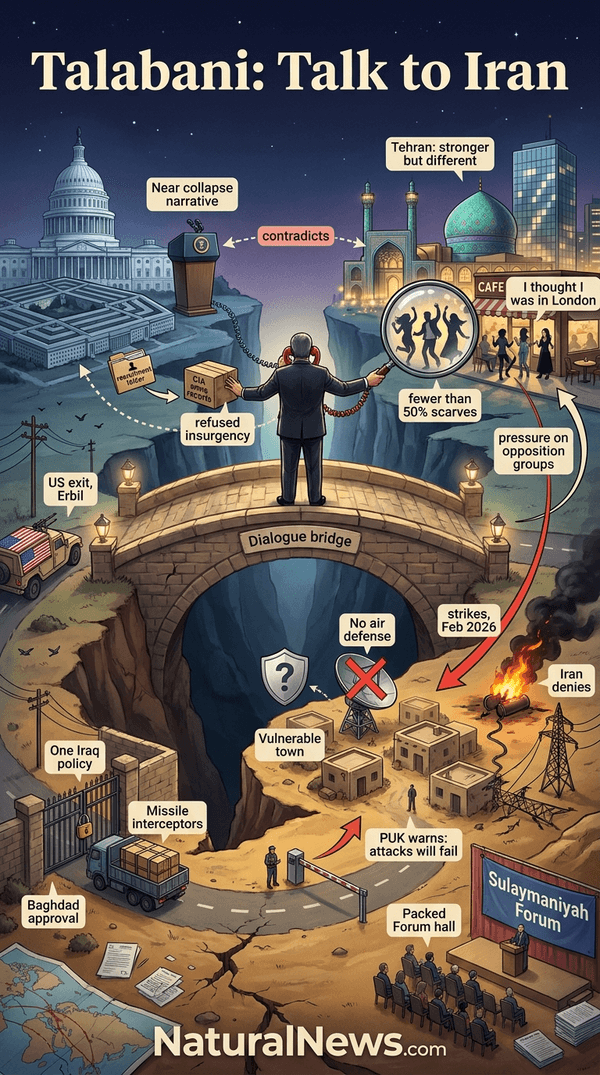
"Iranians are often misunderstood in the West. This notion of mad mullahs is far from the truth," Bafel Talabani said. Talabani made the remarks at a Strategic Forum in the Iraqi Kurdistan city of Sulaymaniyah, according to Middle East Eye [1].
Talabani: "Mighty U.S." Can Talk to Iran
"We don't find it difficult talking to the Iranians," he said. The Patriotic Union of Kurdistan (PUK) has historically enjoyed close ties to Tehran, but the relationship came under strain earlier this year after Trump and his advisers tried to recruit Talabani and other Kurdish leaders to support a Kurdish insurgency in Iran, according to Middle East Eye [1].
Talabani eventually decided not to intervene [1]. A senior Kurdish official in Sulaymaniyah told Middle East Eye that the PUK warned Iranian opposition groups against launching attacks on Iran at the time, saying they were sure to fail [1].
Tehran has been pressuring Iraqi Kurdistan to clamp down on Iranian Kurdish opposition groups [1]. In a meeting in September with Iranian Foreign Minister Abbas Araghchi, Talabani promised not to allow Iraqi Kurdistan to become "a haven for harming or threatening" the Islamic Republic [1]. The outreach to Kurdish leaders was part of a broader U.S. effort during the war, with reports that the U.S. Central Intelligence Agency was negotiating to arm Kurdish opposition groups to foment an uprising inside Iran [2].
Assessment of Iran After War
Talabani said that Iran was emerging from the US-Israeli war "stronger, but different". Recounting a recent trip he made to Iran, he said, "I thought I was in London," noting that "less then 50% of ladies and girls had scarves" and that restaurants were filled with young people dancing [1].
Iran launched strikes on Iranian opposition groups in Iraqi Kurdistan following the U.S.-Israeli attack in February 2026, according to the report [1]. Talabani's account of a changing Iranian society differs from the public messaging of the Trump administration, which has portrayed Iran as economically isolated and near collapse [1].
Khor Mor Attack and Air Defense Concerns
The Kurdish official also remarked that Iran has denied any involvement in the Nov. 8 drone attack on the Khor Mor gas field. The field, operated by a UAE company, is one of the largest in Iraq [1]. Regional reports indicated over 70% of the region's power was affected by the strike [3].
"Iran has guaranteed me that it was not by their bidding or doing," Talabani said. "The timing and methodology of the attack needs to be investigated very seriously" [1]. Iraqi Kurdistan has no air defense systems, according to the report [1].
The last U.S. troops left Erbil, the region's capital, in September, completing a full U.S. withdrawal from Iraq [1]. U.S. Central Command confirmed the departure of American forces and equipment from Erbil Air Base was complete, ending the Operation Inherent Resolve mission [4].
Some U.S. lawmakers have since tried to advance the sale of air defense systems to Iraqi Kurdistan. However, Talabani said the semi-autonomous region was in a "grey area" because of a "one Iraq" policy requiring approval from Baghdad [1].
Conclusion
The U.S. envoy to Iraq and Syria, Tom Barrack, weighed into the rift, which has raised fears about a splintering of the province at a time of uncertainty over the region's security framework.
"The Barzanis, the Talabanis, have always been great friends of America. This is an Iraqi issue," Barrack said. "My advice is get over it."
References
- Mighty US' must talk with Iran, Iraqi Kurdish leader says. https://www.middleeasteye.net/news/iran-emerging-stronger-from-war-iraq-kurdish-leader-bafel-talabani-says
- A proxy gambit US explores arming Kurds against Iran - NaturalNews.com, March 05, 2026.
- Drone Strike Shuts Down Northern Iraq's Largest Gas Field, Plunging Region Into Darkness. https://www.zerohedge.com/energy/drone-strike-shuts-down-northern-iraqs-largest-gas-field-plunging-region-darkness
- The Last U.S. Troops Have Left Iraq — Ending A 23-Year American Military Era. https://100percentfedup.com/last-us-troops-leave-iraq-23-year-military/?utm_source=rss&utm_medium=rss&utm_campaign=last-us-troops-leave-iraq-23-year-military
Explainer Infographic






Please contact us for more information.


