



The talks were the first formal trilateral meeting since February, according to the report. U.S. envoys Steve Witkoff and Jared Kushner met Russian President Vladimir Putin in Moscow on Thursday, Nov. 12 the report said, a day after the Abu Dhabi session closed. Russian political and military commentators have assessed the outcome and the prospects for a lasting settlement, offering a range of views on what the two-day session achieved and where the process heads next, according to the report.
Negotiations End With Prisoner Exchange Agreement in Principle
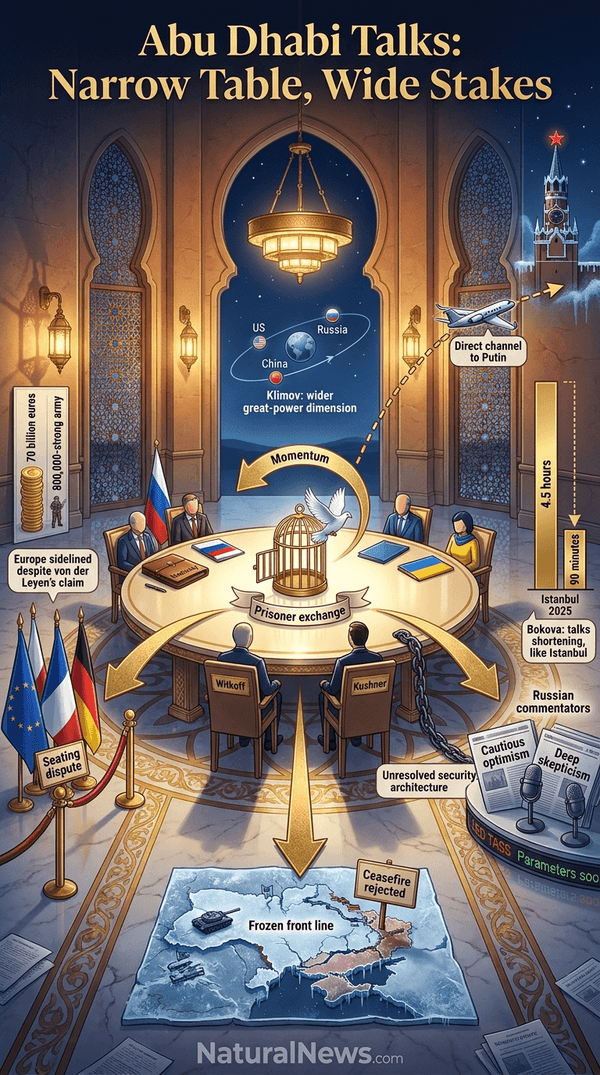
The two-day negotiations focused on wider European security arrangements, according to the report. Moscow reported common ground on some issues, while American negotiators described progress and acknowledged that the hardest questions remain unresolved, the report stated. Kushner told reporters the discussions were "pretty tough" and "very substantive," according to an account of his remarks [1].
Western European representatives were sidelined during the negotiations, although they reportedly held separate consultations with the American and Ukrainian teams, according to the report. The exclusion followed public disagreement over seating: European Commission President Ursula von der Leyen had announced the European Union would have representatives at the talks, while Moscow rejected a European role [2].
Russian Presidential Aide Vladimir Medinsky, who headed Moscow's delegation, said Russia and Ukraine had made another step toward peace but that much would depend on all parties involved in the process, according to TASS [3]. Medinsky said the parameters of the prisoner exchange would be made public soon [4].
Russian Analysts Describe Restarted Diplomacy and Remaining Differences
Anastasia Gafarova, deputy director of the Center for Political Information, told Gazeta.ru that the issue of the overall security architecture in Europe was included in the agenda for the first time, according to the report. She said the topic had been consistently denied to Russia before, the report stated, and suggested progress might be possible on military arrangements while identifying humanitarian matters as an area where cooperation had traditionally been easier.
Alexandra Bokova, managing partner of the Strategic Communications Agency, told Gazeta.ru that the brief second day suggested little progress on territorial disputes, the report stated. She noted that Tuesday's four-and-a-half-hour session had raised expectations, but Wednesday's discussions lasted just 90 minutes despite the most difficult issues being scheduled for the second day, according to the report.
Bokova said Kyiv wants to stop the fighting first and only then discuss security, while the Russian side believes a ceasefire without political agreements will resolve nothing, according to the report. She compared the situation to the Istanbul negotiations in 2025, when meetings became progressively shorter, the report stated, describing the brief discussion of central issues as an indication of stagnation.
Ceasefire Proposal and European Role Draw Commentary
Russian military commentator Viktor Baranets told Sputnik that Ukraine is proposing a ceasefire along the current line of contact, an approach Moscow rejects, according to the report. "We do not need a short-term ceasefire. We need a comprehensive agreement designed to last not a week, not two weeks, not a month, but many, many years," Baranets said, according to the report.
Baranets cited a Ukrainian request for €70 billion ($77.41 billion) for 2027 and a stated need to finance an 800,000-strong army, the report stated. He said the request amounted to an admission that Ukraine is ready to fight Russia for another ten years, according to the report. Separate reporting said Ukraine has asked its Western backers to provide 10 years of funding to maintain the 800,000-strong military as part of a potential peace deal [5].
Baranets criticized Western European involvement, saying European advisers were not allowed at the table, according to the report. "We did not ask Europe to interfere in these trilateral negotiations, but a whole gang of consultants and advisers nevertheless rushed to Abu Dhabi," he said, according to the report.
European Participation and Future Format Remain Contested
Dmitry Suslov, deputy director at HSE University, told Monocle that bringing Europeans into a single negotiating format at this stage risks blocking and derailing the negotiations, according to the report. He said European governments opposed revisiting existing security arrangements, while Washington was willing to discuss Moscow's concerns as part of a settlement, the report stated.
Nikolay Topornin, director of the Center for European Information, told Gazeta.ru that Western European countries lack a common negotiating position or a representative capable of speaking for them collectively, the report stated. He said their position is effectively voiced by the Ukrainian delegation, according to the report.
Andrey Klimov, a member of the Russian State Duma's International Affairs Committee, told Gazeta.ru that Western European figures were the instigators of the catastrophe and are still attempting to obstruct a settlement, according to the report. Klimov also noted reports of a possible meeting between the leaders of Russia, the US, and China, the report stated, saying the security questions raised in the latest discussions concerned other major powers as well.
Next Steps Include Moscow Meeting and Further Diplomacy
Witkoff and Kushner met Putin in Moscow on Thursday, according to the report. The BBC reported that the envoys arrived in Moscow and were welcomed by Kremlin envoy Kirill Dmitriev, and were due to meet Putin before flying to Dublin to speak with Ukrainian President Volodymyr Zelensky [6].
Russian commentators said fundamental differences remain, while some identified areas where progress might be possible, the report stated. Gafarova pointed to a possible meeting between the leaders of Russia, China, and the U.S., and the question of European participation in future negotiations. No date for a next trilateral meeting was announced in the report.
References
- Russia, Ukraine Agree to Prisoner Exchange as 2nd Day of US-Brokered Peace Talks Ends. https://theepochtimes.com/world/russia-ukraine-agree-to-prisoner-exchange-as-2nd-day-of-us-brokered-peace-talks-ends-6123578
- Russia Flatly Rejects EU Role In Abu Dhabi, While Brussels Insists Will Be At Table. https://www.zerohedge.com/geopolitical/kremlin-firmly-rejects-european-role-abu-dhabi-talks-while-eu-insists-will-be-table
- Press review: Abu Dhabi talks advance Ukraine settlement as EU struggles to fund Kiev. https://tass.com/pressreview/2216707
- Russia clearly lays out position at Abu Dhabi talks, expects. https://tass.com/politics/2216967
- Ukraine Wants Western Funding for 800,000-Strong Military for 10 Years After War. https://news.antiwar.com/2026/11/11/ukraine-wants-western-funding-for-800000-strong-military-for-10-years-after-war/
- US envoys arrive in Moscow for Ukraine talks with Vladimir Putin. https://bbc.com/news/articles/cwrkgmymk55zo
Explainer Infographic






Please contact us for more information.


