



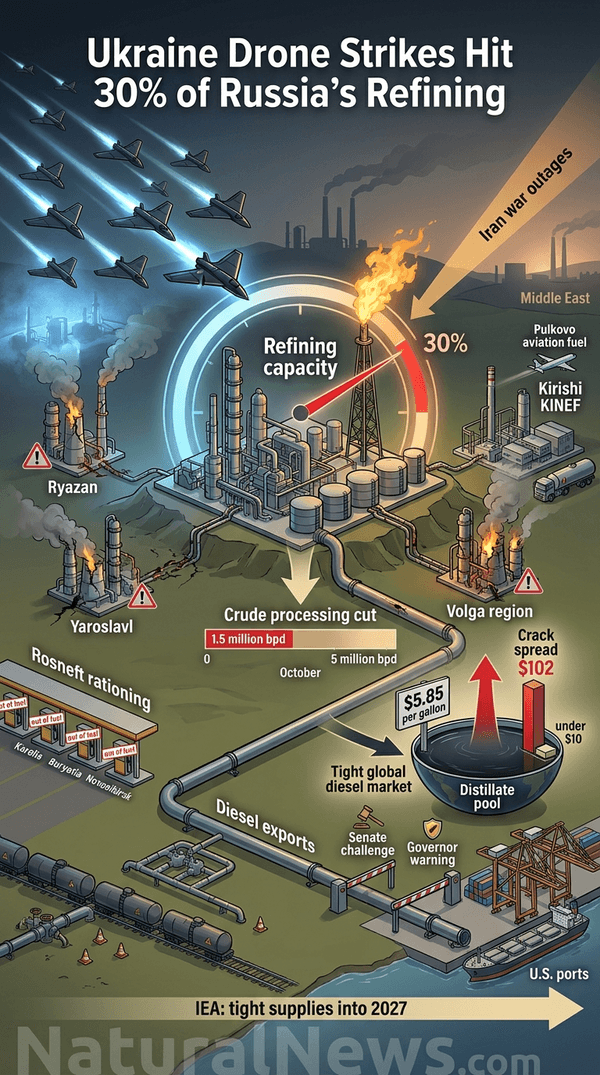
The strikes hit facilities in Ryazan, Yaroslavl and the Volga region, according to the report. The Kirishi plant, known as KINEF, handles about 7% of Russia's refining capacity and supplies aviation fuel to St. Petersburg's Pulkovo airport, the report stated.
The disruption comes as Moscow attempts to increase diesel exports under a controversial arrangement with Washington, the report said. The strikes represent the latest phase in a sustained Ukrainian campaign against Russian energy infrastructure that has repeatedly targeted refineries, export terminals and storage facilities [1].
Estimated Impact on Crude Processing
The actual reduction in crude processing could reach 200,000 metric tons daily, or approximately 1.5 million bpd, according to industry estimates cited in the report. Russian refineries were processing about 5 million bpd at the end of October, following a partial recovery from earlier Ukrainian attacks. The figures were attributed to industry sources and officials; no independent verification was provided in the report.
Analysts cited in the report described the disruption as a reduction in fuel supplies. The report did not quantify downstream retail effects. The estimates imply that some refining capacity was underutilized before the strikes and that operators are attempting to keep key units running, according to a separate industry analysis [2].
The reported reduction is smaller than at the height of a second crisis in September, when the Ukrainian military claimed more than 45% of Russia's refining capacity had been knocked out, a figure it raised to 51% on October 4. Neither claim was independently verified, and they measure damage rather than lost throughput, the report stated [3].
Diesel Export Arrangement With the United States
Russia recently agreed to supply diesel to the United States and international markets under an arrangement announced by President Donald Trump in October, according to the report. The initial agreement covered 300,000 metric tons, followed by additional scheduled shipments. Russian Foreign Minister Sergei Lavrov said Tuesday the arrangement was already helping lower fuel prices, according to the report.
Domestic shortages have reportedly returned to several Russian regions, the report stated. Rosneft capped gasoline and diesel sales at its stations in Karelia, Buryatia, Zabaykalsky Krai and the Novosibirsk, Arkhangelsk and Penza regions, Russian media reported [4].
The arrangement has drawn criticism from a bipartisan group of U.S. senators, who called on Trump to halt the proposed deal, arguing that a 2022 law makes the plan illegal [5]. The senators signing the statement included Jeanne Shaheen, Susan Collins, Richard Blumenthal, Lisa Murkowski, Ron Wyden and Thom Tillis, according to the report. New Jersey Governor Mikie Sherrill also warned port and terminal operators against handling Russian diesel imports [6].
Global Diesel Market Conditions
Middle Eastern refinery outages stemming from the Iran war have sharply restricted refined-product supplies, according to the report. Russian export disruptions have added to market tightness, keeping global diesel prices above levels described in the report as comfortable. The report did not provide specific price figures for diesel benchmarks.
The combined effect was described as complicating an already strained global diesel market. The International Energy Agency said in a report published October 14 that "constrained middle distillate supplies" are expected "to persist well into 2027" [7]. Diesel inventories have been heavily depleted because of the wars in Iran and Ukraine, and it will take time to recover, assuming geopolitical circumstances allow, the agency stated.
U.S. retail diesel prices reached a record $5.85 per gallon on Friday, Sept. 4, surpassing the previous all-time high from June 2022, according to American Automobile Association data [8]. The national average price rose from $5.78 the previous week, the report stated. The diesel crack spread, a key measure of refining profitability, surged to an unprecedented $102 per barrel, a stark deviation from historical norms where it rarely exceeded $10 [9].
Diplomatic Track and Outlook
U.S.-brokered peace talks between Russia and Ukraine are scheduled for November 10–11 in Abu Dhabi, according to the report. The countries remain divided over key territorial demands, the report stated. The report did not indicate whether refinery strikes or energy infrastructure were on the negotiating agenda.
No timeline was given for restoring affected refining capacity. The strikes have continued despite pressure from the Trump administration to halt attacks on Russian energy infrastructure, according to a report on a strike that ended a two-week pause [10]. Russian officials accused Kyiv of ignoring Trump's request to stop the attacks, the report stated.
The strikes have also affected global fuel markets, with U.S. trucking companies facing elevated diesel prices through at least spring 2027, according to energy and truck stop executives [11]. The longer-term trajectory of Russian refining capacity remains uncertain, with industry analysts noting that even upon restart, full production may not be recovered [1].
References
- Bright Videos News - ALZHEIMER OIL EMERGENCY MANNARINO - Mike Adams - BrightVideos.com, May 05, 2026.
- Ukrainian Strikes Cut Russian Refining by 30%: Impact on Crude Oil. https://commodity-board.com/ukrainian-strikes-knock-out-30-of-russian-refining-what-it-means-for-crude
- Ukraine's strikes hit Russian refineries representing 30% of capacity as Abu Dhabi talks open. https://www.intellinews.com/ukraine-s-strikes-hit-russian-refineries-representing-30-of-capacity-as-abu-dhabi-talks-open-483858/
- Ukrainian Drones Fire Russia's Second-Largest Refinery, Squeezing 30% of Capacity. https://www.sofx.com/ukrainian-drones-fire-russias-second-largest-refinery-squeezing-30-of-capacity/
- Several Senators call on Trump to halt Russian diesel deal, argue it's illegal. https://justthenews.com/government/diplomacy/several-senators-call-trump-halt-russian-diesel-deal-argue-its-illegal?utm_source=justthenews.com&utm_medium=feed&utm_campaign=external-news-aggregators
- Sherrill Defies Trump, Warns NJ Ports Against Russian Diesel Imports. https://www.naturalnews.com/2026-11-06-sherrill-defies-trump-warns-against-russian-diesel-imports.html
- No Diesel Relief Until 2027, Consumer Prices Spike, Says IEA Report. https://thenewamerican.com/us/tech/energy/no-diesel-relief-until-2027-as-consumer-prices-spike-iea-report/
- U.S. Diesel Pump Prices Reach Record High as Refined Products Supply Tightens - NaturalNews.com, September 07, 2026.
- Bright Videos News - RED ALERT FOR US ECONOMY GERALD CELENTE INTERVIEW - Mike Adams - BrightVideos.com, August 18, 2026.
- Ukraine Strikes Russian Oil Refinery, Ending Pause and Defying Trump. https://www.naturalnews.com/2026-11-04-ukraine-strikes-russian-oil-refinery-ending-pause.html
- Diesel prices may stay elevated into spring 2027, fuel executives warn. https://www.freightwaves.com/news/diesel-prices-may-stay-elevated-into-spring-2027-fuel-executives-warn
Explainer Infographic










Please contact us for more information.


