



The revenue figure represented growth from the prior quarter, the WSJ report stated, but it came alongside continued losses. TipRanks, citing the WSJ report, said OpenAI's operating loss grew to $10.9 billion from $10.1 billion in the prior quarter [3].
Reuters carried the story under a headline about steep losses even as revenue climbs [4]. The WSJ's Tuesday report cited documents provided to investors [4].
Revenue Growth Outpaces Earlier Periods
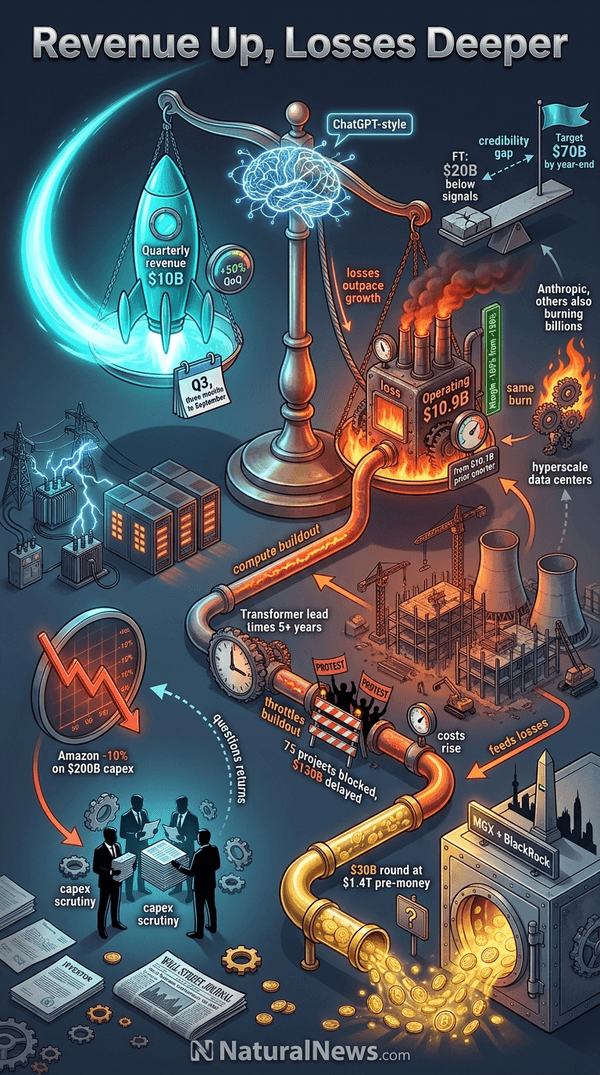
The $10 billion quarterly revenue mark represented a roughly 50% increase from the second to the third quarter, according to the WSJ report [5]. Bloomberg reported that the figure was the first time quarterly revenue hit $10 billion, in the three months ending in September, driven by strong demand for the company's latest artificial intelligence (AI) models [6][7].
OpenAI told investors its adjusted operating margin improved to -109% from -150% in the prior quarter, according to documents viewed, Reuters reported [2]. The revenue growth occurred even as the company continued to report heavy operating losses, the WSJ stated [5]. The WSJ's report showed mixed results in the company's effort to catch up with competitors, according to the newspaper [5].
Losses Reflect High Operating Costs
The operating loss grew to $10.9 billion from $10.1 billion in the prior quarter, according to the WSJ report cited by TipRanks [3]. Forbes reported that the operating loss reached $10.9 billion in the third quarter [8].
The losses have come as AI companies spend heavily on computing infrastructure. OpenAI, Anthropic and other developers are burning billions in losses despite rapid revenue growth, according to an interview with Jay Martin published by the Daily Bell [9].
The infrastructure buildout has faced physical constraints. The lead times for large-scale transformers suitable for hyperscale data centers are currently five years or more, according to commentary published by the Health Ranger Mike Adams [10]. Data center projects also have faced local opposition, with 75 projects worth $130 billion delayed or blocked in the first quarter of 2026, according to NaturalNews.com [11].
Industry Context and Competitive Pressures
The results arrived amid heightened competition and scrutiny of AI spending. Several major technology companies have reported a surge in AI-related capital spending in recent quarters, prompting a sell-off among investors who question whether the investments will generate timely returns, according to NaturalNews.com [12]. Amazon shares plunged more than 10% in extended trading after the company announced a $200 billion capital expenditure plan, the report stated [12].
Investors and analysts have raised questions about the path to profitability. The Financial Times reported that OpenAI's annualized revenue was about $20 billion less than previously signaled, according to financial documents shared with investors [13]. OpenAI later told investors it expected to reach or exceed $70 billion in annualized revenue by year-end, according to ZeroHedge [14].
The company has pursued partnerships and funding. In October 2026, OpenAI was reportedly pitching a $30 billion funding round to a group of United Arab Emirates sovereign funds led by Abu Dhabi's MGX, along with BlackRock, at a $1.4 trillion pre-money valuation, Bloomberg reported [15]. OpenAI has not publicly disclosed a timeline for reaching profitability.
Conclusion
OpenAI's quarterly revenue reached $10 billion in the third quarter while the company posted steep operating losses, according to the WSJ report cited by Reuters [1][2]. The WSJ reported that revenue rose about 50% and that the operating loss widened to $10.9 billion from $10.1 billion, according to TipRanks' account of the report [3].
References
- OpenAI posts steep losses even as quarterly revenue rises. https://www.reuters.com/legal/transactional/openai-posts-steep-losses-even-quarterly-revenue-rises-10-billion-wsj-reports-2026-11-10
- OpenAI posts steep losses even as quarterly revenue rises to $10. https://srnnews.com/openai-posts-steep-losses-even-as-quarterly-revenue-rises-to-10-billion-wsj-reports/
- OpenAI Posts Steep Losses Even as Quarterly Revenue Rises to $10. https://www.tipranks.com/news/openai-posts-steep-losses-even-as-quarterly-revenue-rises-to-10-billion
- OpenAI Q3 Revenue Hits $10B, Loss Widens to $10.9B [2026]. https://shattered.io/openai-q3-2026-revenue-10-billion-operating-loss-10-9-billion-2026/
- OpenAI Continues to Suffer Heavy Losses as Revenue Rises to $10 Billion. https://www.wsj.com/business/earnings/openai-continues-to-suffer-heavy-losses-as-revenue-rises-to-10-billion-d2a96bbb
- OpenAI Third-Quarter Revenue Soars Nearly 50% to $10 Billion. https://www.bloomberg.com/news/articles/2026-11-10/openai-third-quarter-revenue-soars-nearly-50-to-10-billion
- OpenAI’s quarterly revenue reportedly crosses $10B for. https://techcrunch.com/2026/11/11/openais-quarterly-revenue-reportedly-crosses-10b-for-the-first-time/
- OpenAI Revenue Hits $10 Billion As Losses Reach $10.9 Billion. https://www.forbes.com/sites/gabrielalinzainescu/2026/11/11/openai-revenue-hits-10-billion-as-losses-reach-109-billion/
- Jay Martin: America’s AI Giants Have No Moat, And China Knows It. https://thedailybell.com/all-articles/exclusive-interviews/jay-martin-americas-ai-giants-have-no-moat-and-china-knows-it/
- Bright Videos News - THE AI DATA CENTER BUBBLE WILL BURST - Mike Adams - BrightVideos.com, June 01, 2026.
- The rural revolt against AI's concrete giants - NaturalNews.com, August 22, 2026.
- Big Tech Faces Investor Scrutiny Over AI Spending - NaturalNews.com, July 23, 2026.
- Nasdaq Tumbles After FT Reports OpenAI Revenues Disappointing. https://www.zerohedge.com/markets/nasdaq-tumbles-after-ft-reports-openai-revenues-disappointing
- Futures Rise After OpenAI Damage Control Sparks Tech Rebound, Oil Slides. https://www.zerohedge.com/markets/futures-rise-after-openai-damage-control-sparks-tech-rebound-oil-slides
- OpenAI Shops $30 Billion Round To UAE Funds, BlackRock As Altman's 'Bad Things' Remark Draws Bipartisan Fire. https://www.zerohedge.com/ai/openai-shops-30-billion-round-uae-funds-blackrock-altmans-bad-things-remark-draws-bipartisan
Explainer Infographic











Please contact us for more information.


