



The planet, designated TOI-2535 b, is located about 1,000 light-years from Earth. New research indicates the planet has not vanished but is being pulled by an unseen companion, tilting its orbit out of alignment with its star, according to the research team.
The findings were announced by the University of California, Los Angeles, and published in the Astrophysical Journal Letters on Monday, Nov. 9.
Discovery and Observations
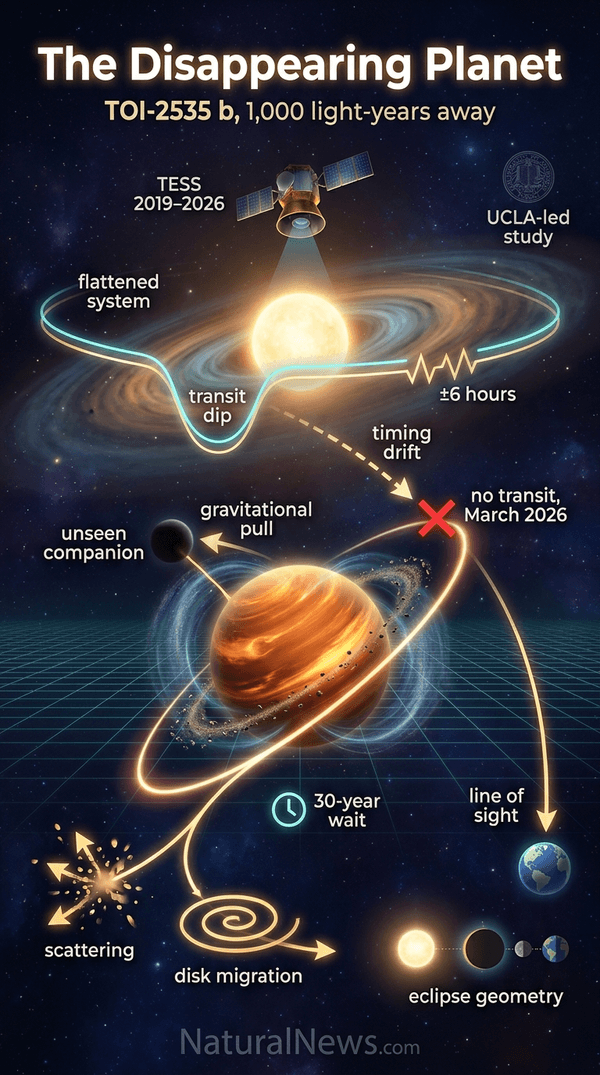
NASA's Transiting Exoplanet Survey Satellite, or TESS, observed TOI-2535 b for seven years, from April 2019 to March 2026, according to the report.
The planet's transits, the events during which it crossed the face of its star and caused a characteristic dip in starlight, became irregular over time. Astronomers recorded TOI-2535 b arriving up to six hours early or six hours late compared with predictions, the report stated [1].
Then, in March 2026, TESS stopped detecting the planet's transits altogether. The planet appeared to have vanished [2]. According to the research team, the most likely explanation involves another planet that astronomers have yet to directly observe [3].
Explanation: Unseen Planet Causes Wobble
Researchers determined that an unseen neighboring planet is gravitationally interacting with TOI-2535 b, causing both orbits to wobble like a spinning top [4]. The wobble tilted TOI-2535 b out of alignment with its star, stopping its transit and making it undetectable by the transit method [5].
According to the research team, TOI-2535 b is not expected to transit its star for at least 30 years, though the hidden companion may cross the face of the star sooner [2].
The planet remains in the system and was not destroyed or ejected, according to the report [6]. The geometry that causes the disappearance, a tilted orbit that periodically aligns and misaligns with Earth's line of sight, is the same as the geometry that makes eclipses infrequent [4].
Implications for Hot Jupiter Formation
Hot Jupiters like TOI-2535 b likely formed far from their stars and migrated inward, according to current theories.
Two migration routes are proposed: violent scattering into an elliptical orbit after a near-collision with another planetary body, or slower spiraling within a protoplanetary disk.
The tilt in TOI-2535 b's orbit suggests that flattened systems can be twisted later by more tilted orbits, allowing slower migration to occur despite the tilt, the report stated [2].
UCLA-led astronomers described the discovery as the first known "disappearing planet" about 1,000 light-years away, according to a university release [4]. The research adds to a growing body of work on planetary migration, including studies of rare double hot Jupiter systems that form through gravitational interactions [7].
Conclusion
The system presents an unusual configuration containing two short-period giant planets, according to the study [1].
References
- A TESS Disappearing Act: The Vanishing Transits of TOI-2535 b. https://arxiv.org/abs/2611.13343
- A distant exoplanet mysteriously vanished from sight. Astronomers just discovered why | Space. https://www.space.com/astronomy/exoplanets/a-distant-exoplanet-mysteriously-vanished-from-sight-astronomers-just-discovered-why
- Planet 1,000 light-years away mysteriously vanishes before astronomers’ eyes. https://www.newsnationnow.com/space/disappearing-planet-vanishes-ucla-astronomers-toi-2535-b/
- First known disappearing planet has a neighbor that makes it wobble like a top | UCLA. https://newsroom.ucla.edu/releases/first-known-disappearing-planet-neighbor-wobble-like-top
- 'Hot Jupiter' exoplanet suddenly vanishes – here's why | The Independent. https://www.independent.co.uk/bulletin/news/nasa-jupiter-exoplanet-toi-2535-b3082657.html
- TOI-2535 b Exoplanet tilted out of view by hidden world. https://orbital-wire.com/astronomy-astrophysics/toi-2535-b-exoplanet-tilted-view/
- Astronomers uncover the cosmic dance behind rare double hot Jupiter systems - NaturalNews.com, July 03, 2025.
Explainer Infographic











Please contact us for more information.


