


The announcement was made by U.S. Deputy Secretary of Energy James P. Danly on Thursday, according to the report [1]. The project will investigate methods to address the long-term burden of radioactive nuclear waste while also focusing on developing advanced reactor technologies [2].
The award is intended to support research into fuel technology that could reduce waste stockpiles while exploring alternative fuel cycles, according to the announcement.
Background: Nuclear Waste and Thorium
The United States has accumulated tens of thousands of metric tons of spent nuclear fuel stored at reactor sites, according to Department of Energy data cited in the report [1]. Spent fuel is removed from reactors after it can no longer sustain a fission chain reaction efficiently, but it still contains substantial amounts of unburned uranium and other fissile materials.
Thorium is a naturally occurring radioactive element that is more abundant than uranium in the Earth's crust [3]. Historical research into molten salts for nuclear energy production dates to the beginning of nuclear research, according to a 2006 study published in Nuclear Engineering and Design [4].
Claims about waste reduction or safety are attributed to the report and named experts. A 2005 study published in Progress in Nuclear Energy examined the potential of thorium molten salt reactors for large-scale energy production [5]. The study presented detailed calculations and concept evolution but did not independently endorse specific waste-reduction outcomes.
How the Reactor Concept Works
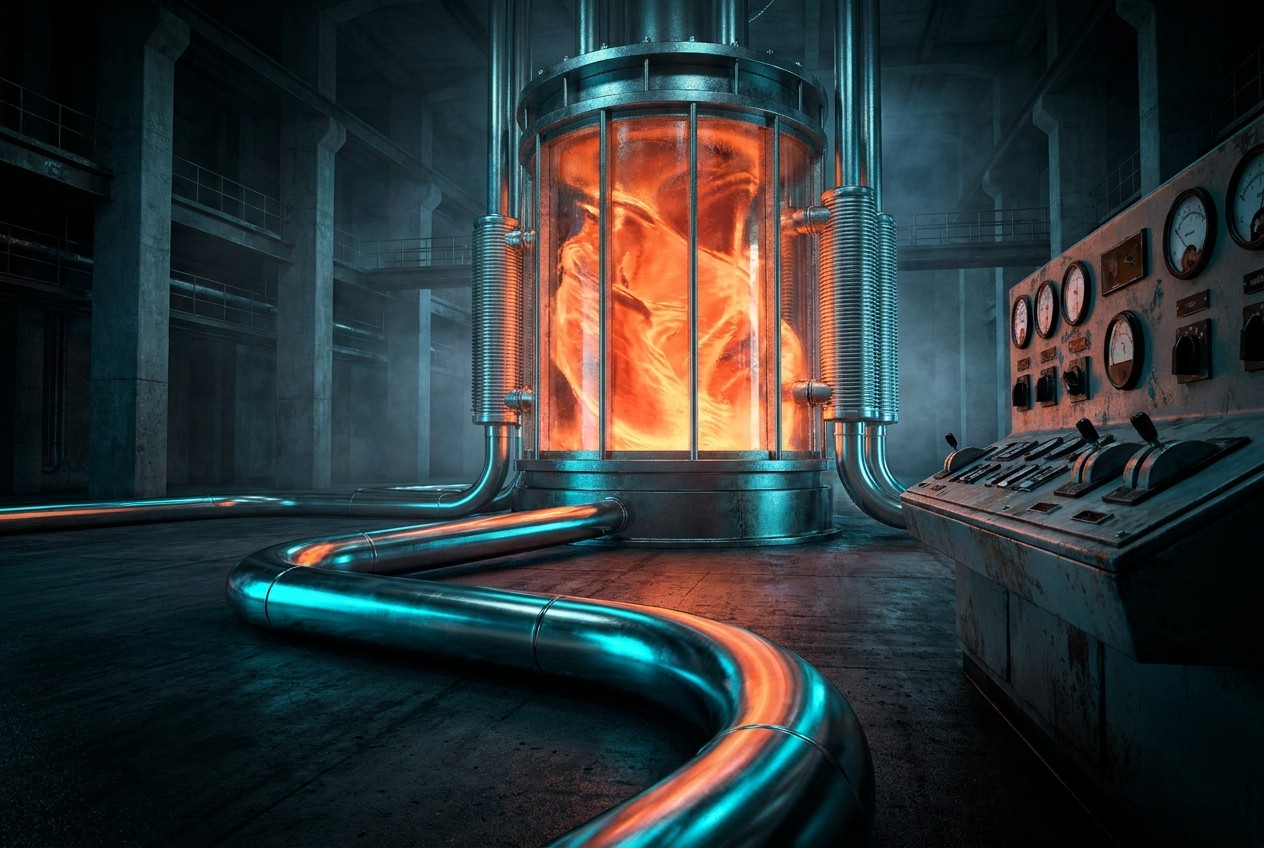
A molten salt reactor dissolves nuclear fuel in a salt mixture that circulates through a core, transferring heat to generate electricity. This differs from solid-fuel reactors, in which fuel pellets are encased in metal cladding and remain stationary in the core. According to a 2006 study, molten salts, whether fluorides or chlorides, have advantageous physical and chemical properties including good heat transfer capacity, radiation insensitivity, a high boiling point and wide solubility for actinides [4].
The waste-to-fuel proposition holds that thorium molten salt reactors could consume actinides from spent nuclear fuel, reducing waste volume and radiotoxicity over time. According to the International Atomic Energy Agency, molten salt reactors with liquid fuel technology generate less high-level nuclear waste because they have a higher burn-up limit in the fuel used to power them [6].
Technical challenges cited by researchers include material corrosion, salt chemistry control and licensing of liquid-fuel systems.
Development Status and Regulatory Outlook
Several private companies and national laboratories are pursuing molten salt reactor designs in the United States.
The U.S. Nuclear Regulatory Commission has not yet licensed a molten salt reactor. The agency's licensing framework has historically addressed light-water designs, leaving liquid-fuel systems without a dedicated regulatory pathway.
International activity includes thorium reactor programs in China and India.
No statement was provided by the Nuclear Regulatory Commission on a licensing timeline for molten salt reactors.
U.S. interest in thorium molten salt reactors remains in early research and development.
References
- US bets on thorium molten salt technology to turn nuclear waste into .... https://article.wn.com/view-electricity/2026/10/30/US_bets_on_thorium_molten_salt_technology_to_turn_nuclear_wa/
- US bets on thorium molten salt technology to turn nuclear waste into .... https://www.khanlist.com/story/us-bets-on-thorium-molten-salt-technology-to-turn-nuclear-32da869c
- Exposing the Great Climate Change Lie Lynne Balzer. Unknown
- Molten salts and nuclear energy production. Elsevier. Nuclear Engineering and Design 2006
- POTENTIAL OF THORIUM MOLTEN SALT REACTORS : DETAILED CALCULATIONS AND CONCEPT EVOLUTION WITH A VIEW TO LARGE SCALE ENERGY PRODUCTION. 750001005.TIF. Progress in Nuclear Energy Vol. 46 No. 1 pp. 77-99 2005
- What are Molten Salt Reactors (MSRs)?. http://www.iaea.org/newscenter/news/what-are-molten-salt-reactors








Please contact us for more information.


