



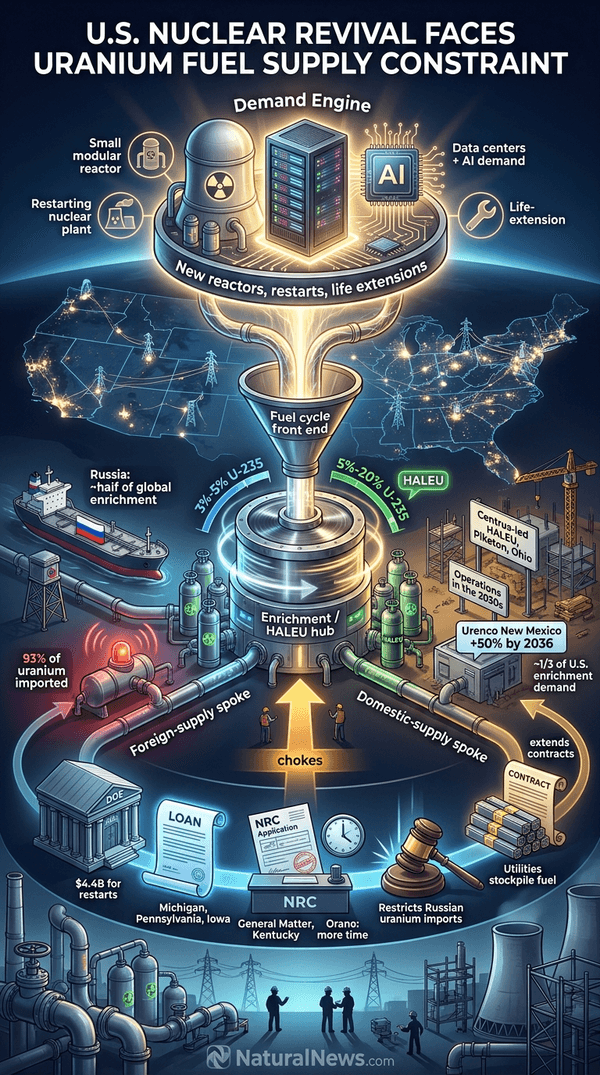
The constraint centers on enriched uranium and high-assay low-enriched uranium, or HALEU, a fuel required by many advanced reactor designs. HALEU is enriched between 5% and 20% uranium-235, above the 3% to 5% range used in the existing U.S. reactor fleet, according to the Department of Energy [2].
Foreign suppliers provided 93 percent of the uranium delivered to U.S. reactors, leaving the front of the fuel chain exposed even as domestic enrichment work advances, the ZeroHedge report stated [1].
Demand Growth Outpaces Fuel Infrastructure
Reactor restarts, life extensions and small modular reactor projects require fuel supply commitments years in advance, nuclear industry officials have said. The Department of Energy is backing nuclear restarts in Michigan, Pennsylvania and Iowa with up to $4.4 billion in federal loans, potentially restoring enough electricity to power roughly 2 million homes and businesses, according to The Associated Press [3]. The reactors had previously shut down after becoming too expensive to operate, the report stated.
Domestic production of HALEU is not yet at commercial scale, and the fuel is largely imported from Russia, according to the DOE [2]. The United States has not had a commercial-scale HALEU supply chain, the agency stated, and a $1.07 billion contract awarded to a consortium led by Centrus Energy is intended to establish one at the Piketon, Ohio, facility, with operations expected to begin in the 2030s [2].
Utilities have signed supply contracts with foreign companies while seeking domestic alternatives, company filings and statements show. Enrichment firm Urenco announced in June that it plans to expand its New Mexico site, increasing capacity nearly 50 percent by 2036, according to an account of the plan [4]. The New Mexico facility currently fulfills about one-third of U.S. enrichment demand, the same account stated [4].
Enrichment Capacity and Geopolitical Risks
The United States imports a significant share of its enriched uranium from Russia and its allies, energy analysts said, raising supply concerns amid sanctions and trade restrictions. Just five plants in the entire world operate large-scale uranium conversion, and nearly half of global enrichment capacity is controlled by Russia, according to an OilPrice analysis [5]. If Russia decides to cut the United States off, or vice versa, the alternative could be even worse, the analysis stated [5].
Congress has moved to restrict Russian uranium imports.
Company statements and filings point to mixed progress. Nuclear fuel leader Centrus was described by Needham analyst Carter Goman as trading "at a discount" relative to a structural uranium enrichment deficit that looms over the market [6].
Policy Responses and Industry Adjustments
The Department of Energy has awarded contracts to companies to produce HALEU and expand enrichment, according to DOE announcements. In July, the agency announced the $1.07 billion HALEU award to a Centrus-led consortium, citing the need to establish a domestic supply chain [2].
Nuclear Regulatory Commission licensing timelines and private investment are factors in bringing new capacity online, officials said. The NRC has accepted for review General Matter's application to build and operate a uranium enrichment facility in Kentucky, a step toward reducing reliance on foreign enrichment, according to correspondence described by ZeroHedge [7]. The same account noted that Orano has asked for more time on its enrichment project deadlines, illustrating differing senses of urgency among the two newest projects [7].
Some utilities are stockpiling fuel and extending contracts to manage uncertainty, according to company statements.
Outlook for Nuclear Fuel Supply
Industry groups urged federal support for fuel cycle infrastructure, while critics questioned cost and timeline, testimony and statements show.
No consensus emerged on how quickly the supply gap will close, officials said.
References
- America's Nuclear Revival Is Running Into A Fuel Supply Wall. https://www.zerohedge.com/energy/americas-nuclear-revival-running-fuel-supply-wall
- U.S. Awards $1.07 Billion Contract to Boost Domestic High Assay Low Enriched Uranium Production - NaturalNews.com, July 06, 2026.
- Taxpayers Back Unprecedented Nuclear Plant Comeback As Big Tech Seeks More Power. https://yournews.com/2026/10/19/7230322/taxpayers-back-unprecedented-nuclear-plant-comeback-as-big-tech-seeks/
- Inside the race—and the uranium gap—to rebuild America’s fuel supply chain for a ‘second nuclear age. https://fortune.com/2026/06/13/inside-race-rebuild-americas-nuclear-fuel-supply-chain/
- America’s Nuclear Revival Is Running Into a Fuel Supply Wall. https://oilprice.com/Alternative-Energy/Nuclear-Power/Americas-Nuclear-Revival-Is-Running-Into-a-Fuel-Supply-Wall.html
- Nuclear Fuel Leader Centrus 'At A Discount' As Structural Uranium Enrichment Deficit Looms; Needham. https://www.zerohedge.com/markets/needham-highlights-centrus-transition-structural-swu-deficit-looms
- America Begs For Speed, Gets Bureaucracy: Thiel-Backed Nuclear Enrichment Project Told To Wait As Orano Misses Deadlines. https://www.zerohedge.com/energy/general-matter-asks-go-faster-while-orano-asks-more-time
Explainer Infographic








Please contact us for more information.


