


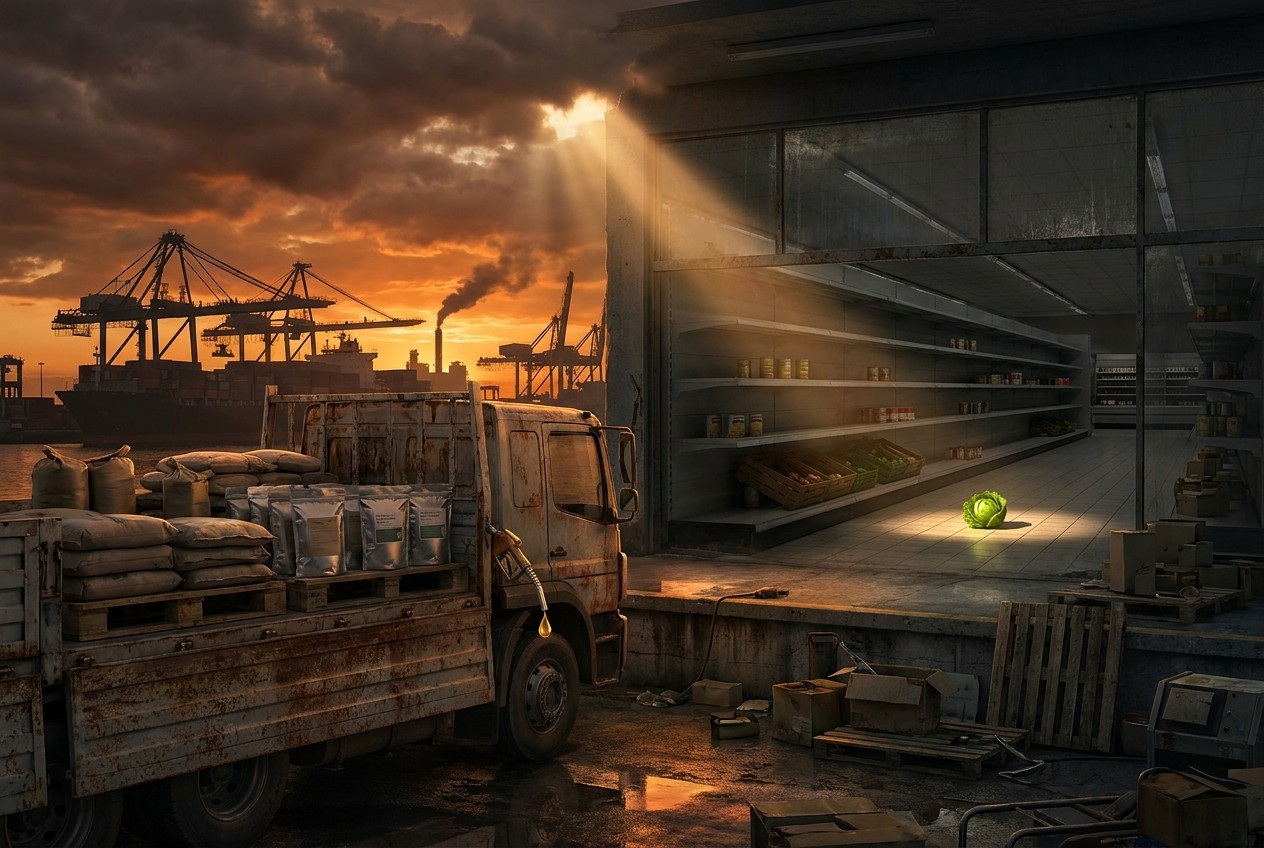
Wholesale Food Costs Are Skyrocketing
I walked out of a product acquisition meeting for my managers at Health Ranger Store last week, and the numbers on the table were worse than anything I expected to see this year. The cost of shipping a single unit of freeze-dried blueberries in wholesale quantities has jumped from the $50 to $60 range up to $80 to $90, and several of our suppliers are now offering us drastically less inventory than they did just months ago. One supplier that used to quote us 250 pallets of cacao powder now has only 35. Alarm bells are sounding about the food supply at the wholesale level.
The pattern repeats across nearly every category we buy: freeze-dried fruit, organic cacao, storable grains, nuts, seeds and honey. When a supplier's available inventory collapses by more than 80 percent in a matter of months, you are no longer looking at a temporary hiccup. You are looking at physical scarcity arriving at the wholesale level, which means it is already on its way to every grocery store shelf in America.
In my assessment, this is only the beginning. The prices you are paying for food right now represent the lowest prices you will see for years to come. I made this case in late September 2026 when I warned that a global food shock is coming by 2027, and nothing I have seen since has softened that conclusion. If anything, the situation has gotten worse.
Diesel, Refineries, and the Shipping Cost Shock
Diesel is the bloodstream of the modern food system, and that bloodstream is being squeezed dry. National average diesel prices have exceeded $6 per gallon, with regular gasoline hovering above $4.20, driven by a global refining squeeze tied to the Iran conflict and Ukrainian strikes on Russian refineries.
The White House has even explored invoking the Defense Production Act -- a tool never before used for refining capacity -- to expand domestic fuel production. [1] Diesel prices are hovering near a record $6.45 per gallon on average, according to the American Automobile Association (AAA). [2] Every gallon of diesel that powers a tractor, a refrigerated truck or a cargo ship is a gallon whose cost is baked into the price of every loaf of bread, every chicken breast and every bag of rice.
The refinery bottleneck is not a political problem that can be solved with a press conference. It is physical. We cannot simply conjure more refining capacity out of thin air when the infrastructure has been neglected for decades. President Trump has tried to ease the pain with executive orders expanding access to tax-free red-dyed diesel, [3] and his administration has pushed for a coordinated 100-million-barrel emergency energy release through the G7 that prioritizes diesel during the first 20 days. [4] These are real interventions, but they are palliative measures applied to a structural wound. As I have documented before, the war-driven price shocks we are seeing are not a spike -- they are a ratchet.
When shipping costs rise, they do not retreat to their old levels. They become the new baseline. Trucking companies, freight forwarders and food manufacturers all pass those costs down the line until they land on the consumer at the checkout counter. And with the U.S. freight economy already shedding jobs -- about 1,850 workers were cut across 15 companies in transportation, logistics and food manufacturing in a single recent round [5] -- the pressure on the system is compounding from every direction at once.
Fertilizer, War, and the Strait of Hormuz
The fertilizer supply chain remains cramped because the war with Iran and the disruption around the Strait of Hormuz have strangled the shipping lanes that carry the inputs farmers need for spring planting. American farmers are ringing alarm bells, warning that the closure of the Strait of Hormuz could trigger a cascading crisis in agriculture and food supply, with fertilizer stuck in disrupted shipping lanes while food prices are already rising -- up 3.1 percent in the 12 months ending February 2026. [6] Modern industrial agriculture relies on diesel for machinery and transport and natural gas as a feedstock for nitrogen fertilizers. When those two inputs become expensive or unavailable, farmers in the U.S. Midwest and the Brazilian Cerrado reduce planting, setting the stage for a multi-year food shortage. [7]
This creates an ugly feedback loop that feeds on itself. Natural gas is the primary feedstock for nitrogen fertilizer, so fuel scarcity feeds directly into crop scarcity. Farmers who cannot afford to fertilize their fields do not simply produce less -- they produce dramatically less, because modern crop yields depend on inputs that have now become prohibitively expensive or physically unavailable. The war in Iran has been escalating for months, and every escalation tightens the noose around global food production.
President Trump's suggestion that the war will end after the midterms is not credible. If he could end it, he would end it now. The conflict has already stretched through multiple ceasefires and escalations, and the economic warfare being waged against Iran -- including Treasury Secretary Scott Bessent's warnings about countries that continue doing business with Tehran -- threatens to blow up the global financial system itself. [8] I expect this conflict to stretch into 2027 and beyond, and with it, the fertilizer crisis that is strangling the world's ability to grow food. As I wrote earlier this year, the avalanche of price hikes has already begun, and the war's chokehold on humanity continues to tighten even during periods of supposed ceasefire. [9]
Global Famine Risk and America's Empty Shelves
The people who will suffer first and worst are subsistence farmers in Africa, Southeast Asia and South America. These are human beings who farm to eat, not to trade, and when the cost of fertilizer and diesel exceeds what they can earn from their harvest, many will simply not plant at all. Others will have no choice but to charge double or more for whatever they manage to grow. This is not an abstraction. The U.S. cattle herd has already plummeted to just 2 million head, the lowest level since 1952, driving ground beef prices to a record $6.10 per pound -- a 50 percent increase since 2014. [10] If that is what is happening in the wealthiest nation on Earth, imagine what is unfolding in countries where farmers have no safety net at all.
JPMorgan has warned that the next global food crisis may already be taking shape, driven by what its analysts describe as five forces: War, Weather, Warehousing, Water and Waste. [11] UBS analysts have similarly concluded that global food inflation will be structurally higher than its pre-pandemic average. [12] AARP's analysis found that one in eight Americans aged 50 to 64 now lives in poverty, with the poverty rate higher for those 65 and over at 15.4 percent and nearly 17 percent for women. [13] These are not just statistics. These are our parents, our neighbors and our grandparents, and they are being pushed to the edge by a system that the establishment media and the White House keep telling us is fine.
I believe global food inflation could average more than 25 percent in the next year, with some foods rising 50 percent or even 100 percent, while America will see missing items and much higher prices rather than totally empty shelves. The establishment media has downplayed this crisis because admitting the war is not over would expose their lies. Food security will not be there in 2027.
The consolidating grip of a handful of giant food corporations on our food supply is a major part of why this crisis is so severe. Consolidation within the food industry has given a limited number of corporations enormous power to make decisions about what food is produced, how, where and by whom, and who gets to eat it. [14] U.S. farmers have also been hammered by free trade policies that fail to protect domestic production. As Walden Bello documented in his analysis of the global food system, liberalization without infrastructure support has devastated farmers in developing countries. [15]
Meanwhile, corporate agribusiness consolidates power while telling the public that abundance is just around the corner. The real cost of cheap food is now coming due, and corporate agribusinesses like Cargill, ADM and Bunge have historically profited handsomely during the very food crises that devastate consumers -- with profits surging during the 2007-2008 crisis even as global hunger exploded. [16]
Prepare Now: Grow Food, Stack Supplies, Reject Complacency
I am not just saying this to sell food. I think Health Ranger Store will sell out of its buckets sometime in 2027 because we are tiny compared to the need that is coming. When the shelves in mainstream grocery stores start showing gaps, people will remember the warnings they laughed off. Buying supplies in bulk is a smart play, as it allows a prepper to save money while also ensuring they have what they need in an emergency. [17] The time to prepare is now, not when the shelves are empty.
My advice is simple and practical. Grow whatever you can. If you have a yard, dig it up and plant food. If you have a balcony, fill it with pots. If you have a window, use it. Plan a fall crop now, and sprout seeds in the meantime -- sprouting is one of the cheapest and fastest ways to produce fresh nutrition in your own kitchen, regardless of the season. But beyond growing food, you need to think about personal financial resilience. I expect big trouble ahead for the U.S. economy, and those who hold physical assets -- including the most honest forms of money, gold and silver -- are best positioned for what is coming. [18]
Self-reliance and personal preparedness are not paranoia -- they are the only rational response to a global food system that is breaking down. There are people who have already learned the skills of growing abundant food with minimal space and effort, and these are the people who will feed their families and their neighbors when the system fails. [19]
This is why a decentralized food system -- one that returns power to the individual through personal liberty, economic freedom and self-sufficiency -- is the only sustainable path forward. If you want to learn more about food freedom, check out BrightLearn.ai, the free book library created there by over 15,000 authors. For uncensored health and freedom news, visit NaturalNews.com. And to find clean, lab-verified storable foods and superfoods that I personally consume, visit HealthRangerStore.com.
References
- Trump weighs emergency powers as diesel tops $6, threatening economy ahead of midterms. 2026-09-15T06:00:00.000Z. https://www.naturalnews.com/2026-09-15-trump-weighs-emergency-powers-diesel-tops-6.html
- What a US diesel export ban could mean for youThe threatened proposal aims to protect US consumers from rising costs, but it could trigger major economic waves if it were to happen.19 hrs agoBusiness. 2026-09-29T13:01:13.186Z. https://bbc.com/news/articles/cky9z3r00l9eo
- BREAKING: President Trump Signs Executive Order to Expand Access to Tax-Free Diesel. 2026-10-06T00:22:05.000Z. https://100percentfedup.com/breaking-president-trump-signs-executive-order-expand-access/?utm_source=rss&utm_medium=rss&utm_campaign=breaking-president-trump-signs-executive-order-expand-access
- President Trump Forces G7 Into 100-Million-Barrel Emergency Release As Diesel Prices Soar. 2026-10-03T15:24:20.135Z. https://100percentfedup.com/president-trump-forces-g7-100-million-barrel-emergency/
- Freight Distress Report: Logistics, manufacturing cuts put 1,850 jobs on chopping block. 2026-09-28T18:53:00.000Z. https://www.freightwaves.com/news/freight-distress-report-logistics-manufacturing-cuts-put-1850-jobs-on-chopping-block
- Fertilizer Bottleneck at Hormuz Raises Risk of Food Inflation and Worsening Global Hunger. 2026-03-17T18:50:18.000Z. https://thenewamerican.com/us/fertilizer-bottleneck-at-hormuz-raises-risk-of-food-inflation-and-worsening-global-hunger/
- Analytical Report Global Ramifications of US Invasion and Occupation of Venezuela 2026 - NaturalNews.com, January 06, 2026. by NaturalNews.com
- Bessent Suggests Economic Warfare Against Iran Could ‘Blow Up the Global Financial System’. 2026-09-26T13:00:00.000Z. https://activistpost.com/bessent-suggests-economic-warfare-against-iran-could-blow-up-the-global-financial-system/
- Trumps Ceasefire is a Smart Retreat But the Wars Chokehold on Humanity Tightens - NaturalNews.com, April 22, 2026. by NaturalNews.com
- US beef industry in crisis Record prices shrinking herds and mounting pressures on ranchers - NaturalNews.com, February 17, 2026. by NaturalNews.com
- "Won't Be Short-Lived": JPMorgan Warns Next Global Food Crisis Could Erupt Next Year. 2026-08-15T22:05:00.000Z. https://www.zerohedge.com/commodities/wont-be-short-lived-jpmorgan-warns-next-global-food-crisis-could-erupt-next-year
- End Of Cheap Food? Five Forces Set To Drive Grocery Bills Even Higher. 2026-08-06T03:00:00.000Z. https://www.zerohedge.com/markets/end-cheap-food-five-forces-set-drive-grocery-bills-even-higher
- Poverty Rate Among Older Adults Rises for Fifth Straight Year, AARP Analysis Finds. 2026-09-26T06:00:00.000Z. https://www.naturalnews.com/2026-09-26-aarp-poverty-rate-seniors-rises-fifth-year.html
- How a Few Big Food Companies Control What You Eat. https://childrenshealthdefense.org/defender/big-food-companies-control-what-you-eat/
- The Food Wars. by Walden Bello
- The real cost of cheap food. by Carolan Michael S
- Prepping for the long-term Why its smart to buy supplies in bulk - NaturalNews.com, March 23, 2019. by NaturalNews.com
- Brighteon Broadcast News - The TIMELINE Of Coming ATTACKS - Mike Adams - Brighteon.com, July 16, 2024. by Mike Adams - Brighteon.com
- Mike Adams interview with Marjory Wildcraft - April 17 2025. by Mike Adams
- ‘100% Not in Line’ With MAHA: USDA Cuts to Critical School Lunch, Local Farm Programs Put Kids at Risk. https://childrenshealthdefense.org/defender/usda-cuts-school-lunch-farms-kids-health-maha/
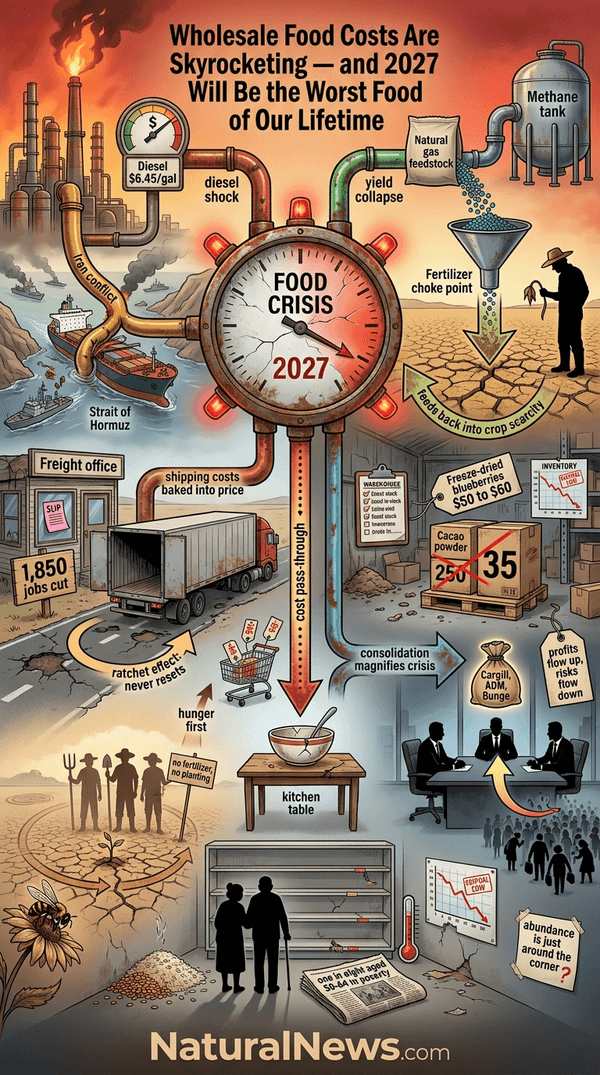
Explainer Infographic
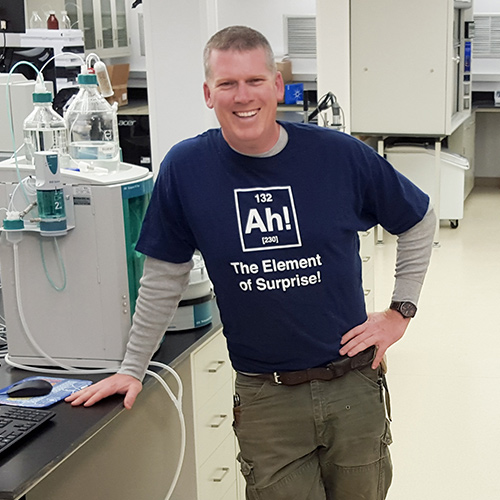
Mike Adams (aka the "Health Ranger") is the founding editor of NaturalNews.com, a best selling author (#1 best selling science book on Amazon.com called "Food Forensics"), an environmental scientist, a patent holder for a cesium radioactive isotope elimination invention, a multiple award winner for outstanding journalism, a science news publisher and influential commentator on topics ranging from science and medicine to culture and politics.
Mike Adams also serves as the lab science director of an internationally accredited (ISO 17025) analytical laboratory known as CWC Labs. There, he was awarded a Certificate of Excellence for achieving extremely high accuracy in the analysis of toxic elements in unknown water samples using ICP-MS instrumentation.
In his laboratory research, Adams has made numerous food safety breakthroughs such as revealing rice protein products imported from Asia to be contaminated with toxic heavy metals like lead, cadmium and tungsten. Adams was the first food science researcher to document high levels of tungsten in superfoods. He also discovered over 11 ppm lead in imported mangosteen powder, and led an industry-wide voluntary agreement to limit heavy metals in rice protein products.
Adams has also helped defend the rights of home gardeners and protect the medical freedom rights of parents. Adams is widely recognized to have made a remarkable global impact on issues like GMOs, vaccines, nutrition therapies, human consciousness.






Please contact us for more information.


