
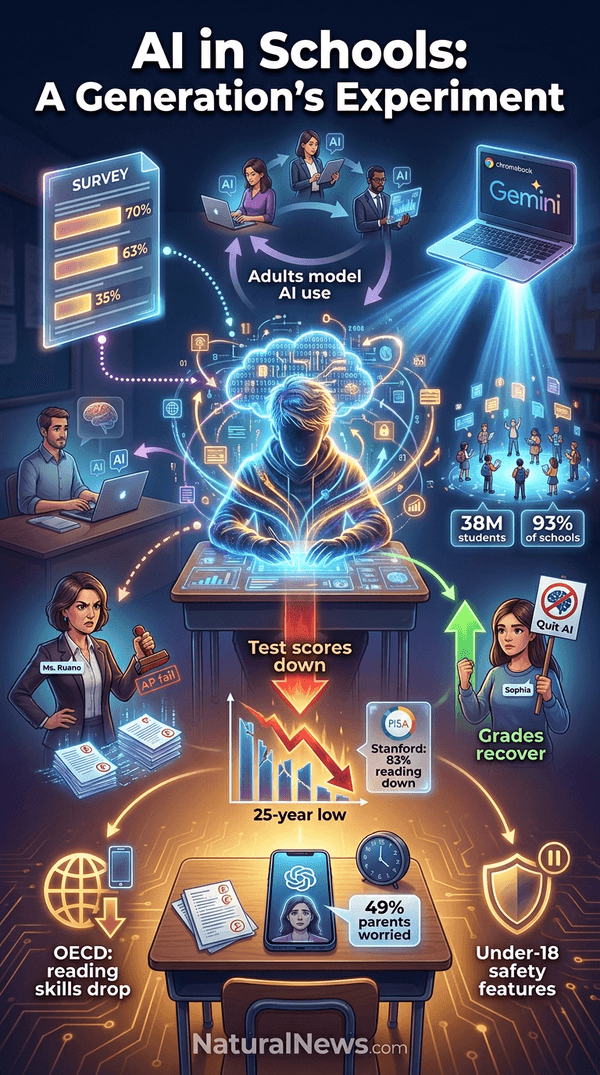
The survey found that 63% of teens said they use AI to get answers, while 35% said they use it to fix or improve an answer they already know, according to the report. The findings were released as Google pushes to increase use of its Gemini AI on school-issued Chromebooks, which WSJ reported are used widely in U.S. classrooms.
The release of the survey coincided with data showing declines in national and international test scores. Student scores last year dropped to the lowest level in 25 years on the 2025 Program for International Student Assessment, according to the report [1].
A separate Deloitte back-to-school survey found that 49% of parents said they were worried their children rely on AI too much, while 35% of respondents said they were concerned schools are not doing enough to prepare students for AI, according to the survey [1]. OpenAI has also introduced new safety features for under-18 users, including removing human-voice responses and adding reminders for young people to take breaks from the tool, according to BBC News [2].
Classroom Reports and Test Score Declines
Richard Scott, a 15-year-old from Pennsylvania, told WSJ that AI use slowed his thinking and that he struggled on a test when he could not use AI. Scott said his algebra test scores dropped after he used an AI search tool on his school-issued laptop; he received mostly B's during the year but failed his final, according to WSJ.
Kaitlyn Ruano, an Advanced Placement Art History teacher in Miami, Florida, said top students' test scores plunged after her school district made Google's Gemini chatbot available to all high-schoolers last year. Ruano said she was surprised when a much larger number of students than she expected failed the AP test, including ones who had been getting A's and B's in class.
"I had kids come to class after saying, 'Miss, I had no clue what half the material was, I'm not going to lie to you. I've been using AI all year,'" Ruano said, according to WSJ. Sophia Chatzigianni, a 15-year-old from Fairfax County, Virginia, said her Human Geography and Algebra grades dropped after she used AI shortcuts on her school-issued laptop. She said her grades improved after she quit using AI on assignments, according to WSJ.
Google Chromebooks and AI Expansion
Google is pushing to increase use of its Gemini AI on school-issued Chromebooks, which have become common in U.S. classrooms, according to the report. ChromeOS serves more than 38 million K-12 students globally, according to the technology and education website ommandlinux.com.
The report stated that 93% of schools were planning to buy Chromebooks this year, and that education accounted for more than 60% of Chromebooks' global market share in 2025, according to ommandlinux.com.
A Google spokeswoman told WSJ that studies show AI tools paired with teacher-led instruction can improve student learning. "Teachers around the world use our technology every day because it solves real classroom challenges and helps improve learning outcomes," she told WSJ. The media outlet reported that Google researchers have said AI can pose risks to children, who may struggle to distinguish chatbots from human interaction.
Researcher Concerns and International Test Data
Mikel Rodriguez, a former Google research scientist who left the company last year, told WSJ that the long-term effects of widespread AI use on learning are uncertain. "We're doing this experiment on an entire generation on cognitive development, with no control group," Rodriguez said. "It's really uncertain what that's going to lead to in terms of learning."
The Organization for Economic Cooperation and Development said AI and smartphone use have contributed to a drop in reading skills worldwide, according to the report. Student test scores last year dropped to the lowest in 25 years on the 2025 Program for International Student Assessment, the report stated.
A May report from the Educational Opportunity Project at Stanford found reading scores down in 83% of U.S. school districts and math scores down in 70%, regardless of wealth and racial demographics, according to the data cited in the report. Yvette Renteria, chief program officer at Common Sense Media, said AI is working against critical thinking and curiosity, according to the report. "You can imagine a young person seeing mom use AI, seeing teachers use it, seeing leaders use it, and thinking, 'Oh, that's justifiable, it's fine, it's safe. Everybody else is using it,'" Renteria said, according to WSJ.
Conclusion
The survey and interviews present a range of perspectives on AI in education, including reports of lower test scores from teachers and students and statements from Google that AI can support learning when paired with teacher-led instruction, according to the sources.
Google's Chromebook and ChromeOS expansion continues, with the company reporting more than 38 million K-12 students served globally, according to the report. National and international test scores remain below prior levels, according to the data cited in the report.
The debate continues as schools expand access to AI tools and as parents, teachers and researchers report concerns about cognitive development and academic performance, according to the sources. Common Sense Media is a nonprofit organization that produces research and ratings on media and technology, according to the report.
References
- Many Parents Now Worried Their Kids Rely On AI Way Too Much. yournews.com. July 10, 2026.
- OpenAI makes ChatGPT less 'human' for teens in new safety update. BBC News. August 18, 2026.
- Today's Kids Are Caught in a Dangerous Digital Trap. What Can Parents Do? Children's Health Defense.
- Social media bans and digital curfews to be trialled on UK teenagers. BBC News. March 24, 2026.
- Roberta Berns. "Child family school community".
- Neil Gillman. "The way into encountering God in Judaism".
- Elsevier. "Metacognition in computation: A selected research review". Artificial Intelligence 173 (2005) 97-124.
Explainer Infographic











Please contact us for more information.