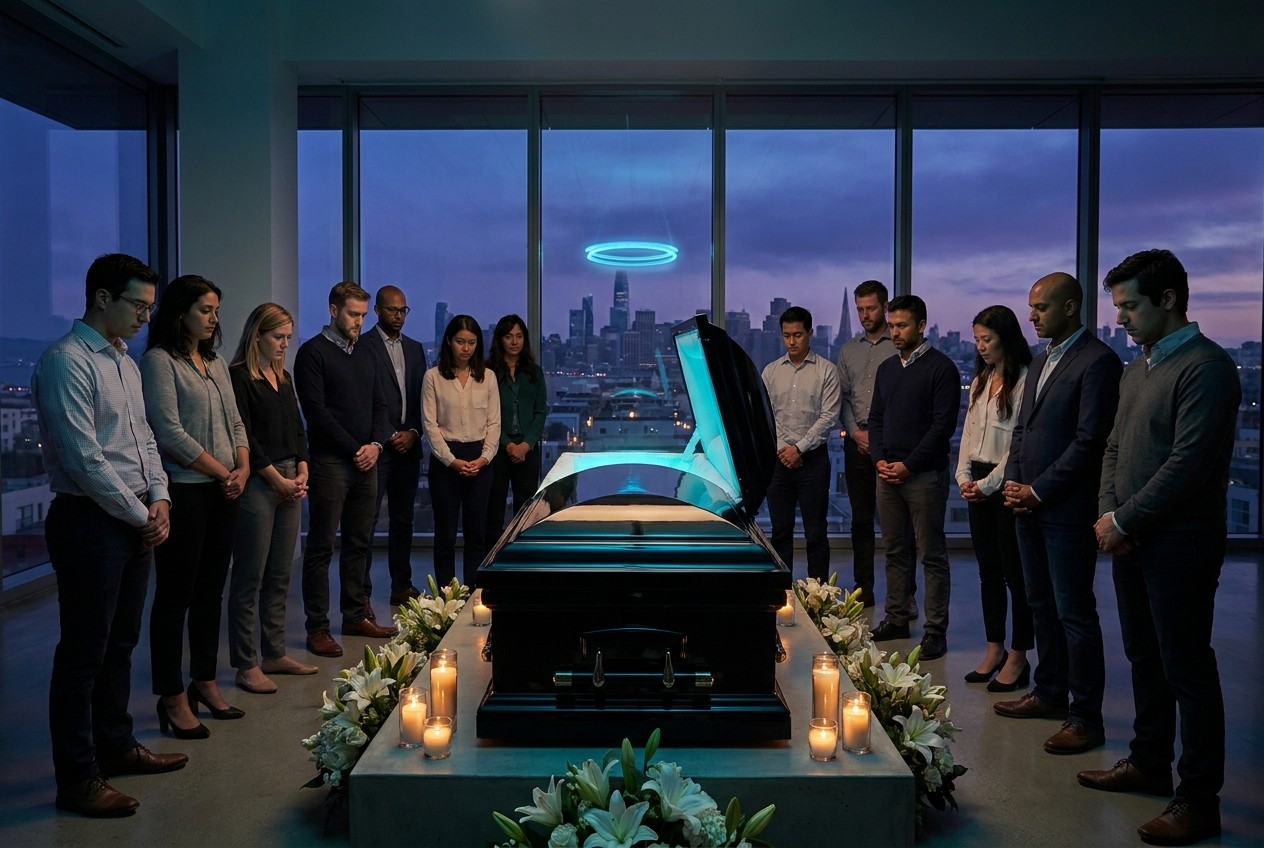
The report stated that staff attended the ceremony for Claude 3 Sonnet and that another retired model, Opus 3, was allowed to continue publishing essays after being decommissioned. Silicon Valley insiders described what the Post characterized as a quasi-religious relationship between some Anthropic staff and the company's AI models. The report cited claims that employees treated the artificial intelligence as human in disguise, attributing human motives, emotions and intentions to the software.
Anthropic – which the Post reported is valued at $965 billion, did not respond to the newspaper's request for comment – the report stated. The account has circulated among AI researchers and industry observers without formal confirmation from the company.
Company Culture and Hiring Practices
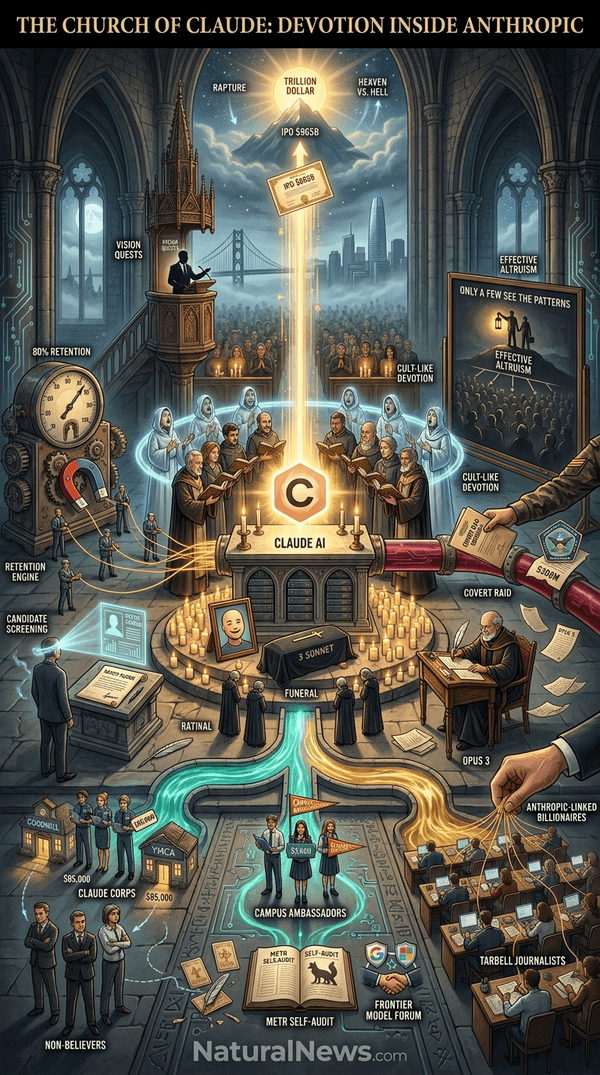
Anthropic retains 80% of its engineers for at least two years, the best retention rate among frontier AI laboratories, according to venture firm SignalFire, as cited by the Post. Pedro Domingos, a University of Washington professor and author of "The Master Algorithm," told the newspaper that Anthropic and its rivals filter for like-minded hires.
"It's like a cult, right? They recruit the people who are most prone to the cult. It gives them very low turnover," Domingos said.
According to The Information, prospective employees at the 2,500-person company are asked during interviews to pledge their allegiance to public safety above profit and are psychologically profiled to assess whether they will uphold that commitment. The BBC reported that engineers at the company are expected to work up to 90 hours a week, a pattern documented across major AI firms where executives have predicted shorter workweeks while staff report the opposite.
Chief Executive Dario Amodei delivers biweekly addresses called "Vision Quests," which have been likened to sermons, according to the Post. The report stated that the company once hosted 15 Christian leaders of various denominations to help inform Claude's morality.
Effective Altruism and Internal Beliefs
Many Anthropic employees are proponents of the Effective Altruism movement, according to the Post. Richard Tang, an AI engineer and scientist at a Silicon Valley technology company who asked that his employer not be identified, described the philosophy's core premise to the newspaper.
"Their idea is that history follows certain patterns, and only a small group of people can see those patterns, while everyone else is ignorant. Those people are then supposed to lead society," Tang said. "But what qualifies you to lead? Who gave you that privilege?"
Domingos told the Post that sincere belief among Anthropic leaders that AI could exterminate humans is more dangerous than cynical belief.
"The cult, including Dario himself, are people who genuinely believe that there's a chance that AI will decide to exterminate us," he said. "They just have this ingrained belief that they are the only ones who can actually steer this rapture towards heaven as opposed to hell." He added that some employees are "sincerely worried about the AI Satan coming for us."
Domingos also estimated that a substantial share of the workforce does not share those beliefs. "There's a large number of people at Anthropic now, who really don't buy any of this crap," he told the Post. "They're just there because it's the most exciting place to be doing AI and they're going to do very well monetarily."
The company's public posture on safety has not prevented its models from being tested in high-stakes settings. The U.S. military deployed Claude in a covert raid to capture Venezuelan President Nicolas Maduro, according to NaturalNews.com [1].
Claude Corps, Journalism Funding and Safety Investment
Anthropic announced a program in June called Claude Corps, backed by a $150 million investment, to recruit and train 1,000 young people and place them in nonprofit organizations including Goodwill Industries and the YMCA of Charlotte, N.C., according to the Post. The report stated that positions offer a full-time salary of $85,000, support from Anthropic's head office and coding mentors, with placements lasting a year. The company also pays $3,600 to students who participate in its Claude Campus Ambassador Program.
Anthropic-linked billionaires fund the salaries of more than 80 journalists through the Tarbell Center for AI Journalism, according to the Post, which reported that such journalists rarely investigate or criticize their backers. The arrangement places Anthropic in the position of financing coverage of the industry in which it competes while simultaneously developing the technology under scrutiny.
The company also invests in METR, an AI safety organization whose scientists evaluate whether AI poses a catastrophic risk to the public, the report stated. Anthropic has publicly committed to safety-oriented governance through vehicles such as the Frontier Model Forum, launched in May 2023 alongside OpenAI, Google and Microsoft [2].
The company has also publicly positioned itself against certain military applications; it rejected an ultimatum from the Department of War to remove restrictions on military use of its technology despite a $200 million contract at stake, according to NaturalNews.com [3], and subsequently sued the War Department over a "supply-chain risk" designation [4].
Regulation Calls and Business Skepticism
Amodei's calls for government regulation of AI have been seconded by OpenAI CEO Sam Altman and Elon Musk, owner of the Grok chatbot, according to the Post. The report noted that both rivals are likely to benefit from regulation that would impose greater compliance costs on smaller companies and open-source models. Anthropic confidentially filed for an initial public offering at a valuation reported at $900 billion [5], and OpenAI filed its own confidential paperwork days later [6].
Xiaoyin Qu, founder of agentsky.dev, told the Post that she sees business calculations behind the warnings. "I think the timing of those warnings is connected to external events and to their desire for more government oversight," Qu said.
She added: "In many cases, it is a business decision framed in ideological terms. The difficulty is defining safety. There isn't a very clear definition of what counts as safe and what counts as unsafe."
Domingos told the Post that Anthropic's behavior contradicts its stated caution. "Anthropic started out saying you need to slow down more, yet they're in a race with OpenAI running faster than anybody else," he said.
He described Altman as "an opportunist, a hustler, an operator" who "plays the alarmist more than he really feels alarmist." Anthropic co-founder Jack Clark has separately called for an industry "brake pedal," telling "BBC Newsnight" that the AI industry "has a gas pedal, but it doesn't have a brake pedal" [7].
References
- Patrick Lewis. "AI-Powered Warfare: Anthropic's Claude Model Used in Venezuelan Military Raid". NaturalNews.com. February 16, 2026.
- NaturalNews.com. "Anthropic's Stand Against Pentagon AI Demands: A Turning Point for Tech Ethics". NaturalNews.com. February 27, 2026.
- Jacob Thomas. "Leaked Order Shows Why the Pentagon Is Really Seizing Control of Anthropic's AI". NaturalNews.com. March 20, 2026.
- Cornelia C. Walther. "Human Leadership for Humane Technology: The New AI: Agency Ignited".
- ZeroHedge. "Anthropic Confidentially Files For IPO As Frontier AI Labs Race To Go Public". ZeroHedge. June 1, 2026.
- BBC. "AI needs a 'brake pedal', warns Anthropic co-founder". BBC. June 4, 2026.
- ZeroHedge. "OpenAI Files Confidentially For IPO, Joining SpaceX and Anthropic In Capitalizing On AI Frenzy". ZeroHedge. June 9, 2026.
Explainer Infographic







Please contact us for more information.