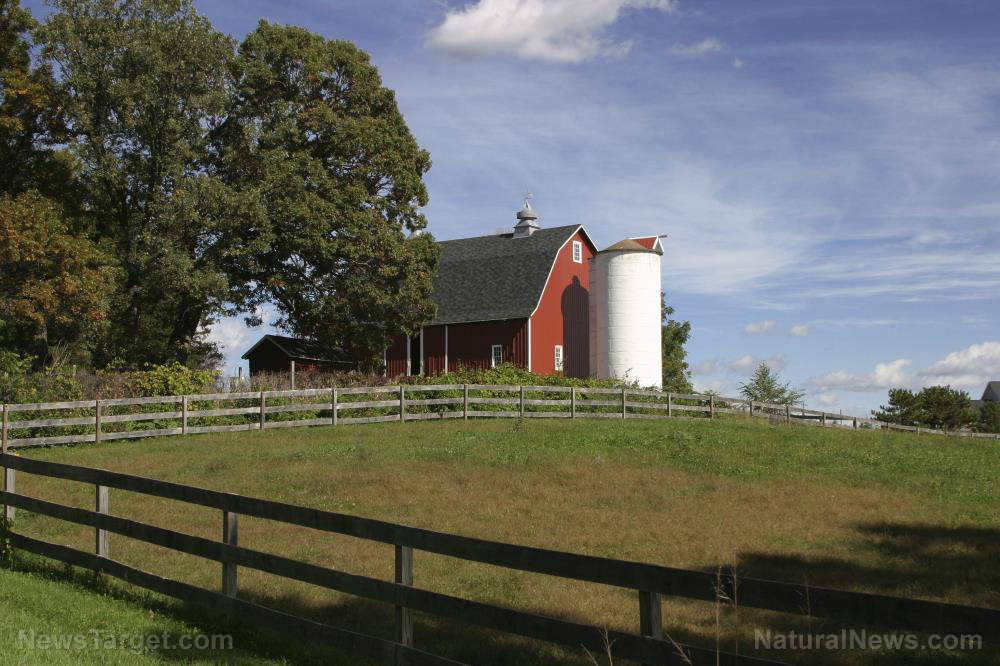
- Joel Salatin advises new farmers to use temporary structures, observe how the land and livestock behave and wait three years before committing to permanent designs.
- Roads, houses, creeks, steep hillsides, wet areas and forests provide the starting framework for determining where infrastructure should go.
- A poorly positioned fence, gate or access lane can disrupt livestock movement and create unnecessary stress and chaos.
- Salatin argues that fences should adapt to the natural contours of the land rather than being forced into straight lines.
- The farm should evolve through observation and experimentation, with animal behavior and terrain providing feedback until the most effective arrangements become permanent.
Brighteon University is streaming an episode a day of "Foundations in Farming and Homesteading + Pastured Laying Hens" from Sept. 26 through Oct. 4, featuring award-winning farmer Joel Salatin's practical guidance on everything from designing a self-reliant homestead to raising productive pastured laying hens. Replays of Episodes 1-4 will be on Oct. 5 and Episodes 5-9 on Oct. 6, followed by the complete course marathon on Oct. 7. Register here to learn how to build smarter farming systems, reduce costs and labor and turn your land and livestock into productive assets for a more resilient future.
What if one of the biggest mistakes a new farmer can make is deciding too quickly where everything should go?
In Episode 2, airing on BrightU on Sept. 27, farmer and author Joel Salatin challenges the instinct to lock a farm into place before the land has had a chance to reveal how it actually works. His advice is striking: build temporarily, watch closely, move things when they fail – and wait three years before making most decisions permanent. A misplaced fence, an awkward gate or an access lane that's just a few feet off can turn routine livestock movement into chaos. But give the landscape time to speak, Salatin suggests and what initially looks like a mistake can become the blueprint for a far more functional farm.
Let the land tell you where things belong
For anyone starting a farm or homestead, the temptation can be overwhelming. Where should the fences go? Where should the gates sit? How should livestock move between paddocks? Where should the barn, lanes, gardens and other infrastructure be placed? Salatin argues that trying to solve every question in advance can become its own trap.
His starting point is deceptively simple: begin with the "givens" – the features that already exist or obviously need to be accounted for. A road, a house, a creek, a steep hillside, a wet area, a forested section. From there, the landscape begins to dictate the design.
But when it comes to everything else, Salatin recommends patience.
"Don't put anything in permanent for three years," he says.
That three-year window becomes a period of experimentation. Temporary fences and movable infrastructure allow farmers to observe how animals actually behave rather than how they imagine animals will behave on a map. A gate that looks perfectly positioned may turn out to create a bottleneck. A fence line that seems logical may force livestock into awkward corners. A seemingly minor adjustment can transform the daily rhythm of an entire operation.
Salatin recounts how livestock movement can quickly expose flaws in a design. Young animals may bunch up in a corner rather than follow the mature animals through a gate. Once stressed, they can rush past the intended opening, turning what seemed like a straightforward move into a chaotic chase.
According to him, sometimes moving an access 10 feet can be all the difference between easy flow and hard flow of livestock. That observation captures the larger philosophy behind the episode. Good design isn't necessarily about imposing perfect geometry on the land. It is about observing movement and adapting to it.
That is why Salatin rejects the assumption that fences should automatically be straight. On a real farm, terrain changes constantly and fencing can work with those contours rather than against them.
"All the fences are crooked. Why? Because they follow the terrain," he points out.
The result is a landscape shaped gradually through experience rather than finalized through speculation. Temporary decisions become experiments. Animal behavior becomes feedback. Terrain becomes a guide. And after three years, the things that have proven themselves can finally become permanent.
Episode 2 presents this approach as more than a fencing strategy. It is a philosophy of working with a landscape rather than attempting to dominate it. The most important design tool may not be a blueprint, a measuring tape or a construction crew – it may simply be time.
Want to know more?
Discover practical strategies for building a productive, resilient homestead and raising pastured laying hens in "Foundations in Farming and Homesteading + Pastured Laying Hens," streaming on BrightU. Led by award-winning farmer Joel Salatin, this nine-episode series takes you step by step through the foundations of self-reliant homesteading, from designing your land and building efficient infrastructure to establishing a productive pastured egg operation. You'll explore practical approaches to housing, fencing, water systems, mobile infrastructure, flock health, pasture management, seasonal production and profitability.
Whether you're new to farming and homesteading or looking to expand your skills, you can purchase the "Foundations in Farming and Homesteading + Pastured Laying Hens" combo package here to get lifetime access to Salatin's practical guidance. The package includes 32 video sessions, more than nine hours of instruction, homework PDFs and complete video transcripts to help you learn, review and apply the lessons anytime.
Watch the trailer for "Foundations in Farming and Homesteading + Pastured Laying Hens" below.
This video is from the BrightU channel on Brighteon.com.
Sources include:




Please contact us for more information.