


As of Aug. 3, the average for 87-octane gasoline stood at $4.09, marking the second consecutive week above the $4 level, according to American Automobile Association (AAA) data cited by ZeroHedge [1]. On July 20, the average was $4.003 after the United States and Iran traded strikes through the weekend, the AAA reported [2].
Iran has kept the waterway closed. On Aug. 8, Iranian officials said the Strait of Hormuz will not be opened until the United States agrees to a list of six demands, according to a statement from the country's Supreme National Security Council [3]. The passage normally carries a significant share of global oil and gas supplies, and its closure has reduced traffic through a key shipping chokepoint.
Tom Kloza, chief oil analyst at Gulf Oil, said: "We're paying more than we've ever paid this time of year. For August, this is pretty high."
Seasonal Patterns and Historical Context
Gasoline prices typically follow a seasonal pattern, rising during the summer driving season and easing in autumn as demand recedes and blending rules shift, according to industry analysts. The current market has been shaped by upheaval in the Persian Gulf.
Average U.S. gas prices surged 56% since the U.S. bombed Iran in late February, reaching $4.517 per gallon in May, according to a NaturalNews report [4]. The Consumer Price Index (CPI) rose 3.8% year over year in April, the largest jump in three years, driven by energy costs [4].
Historical episodes offer a point of comparison. The 1970s double-hump inflation was triggered by the Organization of the Petroleum Exporting Countries' oil embargo in 1973. Even if peace were declared today, markets would still take months to recover, according to Chris Martenson of PeakProsperity.com [5].
The last major U.S. gasoline price spike occurred in 2022 after Russia's invasion of Ukraine, when the national average peaked above $5 per gallon. By Aug. 12, 2022, AAA data showed the average at $3.99.
Analysts See Elevated Prices Lasting Into Fall
Analysts expect elevated prices to persist. Kloza projected prices could remain stubborn for the next four to five weeks.
Jim Mitchell of Wood Mackenzie said the high prices could continue for four to six weeks. "With winter gasoline, you're blending in way cheaper components, so, once we get by probably the next four to six weeks, we'll see much upward price pressure on gasoline," Mitchell said.
Kloza said: "I don't think we're going to have apocalyptic prices in the next 90 days or so, but I do think they're going to be as high as they’ve ever been for this time of year." Barring an impactful hurricane, he said average prices could be about $3.50 to $3.75 per gallon.
The administration has taken steps aimed at easing costs. The Department of Energy announced in May that it would loan 53 million barrels of crude oil from the Strategic Petroleum Reserve to petroleum companies [6].
The White House also extended a waiver of the Jones Act, which requires U.S.-built and crewed ships to carry cargo between U.S. ports, for another 90 days. Analysts said the waiver's direct effect on retail prices has been minimal, describing it as pennies per gallon [7].
International Demand and Refinery Constraints
Challenges moving crude through the Strait of Hormuz are pushing other markets to buy U.S.-produced gasoline, according to David Doherty of BloombergNEF. "The U.S. is basically sending a bunch of different oil products to Europe to fill some of the gap," Doherty said. U.S. oil product exports surged to a record 8.2 million barrels per day in early May, with diesel exports reaching an all-time high, according to Bloomberg reporting cited by NaturalNews [8].
Jerome Corsi wrote in "Atomic Iran" that with China, India and Japan forced to go to other sources to obtain their supplies, the upward pressure on world oil prices would be felt by everyone [9]. Global supply losses have been extensive.
An analysis by Chris Martenson estimated that missing seaborne crude volumes of 14.5 million barrels per day equate to roughly 435 million barrels lost each month [10]. The International Energy Agency warned in May that commercial oil inventories have only a few weeks of supply left and that emergency reserves are limited, according to the agency's chief [11].
Kloza said drone strikes in Russia and the Middle East are reducing global oil refining capacity. "It's not a crude oil production crisis now. It's more of a refined products production crisis," he said.
Attacks on infrastructure have compounded the squeeze. The Saudi Ministry of Energy confirmed that Iranian strikes on the kingdom's East-West pipeline reduced export capacity by approximately 700,000 barrels per day [12].
Diesel Costs and Broader Consumer Impact
Kloza warned that high diesel prices could raise costs for everyday products because diesel fuels the trucks that move goods. "The biggest problem with the CPI going forward, will arrive via the additional costs related to freight and movement that are tied to high diesel prices," he said.
Diesel prices have already shown the strain of the supply disruption. San Francisco's average diesel price surpassed $8 per gallon in April – the first time any U.S. city reached that level, according to GasBuddy [13].
Sharon Astyk wrote in "Depletion and Abundance" that "our food is grown with oil, packaged in oil and transported to our grocery stores with oil," and that rising energy prices mean rising prices for everything else [14]. Independent analysts have also warned of a diesel shortage. A NaturalNews report noted that the CEO of Shell has admitted fuel shortages are coming and that U.S. refining capacity has been under pressure [15].
Fuel prices are likely to factor into the midterm elections. Polls show voters' top priority is the economy, including concerns that the war in Iran is driving up prices at home [16]. An AP-NORC poll conducted from July 23 to 27 found that about two-thirds of U.S. adults say the war has not been worthwhile [17].
References
- Zero Hedge. "Trump Blasts Oil Majors: 'Get Gas Prices Down Now!'" August 3, 2026.
- Zero Hedge. "US Gas Prices Cross Politically Sensitive $4 Level Closely Watched By Trump". July 20, 2026.
- The Epoch Times. "Strait of Hormuz Will Stay Closed Unless US Agrees to List of Demands, Iran Says". August 8, 2026.
- NaturalNews.com. "Iran Conflict Sends U.S. Gas Prices Soaring 56%, Fueling Largest Inflation Spike in Three Years". Willow Tohi. May 20, 2026.
- Chris Martenson. "Investor Complacency Amid An Energy Shock Why Markets Aren't Reacting". PeakProsperity.com. March 7, 2026.
- NaturalNews.com. "US Releases 53 Million Barrels From Strategic Petroleum Reserve Amid Rising Gas Prices". May 14, 2026.
- FreightWaves. "Trump extends Jones Act waiver; direct effect 'pennies per gallon,' say analysts". August 11, 2026.
- NaturalNews.com. "U.S. Fuel Exports Hit Record High as Hormuz Crisis Reshapes Global Energy Flows". Garrison Vance. May 9, 2026.
- Jerome R. Corsi. "Atomic Iran".
- Chris Martenson. "The Largest Energy Shock On Record Is Worse Than You Think". PeakProsperity.com. April 24, 2026.
- NaturalNews.com. "IEA Chief Warns Global Oil Reserves Down to Just Weeks of Supply as Hormuz Crisis Deepens". May 21, 2026.
- NaturalNews.com. "Saudi Pipeline Attack Removes 700,000 Barrels Daily from Oil Exports". April 10, 2026.
- NaturalNews.com. "Diesel Prices Exceed $8 Per Gallon in San Francisco as Supply Disruptions Affect California". Sterling Ashworth. April 7, 2026.
- Sharon Astyk. "Depletion and Abundance Life on the New Home Front".
- NaturalNews.com. "The Diesel Shortage Is Real—and Refineries Are At Risk of Blowing Up From Lack of Scheduled Maintenance". August 3, 2026.
- Responsible Statecraft. "Let them eat burritos: Out of touch influencers risk all for Trump war". August 8, 2026.
- NaturalNews.com. "AP-NORC poll: Two-thirds of US adults say Iran war not worthwhile; Trump approval on handling at 28%". July 31, 2026.
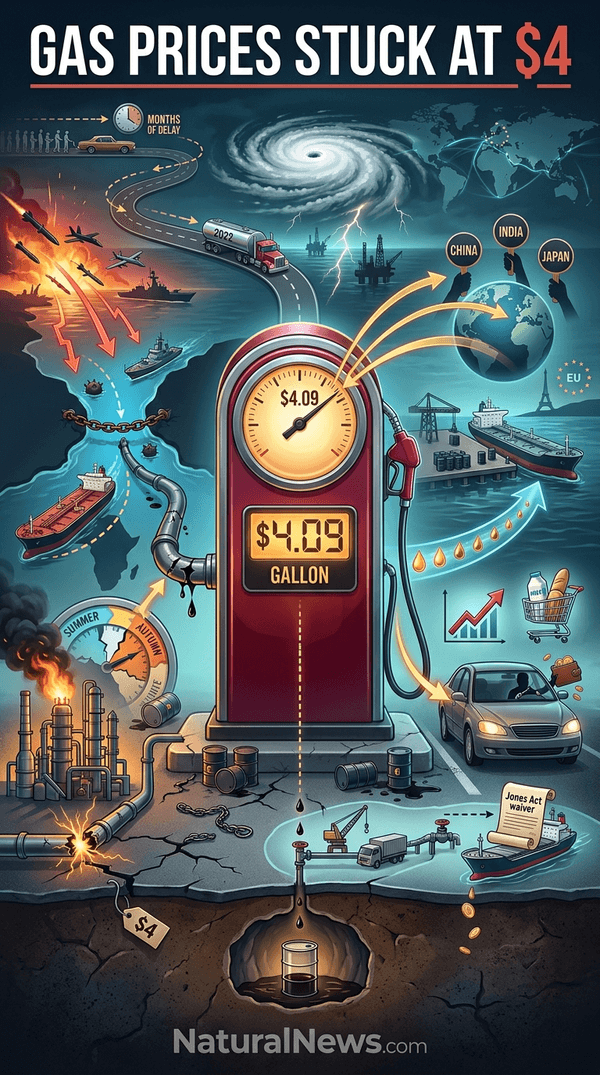
Explainer Infographic












Please contact us for more information.


