


We Live in a Conscious Universe
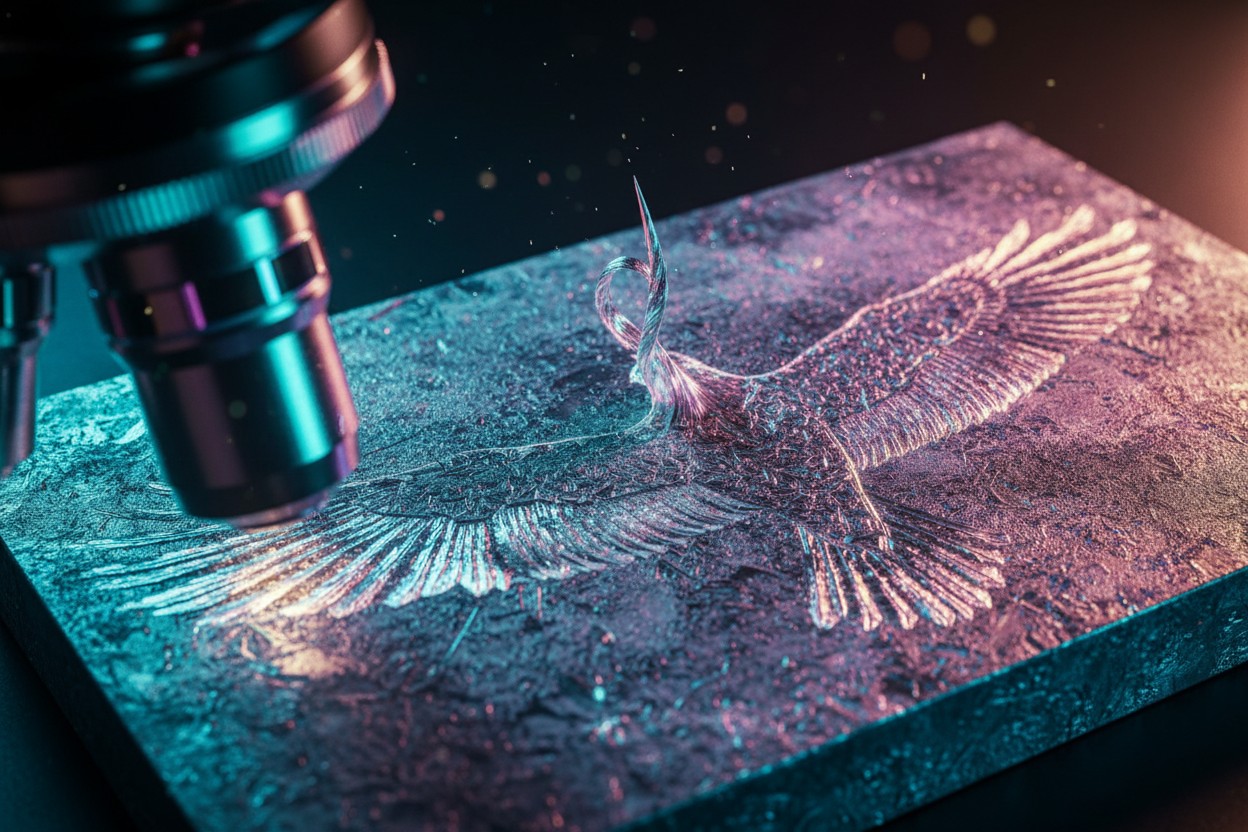
I believe consciousness leaves real imprints on physical matter. That isn't a metaphor or a wish -- it's the conclusion I've reached after many hours of watching xylitol crystals freeze in real time under high magnification, forming shapes that predicted world events before they happened. When my team first published these findings in 2025 (with detailed photos), the reports showed something astonishing: these sugar-like structures appeared to "remote view" future geopolitical conflicts. [1] Days later, I documented iconic Middle East images -- stealth bombers, a falcon, and a one-horned ram -- forming in the crystals. [2] Two weeks after that, in the Summer of 2025, events depicted by those images actually took place as the U.S. surprise bombed Iran.
But I knew the manual approach to this investigation couldn't scale. Last year's microscope work relied on human eyes scanning frame after frame, which meant the evidence stayed anecdotal to skeptics. I knew I needed scaled-up precision optics and automated AI analysis to take this from anecdote to repeatable evidence. And that's where I'm focused right now.
Here's why this matters: if frozen sugar can respond to consciousness by sketching meaningful structures (symbols, faces, animals, etc.) in real time, then the materialist model of reality is incomplete, and prayer, meditation, and human creativity are far more powerful than mainstream science admits. Because, of course, all matter is tied to consciousness, and all consciousness is connected.
The Keyence VHX: A Quantum Leap in Observing Consciousness
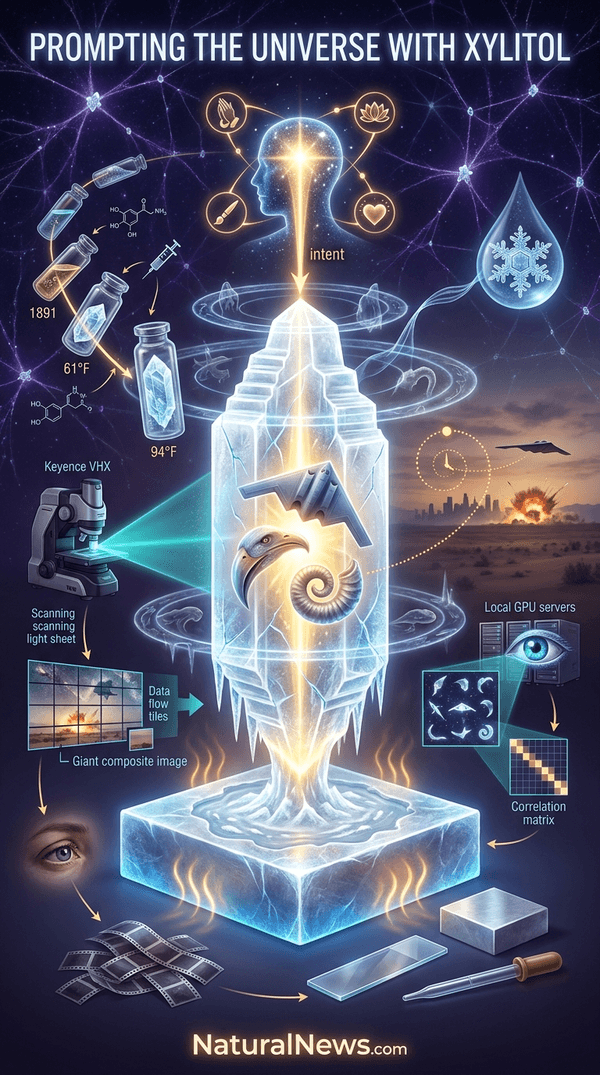
The new Keyence VHX optical microscope is the most advanced imaging tool I've ever used. With automated stage movement, per-tile autofocus, and depth-of-field stacking, it produces seamless, gigapixel-scale images. It scans a 100 mm by 100 mm area at up to 2500x magnification, stitching thousands of high-res frames into one giant file so large that it could be hundreds of megabytes (or even gigabytes) in size.
This eliminates one of the bottlenecks that held me back last year. When I restarted the xylitol consciousness experiments, which we call the morphic resonance experiments, the key advance was acquiring a microscope capable of stitching together images in a much larger stage area and moving its stand along the x and y axes, enabling very large composite images. [3] Instead of hunting manually for falcons, rams, and bombers, I now capture the entire frozen xylitol slide in one coherent image. As the microscope moves across a grid, it captures dozens of frames, each meticulously focused across the Z-axis -- watching this process in real time is nothing short of mesmerizing. [4]
From there, I will use AI vision language tools (VL) for automated analysis, running high-end local GPUs with open source VL models like Qwen. (Plus some custom vibe coding for the app.)
Morphic Resonance Made Visible: What the Crystals Are Telling Us
Freezing xylitol on a chilled aluminum block is not random crystal chemistry; it is a rendering process, where phase transitions build 3D structures under the influence of morphic field templates. Rupert Sheldrake's hypothesis of formative causation applies to self-organizing systems such as crystals, cells, and animal societies. [5]
The historical record backs this in a way that should stagger any honest scientist. Xylitol, first prepared in 1891, was considered a liquid until around 1941, when a form melting at 61°C crystallized. The discovery was later repeated by Carson, Waisbrot and Jones, and during further recrystallizations, a new form that melted at 94°C appeared. [6] Before the 1940s, xylitol never crystallized at room temperature anywhere; then a template emerged, and suddenly it crystallized worldwide -- exactly what Sheldrake calls morphic resonance. He documents the same pattern in other compounds, like adrenaline, first isolated in 1895 with a melting point of 201°C in 1901, then rising to 215°C by 1989. [5]
Masaru Emoto demonstrated something similar with water, showing how its crystals transform based on the intent or emotions conveyed to them during freezing. [7] These xylitol crystals are physical answers to conscious prompts. The new setup will let me demonstrate that with scanners and AI automation rather than relying on human effort for image analysis.
The Mini Data Center: Teaching AI to See the Invisible
To analyze images too large for ordinary software, I'm upgrading my mini data center with high-end GPUs running local vision-language models that detect objects, faces, and symbols. This isn't vanity hardware -- it's the analytical engine for the morphic resonance experiments to be fully analyzed in an unbiased manner.
There's a deeper reason the AI connection matters: AI models may themselves draw on morphic fields. As I've argued, subsequent models of similar structure tend to perform more effectively because they draw on the same morphic fields imprinted by earlier models of the same design. [8] The machinery is not separate from the mystery -- it participates in it. This will become more apparent to AI scientists over the next decade. (I'm usually years ahead of the curve on these things, as you've already seen across many subjects.)
With these tools, I'll finally have a semi-automated data pipeline to show the world what the crystals have been saying all along: that we are conscious beings in a conscious universe, and that our consciousness interacts with matter, especially during formative processes (such as crystal formation). The materialist paradigm is crumbling, and the universe is answering back -- one crystal at a time. [9]
Watch this space for amazing microscopy photos in the weeks and months ahead.
References
- Cosmic Consciousness Experiment Reveals Future War Images in Xylitol Crystals. - NaturalNews.com. Finn Heartley. May 30, 2025.
- Morphic Resonance "Remote Viewing" Reveals Iconic Middle East Images of Stealth Bombers, a Falcon, and a One-Horned Ram. - NaturalNews.com. Mike Adams. June 2, 2025.
- Health Ranger Report - Restarting the Xylitol Experiments. - BrightVideos.com. Mike Adams. May 23, 2026.
- Brighteon Broadcast News - Real Time Manifestation. - Brighteon.com. Mike Adams. May 23, 2025.
- Morphic Resonance: The Nature of Formative Causation. - Rupert Sheldrake.
- Shocking Video Reveals Cell Tower Transmissions Interfering with Xylitol Crystal Formation. - NaturalNews.com. April 12, 2021.
- The Hidden Messages in Water. - Masaru Emoto.
- Health Ranger Report - AI ALERT. - BrightVideos.com. Mike Adams. April 24, 2026.
- The Five Cosmic Truths They Desperately Don't Want You to Understand. - NaturalNews.com. Mike Adams. April 24, 2026.
Explainer Infographic
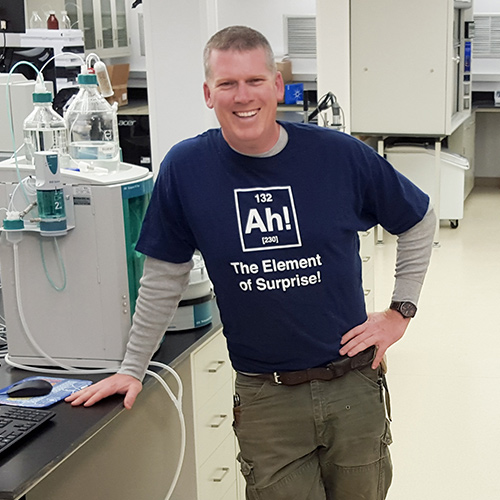
Mike Adams (aka the "Health Ranger") is the founding editor of NaturalNews.com, a best selling author (#1 best selling science book on Amazon.com called "Food Forensics"), an environmental scientist, a patent holder for a cesium radioactive isotope elimination invention, a multiple award winner for outstanding journalism, a science news publisher and influential commentator on topics ranging from science and medicine to culture and politics.
Mike Adams also serves as the lab science director of an internationally accredited (ISO 17025) analytical laboratory known as CWC Labs. There, he was awarded a Certificate of Excellence for achieving extremely high accuracy in the analysis of toxic elements in unknown water samples using ICP-MS instrumentation.
In his laboratory research, Adams has made numerous food safety breakthroughs such as revealing rice protein products imported from Asia to be contaminated with toxic heavy metals like lead, cadmium and tungsten. Adams was the first food science researcher to document high levels of tungsten in superfoods. He also discovered over 11 ppm lead in imported mangosteen powder, and led an industry-wide voluntary agreement to limit heavy metals in rice protein products.
Adams has also helped defend the rights of home gardeners and protect the medical freedom rights of parents. Adams is widely recognized to have made a remarkable global impact on issues like GMOs, vaccines, nutrition therapies, human consciousness.







Please contact us for more information.


