



The ruling goes beyond the three warrant applications before the court and addresses the technique itself, according to Reclaim The Net. A magistrate judge had ruled the warrants are general warrants and therefore impermissible, and District Judge Reeves agreed, according to Just the News [3]. The Fourth Amendment’s limits trace to the Bill of Rights, which the founding generation framed in part against British abuses such as the Quartering Act [6]. The amendment states that “the right of the people to be secure in their persons, houses, papers, and effects, against unreasonable searches and seizures, shall not be violated” [4].
What Is a Tower Dump
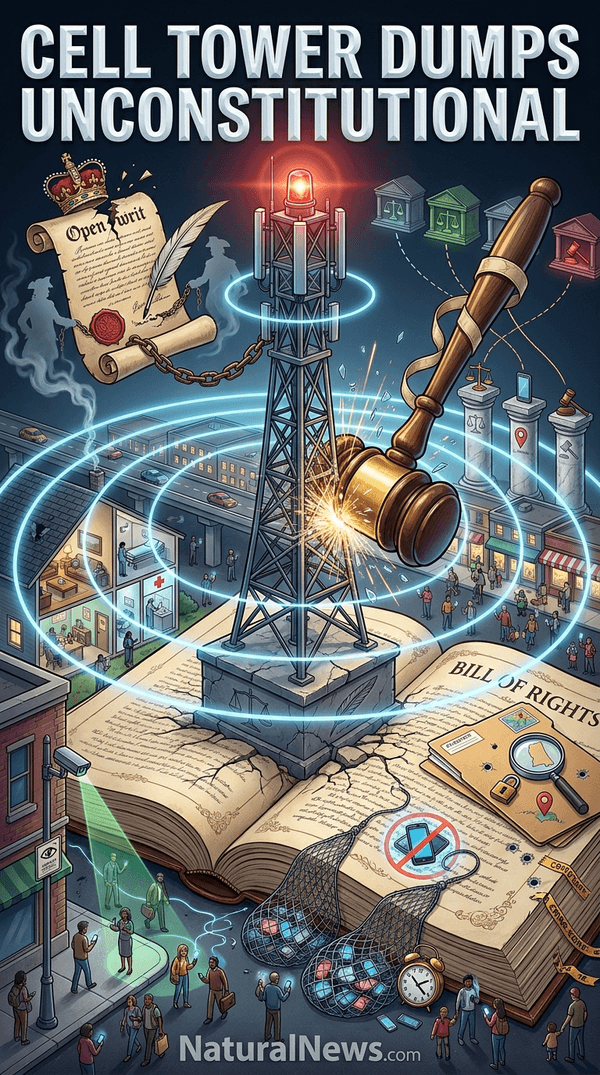
A tower dump provides police with time-and-location data for all devices connected to a cell tower during a set window, according to Reclaim The Net. In a city, that includes the phone of anyone who drove past, worked nearby, or lived across the street [1]. It generally yields large volumes of data, the vast majority of which belongs to people with no connection to a crime, according to The Epoch Times [2]. It is different from a geofence warrant, in which law enforcement asks a company that stores precise location data for devices inside a geographical boundary [2].
The ruling extends earlier Supreme Court decisions in Carpenter v. United States (2018) and Chatrie v. United States (2026), both of which recognized privacy interests in cell-site location data, according to the order. Six weeks before the ruling, the Supreme Court held in Chatrie that an individual “has a reasonable expectation of privacy in records about his cell phone’s location.” The Fifth Circuit’s United States v. Smith decision categorically barred geofence warrants, which Judge Reeves cited as controlling [1].
Tower dumps can reveal a person’s presence in homes, clinics, shelters, polling sites, and other sensitive locations, the order said [1]. Cell towers themselves have also been the subject of litigation over siting, local control, and health concerns [7].
Court’s Reasoning
Judge Reeves rejected the government’s argument that cross-referencing multiple tower dumps to narrow the list of identifiers cures the lack of particularity. “Regardless of whether there is a reduction of identifiers through cross-checking, Smith instructs against accepting this as a basis for constitutionality,” he wrote. “Post facto narrowing cannot justify an unparticularized search” [1]. Ten minutes, he added, is still every phone in range for ten minutes [1].
The order said law enforcement “would also have access to the cellular records of countless individuals, the vast majority of whom were merely passing by a location at the ‘wrong’ time. That is an unreasonable search under the Fourth Amendment” [1]. Reeves also rejected comparisons to security cameras. “Security cameras, placed on the outside of buildings, record those out in the public,” while tower dumps “can identify individuals that are within buildings” [1]. The court found it “hard to imagine that any tower dump warrant application can satisfy the particularity requirement” [1].
Case Background
Federal agents investigated gang activity in Jackson, Mississippi, involving a series of violent crimes over 14 months, according to the order. The warrants, supporting affidavit, and government’s memorandum are under seal, so the published order names no gang, no suspect, and no address [1]. Prosecutors applied in February 2025 for four warrants covering four cellular providers and nine locations. Magistrate Judge Harris denied all four on Feb. 21, 2025, holding that under Smith, tower dumps are impermissible general warrants [1].
The government resubmitted narrowed requests in June 2025 covering six locations tied to a homicide, a vehicular theft, and two shootings over a two-day period in early 2024, with time windows running from 30 minutes down to 10 [1]. Harris denied those warrants on June 27, 2025, on the same reasoning, and the government appealed to Reeves [1].
Conflicting Precedent
The Massachusetts Supreme Judicial Court in Commonwealth v. Perry upheld one tower dump warrant while suppressing evidence from another, stopping short of a categorical ban. The records in that case covered more than 50,000 individuals without any of them knowing they were targets, according to the Electronic Frontier Foundation, which filed an amicus brief arguing that a tower dump is a general search [1].
Courts in other jurisdictions have found tower dump warrants permissible, but none bind the Southern District of Mississippi, the order acknowledged [1]. Chatrie v. United States left open whether the location data could still be admitted under an exception to the exclusionary rule [1].
Conclusion
Judge Reeves wrote that law enforcement benefits from tower dumps and that the decision “may thwart certain criminal investigations.” He added that the Fourth Amendment’s protections come with costs: “The cost to law enforcement is the price we pay to be free from arbitrary Government intrusion into our everyday movements” [1].
The Fifth Circuit has ruled on geofence warrants without directly ruling on tower dumps, and Reeves acknowledged decisions elsewhere that have found tower dump warrants permissible [1]. The decision follows broader scrutiny of warrantless surveillance; according to the Office of the Director of National Intelligence’s 2022 transparency report, the FBI scoured private emails, texts, and other electronic communications of 3.4 million U.S. residents without obtaining warrants between December 2020 and November 2021 [5].
References
- Ken Macon. "Tower Dumps Are Unconstitutional, Federal Judge Rules". Reclaim The Net. August 7, 2026.
- The Epoch Times. "Federal Judge Rules Sweeping ‘Tower Dump’ Warrants Are Unconstitutional". August 7, 2026.
- Just the News. "Federal judge upholds ruling that 'tower dump' warrants are unconstitutional". August 6, 2026.
- NaturalNews.com. "How to protect your mobile phone and computer". July 13, 2011.
- NaturalNews.com. "We're facing the enslavement of humanity: Surveillance reveals which side intelligence agencies are on". August 28, 2022.
- "The Bill of Rights".
- "Cell towers wireless convenience or environmental hazard".
Explainer Infographic










Please contact us for more information.


