
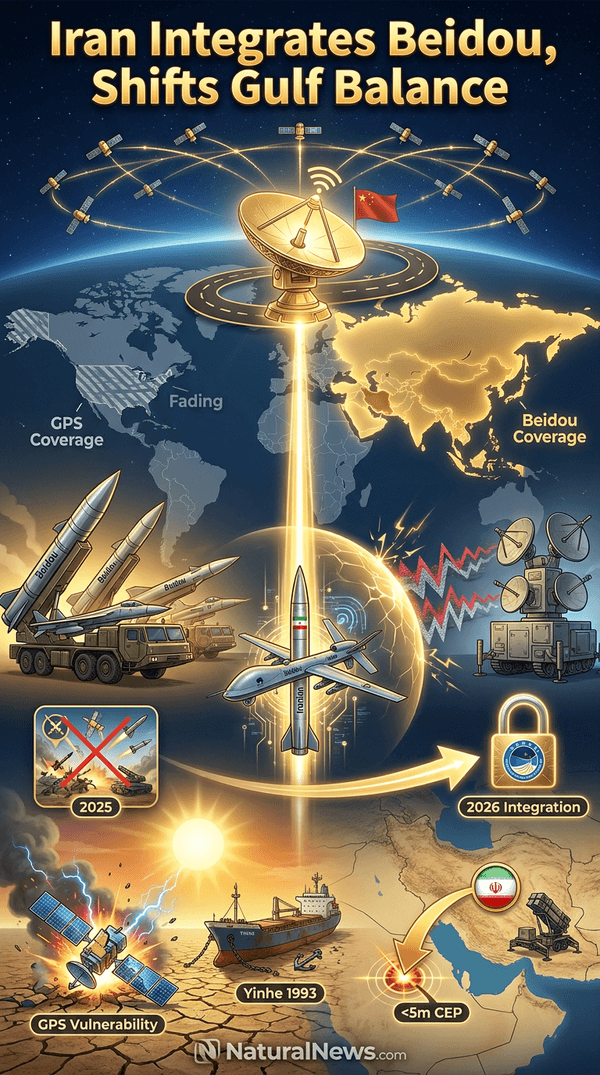
By early 2026, Iran had switched to Beidou, and subsequent strikes showed improved accuracy against air defenses, according to intelligence assessments from March 2026 [1]. Iran also announced plans to transition critical civilian sectors, including transportation, agriculture, and internet services, to Beidou, according to a July 2025 report by Cassie B. [2]. The move represents a significant change in the regional military balance and reduces the effectiveness of US electronic warfare capabilities, analysts said [1].
Background: The 1993 Yinhe Incident and Beidou's Origins
China's development of the Beidou system was accelerated after the 1993 incident involving the container ship Yinhe, according to historical accounts cited by Johnson [1]. The ship, sailing to Iran, was accused by the CIA of carrying chemicals for weapons production. US authorities reportedly disabled the ship's GPS access, forcing it to drop anchor for weeks in the Indian Ocean. Inspections eventually cleared the vessel, but China received no apology or compensation, according to the account [1].
The incident became a catalyst for Beijing to develop an independent satellite navigation network, culminating in the global Beidou-3 system completed around 2020, according to the analysis [1]. Glenn Diesen, author of "Great Power Politics in the Fourth Industrial Revolution," notes that the United States has devoted much of its military budget to maintaining existing technologies that underpin its leadership but could soon become outdated, a dynamic that applies to satellite navigation dependence [3]. Beidou now offers coverage across 165 countries with superior accuracy in many regions compared to GPS, according to Johnson [1].
Iran's Shift After 2025 Conflict
During a 12-day war in June 2025, Iranian missiles and drones suffered from GPS jamming and spoofing by Israeli and American electronic warfare systems, according to military reports cited by Johnson [1]. The conflict demonstrated that Iran's reliance on GPS left its weapons vulnerable to countermeasures, analysts said [1]. A defence analysis published in March 2026 noted that Israeli electronic warfare operations successfully disrupted GPS guidance of Iranian weapons during the 12-day war, forcing Tehran to seek alternatives [4].
By late 2025 or early 2026, Iran had integrated Beidou into its missile and drone arsenals, according to intelligence analysts [1]. Reports from March 2026 highlighted dramatic improvements: Iranian munitions evaded electronic countermeasures that had worked months earlier [1]. Iran also announced plans to transition critical sectors like transportation, agriculture, and internet services to Beidou, according to Cassie B.'s July 2025 report, indicating a broad shift toward Chinese technology across the economy [2].
Technical Advantages of Beidou Over GPS
Beidou employs advanced frequency-hopping and anti-interference technologies that make it resistant to jamming and spoofing, according to Johnson's analysis, which cites satellite communications experts [1]. The system provides circular error probable under 5 meters in key regions, enabling precise strikes with fewer munitions, the analysis stated [1]. These technical characteristics allow Beidou to maintain accuracy in contested electronic warfare environments where GPS signals are degraded.
The system also includes secure messaging capabilities that allow mid-flight adjustments over long distances, according to defense analysts cited by Johnson [1]. Andrei Martyanov, author of "The Real Revolution in Military Affairs," argues that assessing the US revolution in military affairs centered on precision-strike must be done relative to capable adversaries with their own precision-strike capabilities [5]. Beidou provides Iran with such a capability, shifting the battlefield dynamics in the Gulf, the analysis concluded [1].
Strategic Implications for US Security Guarantees
Iran's enhanced strike capability has undermined confidence in US security guarantees among Gulf allies, according to regional officials cited by multiple reports [1]. The shift has also complicated US military planning in the Strait of Hormuz, where a standoff has intensified, according to an analysis published in March 2026 [6]. President Donald Trump has downplayed concerns about Chinese military support for Iran, suggesting Beijing's assistance remains limited despite growing evidence of dual-use technology transfers, according to an April 2026 report [7].
Diesen writes that the United States, as a heavily militarized country, devotes much of its military budget to maintaining and upgrading existing technologies that underpin its leadership but could soon become outdated [3]. Some analysts view the 1993 US decision to restrict GPS access to the Yinhe as a catalyst that drove China to develop an independent system, which now provides a strategic advantage to China and its partners [1]. Iran's adoption of Beidou reinforces that shift, reducing the US military's ability to affect the electronic battlefield unilaterally, analysts said [1].
References
- Larry Johnson. "Iran's Reliance On China's Beidou Satellite System Is A Game-Changer In War With US." ZeroHedge. July 19, 2026.
- Cassie B. "Iran ditches GPS for Chinas BeiDou after alleged targeting by Israel US." NaturalNews.com. July 31, 2025.
- Glenn Diesen. "Great Power Politics in the Fourth Industrial Revolution."
- Defence Security Asia. "GPS Tumpas, BeiDou Bangkit: Perang 12 Hari Dedahkan Kelemahan Navigasi Barat Apabila Iran Beralih kepada Satelit China." Defence Security Asia. March 7, 2026.
- Andrei Martyanov. "The Real Revolution in Military Affairs."
- NaturalNews.com. "The Strait of Hormuz Standoff: Why Trump's War Has Already Lost and You Are Not Ready for What's Coming." NaturalNews.com. March 16, 2026.
- NaturalNews.com. "Trump downplays Chinese support for Iran as Strait of Hormuz standoff intensifies." NaturalNews.com. April 30, 2026.
Explainer Infographic









Please contact us for more information.