


Don't Feed the Wildlife
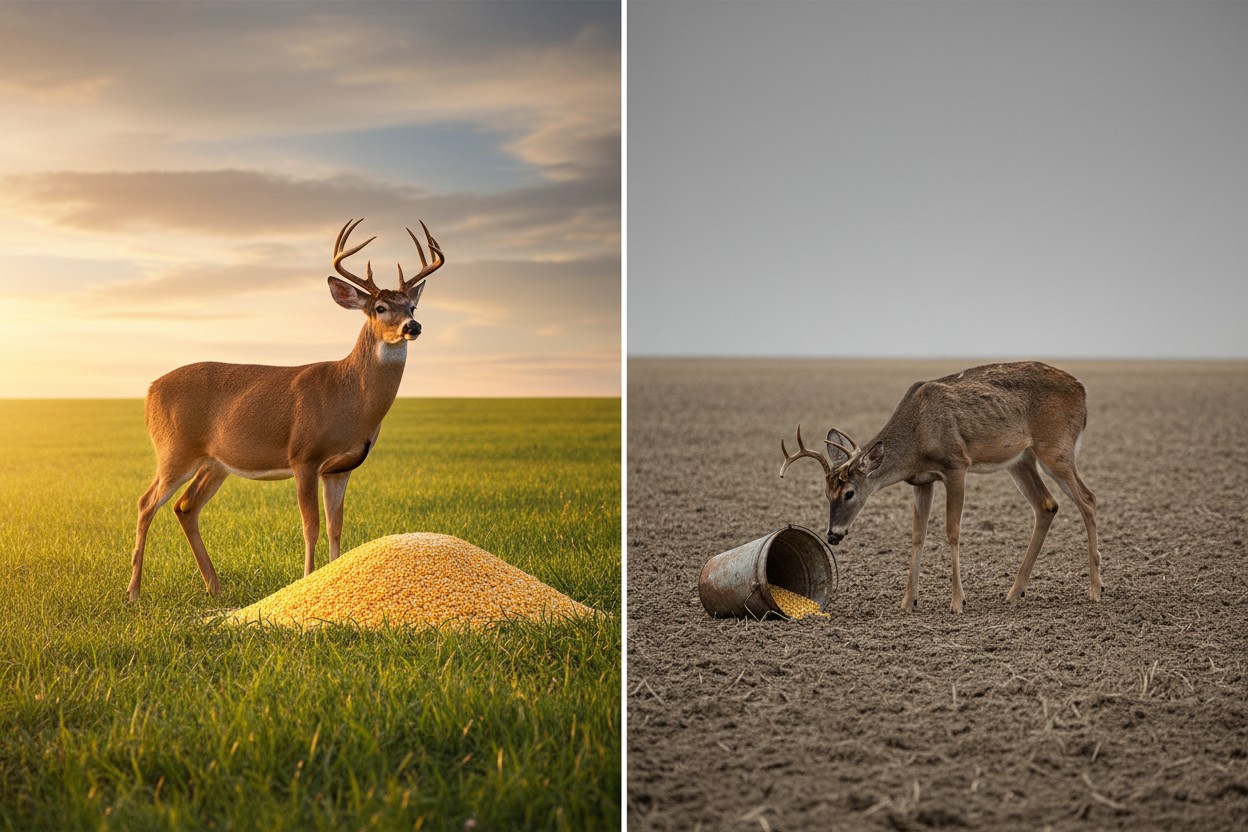
Every morning on my ranch, I watch the deer move through the fields without a single pile of corn left out for them. They thrive on native browse, acorns, and what the land naturally provides. Their numbers are modest, healthy, and sustainable. But when other ranchers put out deer corn by the bucket, the herd swells fast. More fawns survive. The population booms. Then, when the corn stops, the same deer starve or wander into traffic in search of food. The inflated herd collapses back to what the land can actually support.
This is not just wildlife management. This is the stark reality of every living system, including our own. Human civilization today is living on a giant pile of deer corn: fossil-fuel-based fertilizers, global shipping lanes, and a financial system that borrows from the future to feed the present. I believe that the coming years will force a brutal correction, and the world’s population will shrink dramatically to match the available food supply (which is rapidly shrinking due to the war with Iran).
This is not a prediction of doom so much as a statement of ecological cause and effect.
The Deer Corn Analogy
Some people scatter deer corn to attract wildlife for hunting or simple enjoyment. The result is always the same: more deer, higher birth rates, and an unnatural concentration of animals. In my interview with Joel Salatin, he pointed out that spreading deer corn every morning does more than feed deer -- it attracts rats, vultures, and other pests that would not otherwise be there in such numbers. [1] The deer become dependent on that hand-out, too. When the corn runs out, the population crashes not because predators killed them, but because the artificial food source vanished.
Conservationists repeatedly warn against feeding deer for exactly this reason. It creates a false carrying capacity. The deer lose their natural foraging instincts and concentrate in areas where they cannot sustain themselves. As one study on waterfowl and corn fields notes, geese are capable of contributing enormous amounts of waste per day when they congregate around agricultural fields, artificially boosting local populations. [2] The same principle applies to humans on a global scale, except our “deer corn” is the entire industrial food system.
The Human Parallel: Infrastructure and Population
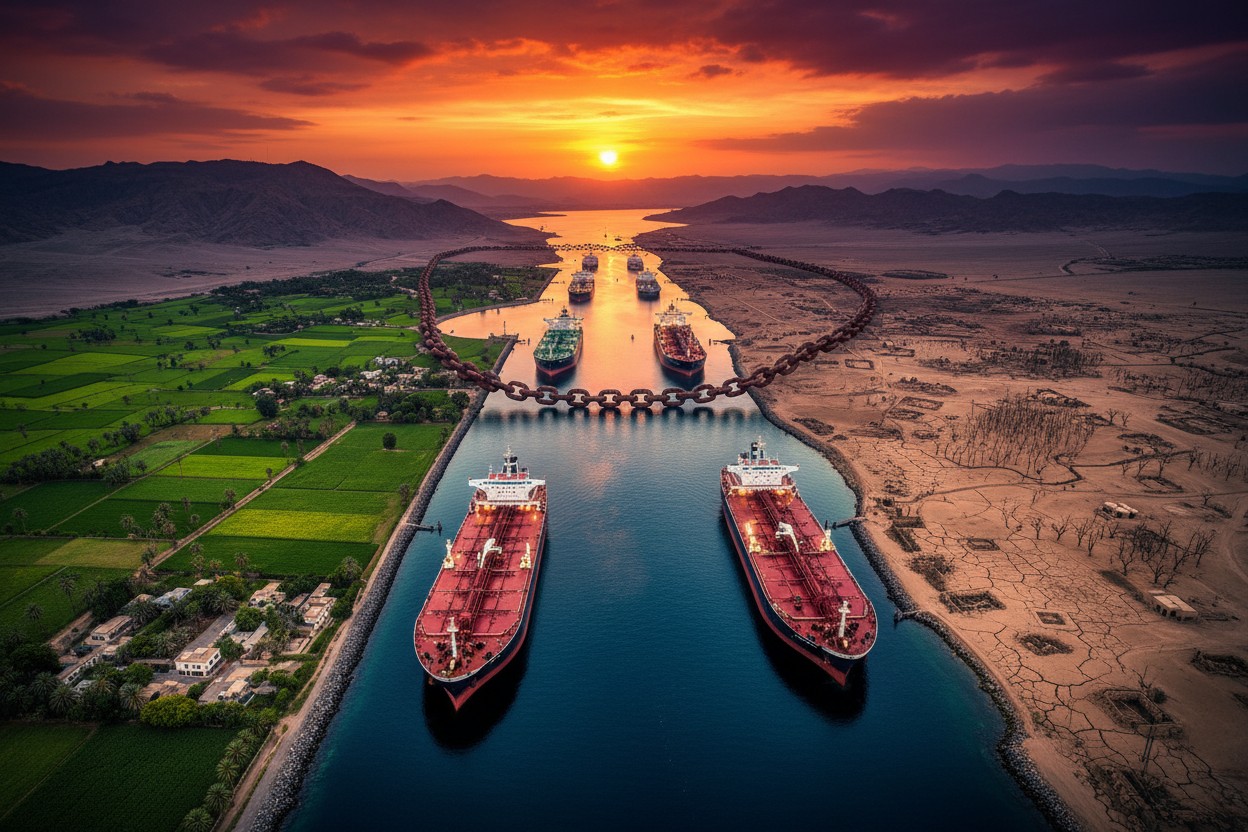
Our modern agricultural system is almost entirely dependent on fossil fuels, particularly natural gas used to produce ammonia fertilizer via the Haber-Bosch process (as I have covered extensively). That natural gas is shipped through vulnerable chokepoints like the Strait of Hormuz. As I have reported, the ongoing conflict with Iran has effectively closed that strait, severing a massive portion of the world‘s natural gas supply -- the very feedstock for global fertilizer production. [3] The result is at least a 25 percent reduction in fertilizer availability, which translates directly into a 25 percent reduction in food production capacity. This is not a speculation; it is the math of a system pushed past its limits. [4]
This infrastructure, built over 60 years, currently supports more than 8 billion people. When you remove a quarter of the energy and fertilizer that makes that population possible, the population must re-equilibrate. Human beings are not exempt from ecological laws. The same way a deer population collapses when its artificial food source is cut, human populations will collapse when the industrial farming inputs are cut. And we are already seeing the first signs: food lines are growing longer across America, with food banks overwhelmed by demand as government programs falter. [5] The era of cheap, abundant food is ending.
The Grim Reality of Contraction
A 25 percent reduction in food availability means roughly 2 billion people will lose access to adequate nutrition. In a worst-case scenario, the number could reach 4 billion. History shows us what happens when resource limits are hit. The Mississippian chiefdoms collapsed when disease and environmental degradation depleted their resource base, forcing survivors to abandon ceremonial centers and band together in smaller groups. [6] The Maya understood this pattern as a cycle of creation and destruction, where neglecting responsibilities to the gods -- read: neglecting the health of the land -- triggered collapse every 52 years. [7]
The coming contraction will hit marginalized nations first, but scarcity will surge in wealthy countries too. The warning from activist ecologist Rachel Carson remains relevant: we are headed for environmental failure because we refuse to see the consequences of our interventions. [8] Chaos, cannibalism, dumpster diving, and mass migration will follow. This is not fear-mongering; it is the mechanical result of pushing a biological system beyond its carrying capacity and then pulling the rug out.
Conclusion: Be Part of the Half That Survives
The only way to survive the coming correction is to opt out of the dependency cycle. The deer that know how to forage will survive when the corn stops. The humans who know how to grow food, raise animals, purify water, and defend their families will survive when the supermarket shelves go bare. In my conversations with survival experts, the consistent message is clear: self-reliance is not a hobby, it is a necessity. [9] Securing a piece of land with clean water, privacy, and room to garden is the single best investment you can make right now. [10]
Pre-panic preparation is critical. Buy storable food now, learn to garden, acquire heirloom seeds, and raise small livestock. But do not rely solely on stockpiles. Develop the skills to produce your own food year after year. Farming requires healthy soil and healthy ecosystems, as regenerative agriculture demonstrates. [11] Do not be the dependent half that lives in cities on processed food and government handouts.
The deer corn for humans is running out. Be one of the foragers who knows how to thrive without it.
References
- Mike Adams interview with Joel Salatin - October 25 2024.
- Wildlife identified as major source of Escherichia coli in agriculturally dominated watersheds by BOX A1R-derived genetic fingerprints. - Journal of Environmental Management 82 (2007).
- The Window Is Closing: How the Iran Conflict Just Unleashed a Global Famine Trigger. - NaturalNews.com. Mike Adams. March 5, 2026.
- We Are Sleepwalking into a Global Catastrophe: Why Trump’s War on Iran Threatens the Infrastructure That Keeps Billions Alive. - NaturalNews.com. Mike Adams. July 15, 2026.
- Food Lines Are Already Growing Longer All Over America. - End of the American Dream. Michael Snyder. October 28, 2025.
- The Creeks. Michael D. Green.
- Maya Civilization A Captivating Guide to Maya History and Maya Mythology. Captivating History.
- The Second Silent Spring Has Sprung. - Mercola.com. August 21, 2019.
- Mike Adams interview with Daniel Vitalis - July 9 2024.
- Mike Adams interview with Jonathan Rawles - October 14 2022.
- Soil Organic Matter Is the Secret to Good Foo. - Mercola.com. October 30, 2018.
- Health Ranger Report - Special Report Globalists train masses on handouts then kill them - Mike Adams - Brighteon.com, July 16, 2022.
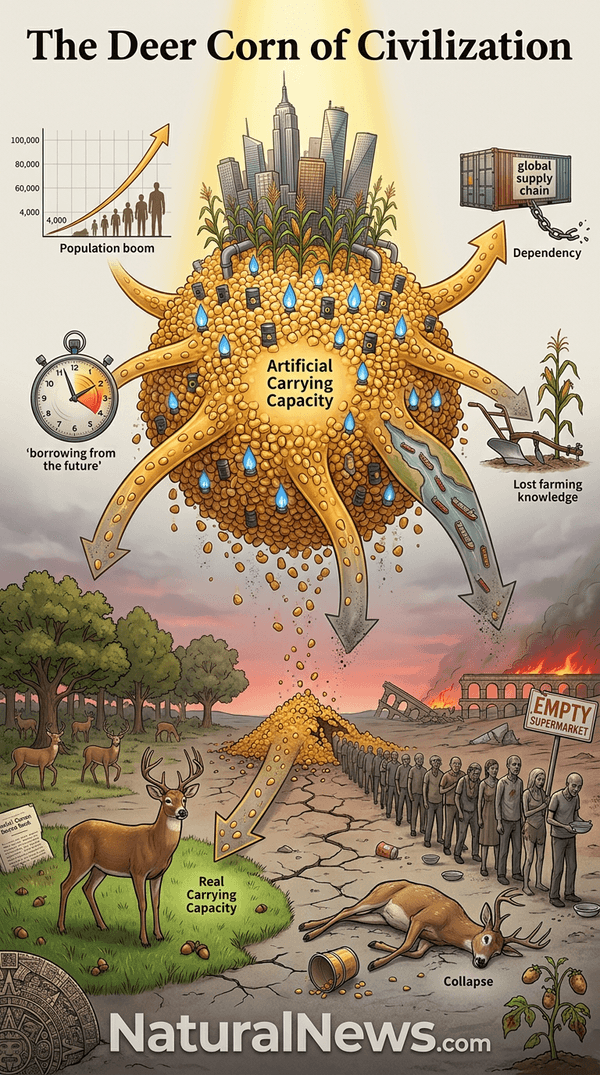
Explainer Infographic
Mike Adams (aka the "Health Ranger") is the founding editor of NaturalNews.com, a best selling author (#1 best selling science book on Amazon.com called "Food Forensics"), an environmental scientist, a patent holder for a cesium radioactive isotope elimination invention, a multiple award winner for outstanding journalism, a science news publisher and influential commentator on topics ranging from science and medicine to culture and politics.
Mike Adams also serves as the lab science director of an internationally accredited (ISO 17025) analytical laboratory known as CWC Labs. There, he was awarded a Certificate of Excellence for achieving extremely high accuracy in the analysis of toxic elements in unknown water samples using ICP-MS instrumentation.
In his laboratory research, Adams has made numerous food safety breakthroughs such as revealing rice protein products imported from Asia to be contaminated with toxic heavy metals like lead, cadmium and tungsten. Adams was the first food science researcher to document high levels of tungsten in superfoods. He also discovered over 11 ppm lead in imported mangosteen powder, and led an industry-wide voluntary agreement to limit heavy metals in rice protein products.
Adams has also helped defend the rights of home gardeners and protect the medical freedom rights of parents. Adams is widely recognized to have made a remarkable global impact on issues like GMOs, vaccines, nutrition therapies, human consciousness.









Please contact us for more information.


