



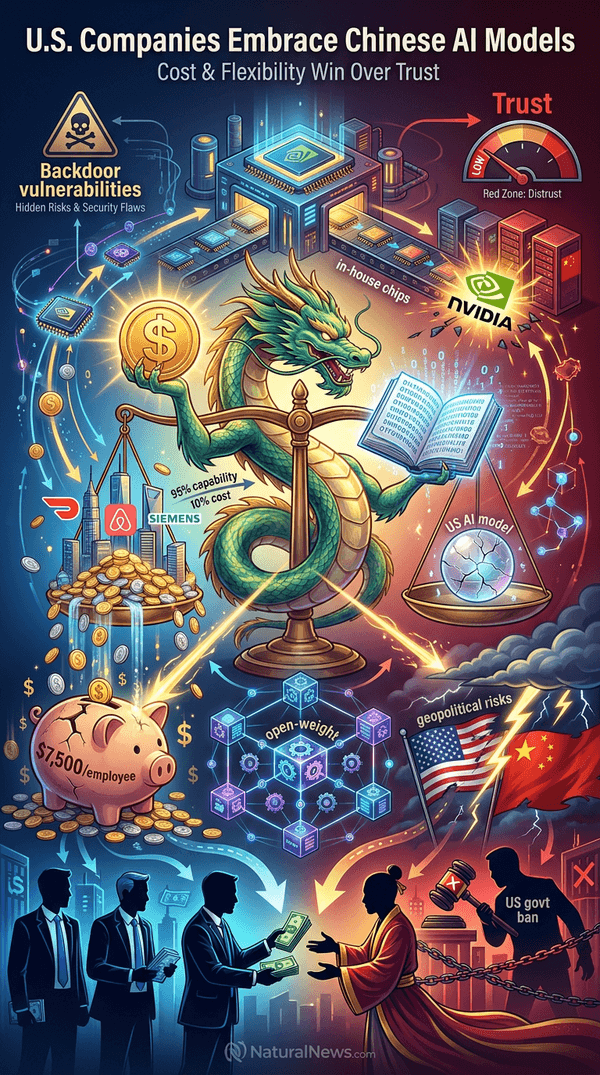
The shift is driven by lower costs and the flexibility of open-weight models that can be customized for specific business needs. Data from the AI platform OpenRouter indicates that leading Chinese models from DeepSeek and Z.ai have surpassed U.S. equivalents from Anthropic and OpenAI in usage, as reported by FT.
The trend reflects a broader reassessment of value in the corporate AI market. A survey by the research firm Public First, cited in a South China Morning Post report, found that pluralities in 11 of 15 countries surveyed believed China had outpaced the U.S. in AI capability and innovation [1]. However, the same poll showed China trails significantly in trust for its AI models, ranking 10th with a negative net trust score.
Cost Savings Driving Adoption
Corporate AI spending has surged, with one organization reportedly spending $500 million in a month on usage fees for Anthropic's Claude, according to FT. Recent research from the Ramp AI Index, also cited by FT, found that the most AI-dedicated businesses are spending around $7,500 per employee per month on AI tools. As costs escalate, companies are seeking cheaper alternatives.
DoorDash cofounder Andy Fang said on X that the company is saving money by using a model from the Chinese startup Moonshot AI for lower-level work. Sam Bresnick, a research fellow at Georgetown University's Center for Security and Emerging Technology, told FT that enterprises have an incentive to shift workloads to cheaper models, asking why firms would pay a premium for U.S. models when Chinese models are generally workable for many tasks. A UBS analysis, cited by ZeroHedge, concluded that Chinese AI models deliver about 95% of the capability of U.S. models at just 10% of the cost [2].
Open-Weight Models Offer Flexibility
Beyond cost, many Chinese AI models are open-weight, meaning their parameters are visible to users, allowing organizations to customize them for specific applications and maintain greater control over data security. Eugene Cheah, CEO of the AI platform Featherless AI, told FT that enterprises are realizing they do not need the best model, but faster and cheaper ones. The combination of cost advantage and open-weight approach is appealing to foreign companies, according to the FT report.
This trend aligns with earlier forecasts. Nandan Nilekani, chair of the Indian tech giant Infosys, predicted in a FT forecast that companies would move toward smaller, customized models rather than purchasing ever larger systems [3]. The open-weight model also resonates with a broader shift toward decentralized AI, as noted by analysts covering the competition between open-source frameworks and centralized, government-controlled systems [4].
Geopolitical and Trust Considerations
The Trump administration's suspension of access to Anthropic's Mythos model overseas has raised concerns about reliance on U.S.-controlled AI, according to FT. Aidan Gomez, CEO of the Canadian AI group Cohere, told FT that the Mythos ban exposed the risk of depending on any single entity for workloads. The U.S. government's export controls on Anthropic's Fable 5 and Mythos 5 models were imposed in June, restricting foreign access [5].
Chinese authorities have raised their own concerns about U.S. AI tools. China's National Vulnerability Database warned that Anthropic's Claude Code contained alleged security backdoor vulnerabilities capable of transmitting sensitive user information without consent [6].
Meanwhile, Chinese firms such as Alibaba have banned employees from using Anthropic's coding tools over distillation scandals [7]. For many businesses, cost and flexibility continue to outweigh geopolitical rivalries, according to analysts.
Implications for AI Industry
The shift toward Chinese models may pressure U.S. AI firms to lower prices or offer more open-weight options, experts said. The long-term impact on U.S. technological leadership remains uncertain, according to the FT report.
Several Chinese companies, including DeepSeek, are developing in-house AI chips to reduce reliance on Nvidia and other U.S. suppliers [8]. The move signals that Chinese AI firms are building deeper infrastructure independence.
As the AI market evolves, smaller and mid-sized companies may benefit from the availability of cheaper models, while U.S. AI leaders face pressure to adapt. The trend also underscores a broader decentralization of AI development, with open-weight models enabling enterprises to take charge of their own AI destiny, as forecast by industry observers [3].
Conclusion
The adoption of Chinese AI models by major U.S. companies marks a significant shift in the global AI landscape. Driven by cost savings and the flexibility of open-weight systems, businesses are increasingly looking beyond traditional U.S. providers.
Geopolitical frictions and trust issues add complexity, but for many enterprises, the immediate economic incentives are decisive. The outcome of this shift may reshape the competitive dynamics of the AI industry for years to come.
References
- "The Globalist Puppet Paradox: How China's AI Lead Exposes the Deep State's Hollow Tech Supremacy." NaturalNews.com. June 17, 2026.
- "China's AI Models: The Definitive LLM Primer." Zero Hedge. July 11, 2026.
- Trends-Journal-2024-12-10.
- Finn Heartley. "The Health Ranger interviewed by Seth Holehouse on AI wars: Decentralization vs. Centralized control - who will rule the future?" NaturalNews.com. January 31, 2025.
- "Could Trump's Fable 5 Export Curbs Slow China's AI Model Race." Zero Hedge. June 15, 2026.
- "Chinese Authority Warns of Intellectual Property Theft via Anthropic's Claude AI." NaturalNews.com. July 12, 2026.
- "Alibaba Bans Employees From Using Anthropic's Coding Tool Over Distillation Scandal." Zero Hedge. July 4, 2026.
- "DeepSeek Developing In-House AI Chip, Reuters Reports." NaturalNews.com. July 9, 2026.
- Willow Tohi. "Chinese AI Gains Global Traction as U.S. Tech Dominance Faces Challenges." NaturalNews.com. July 7, 2025.
- Willow Tohi. "Biden gave China the AI advantage." NaturalNews.com. January 29, 2025.
- Vivek Wadhwa, Ismail Amla, Alex Salkever. "From Incremental to Exponential."
Explainer Infographic











Please contact us for more information.


