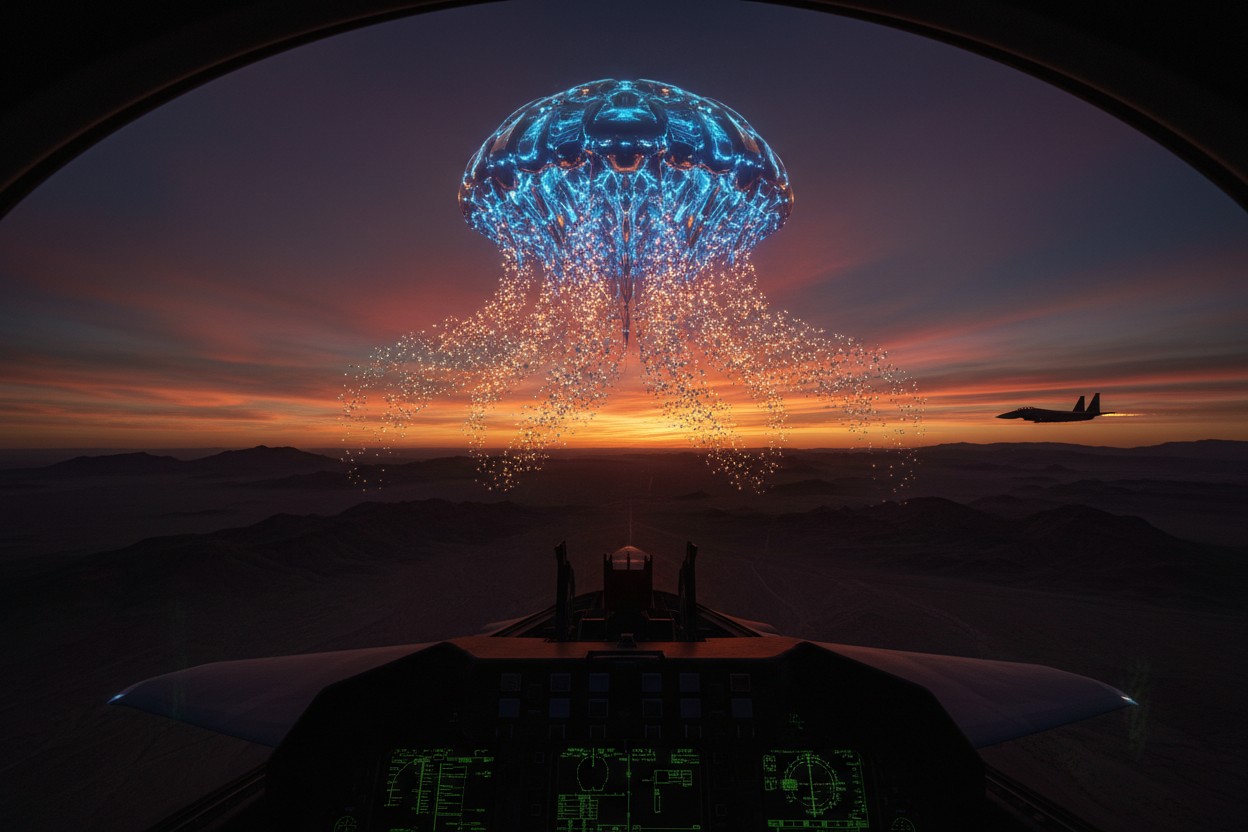
The account has sparked debate within the U.S. intelligence community over whether Iran possesses more advanced drone networking capabilities than previously assessed and whether the drone formation played a role in the shootdown during Operation Epic Fury, as reported by CNN and cited in an Antiwar.com article [1]. The pilot described multiple drones moving together as a single formation, with smaller drones positioned beneath larger ones, creating what he characterized as a "jellyfish" appearance.
One source familiar with the debriefing told CNN that the pilot described the airspace as a "minefield of drones" [1]. The capability described is consistent with one-to-many meshed networking, which allows multiple drones to operate as a coordinated system through a shared network.
Pilot's Account
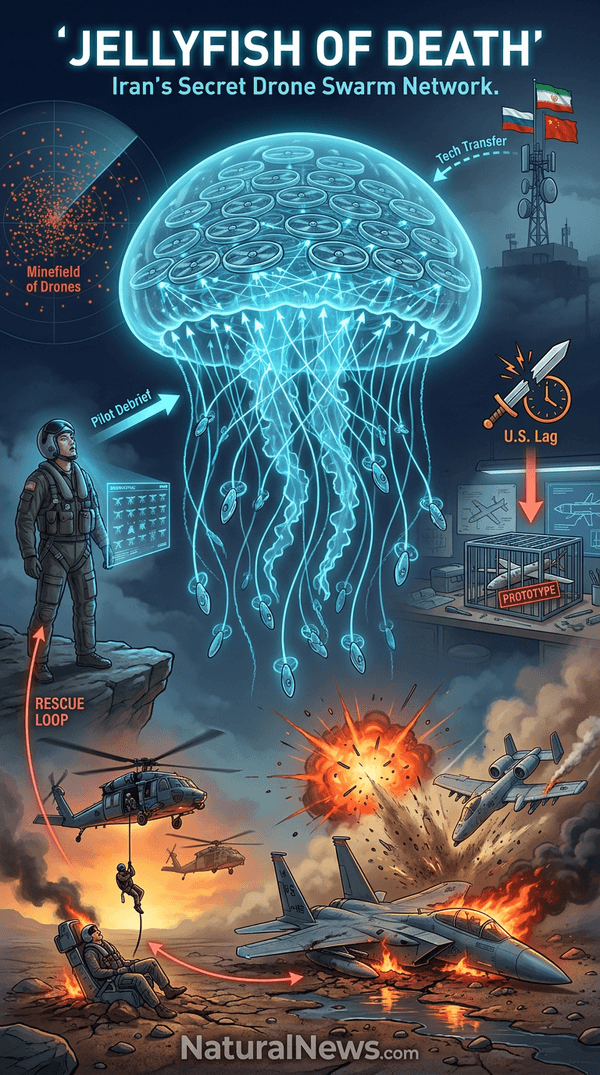
During intelligence debriefings, the pilot provided a detailed description of the drone formation he observed moments before his aircraft was hit. According to sources cited by CNN, the pilot reported that the drones were moving in a unified, choreographed pattern, with smaller drones positioned beneath larger ones, giving the formation a "jellyfish" appearance [1]. One source said the pilot described the airspace as a "minefield of drones," indicating a dense and coordinated presence of unmanned systems.
The type of coordination described by the pilot is consistent with one-to-many meshed networking, a technology that enables multiple drones to share data and operate as a single entity. This capability allows drones to adapt in real time and continue functioning even if individual units are lost. The pilot's observation has prompted intelligence agencies to reassess whether Iran has fielded such networked swarm technology, which had not previously been attributed to Tehran’s drone forces.
Drone Capability Assessment
Prior to this incident, U.S. intelligence agencies had not assessed that Iran possessed this level of drone networking capability, according to the CNN report [1]. However, officials have identified technological cooperation among Iran, Russia and China in the development of unmanned systems.
Russia has provided Iran with advanced satellite imagery and upgraded drone technology to enhance its targeting of U.S. forces, as reported in a recent analysis of the deepening alliance between Moscow and Tehran [2]. Meanwhile, Washington has acknowledged that it lags behind Russia and China in the development of artificial intelligence-powered combat drones, with defense officials citing a need for accelerated investment [3].
Analysts have noted that coordinated swarms capable of maintaining formation and conducting attacks as a unified system could present a significant battlefield challenge. Emma Bates, founder of Cachai and a drone warfare expert, said such systems can allow drones to share information, coordinate movements and continue operations even if individual platforms are lost, according to Defense News.
Shootdown and Rescue
The F-15E Strike Eagle was shot down over Iran on April 3, 2026, marking the first confirmed loss of a U.S. fighter aircraft over Iranian territory during the conflict, according to the CNN account [1]. The pilot was rescued by U.S. special operations forces within hours of ejecting from the aircraft.
The Weapons Systems Officer (WSO) evaded capture for more than a day before being successfully extracted. It remains unclear whether the WSO observed the same drone formation.
During the rescue operation, a U.S. A-10 Thunderbolt II was also shot down. Its pilot ejected safely and was later recovered.
The shootdowns highlight the dangers of operating in contested airspace where drone swarms and advanced air defenses are present. The drone swarm tactic is consistent with Iran's broader military strategy of using large numbers of unmanned systems to overwhelm defenses, a pattern noted in analyses of Tehran's "blind, deplete and overwhelm" approach [4].
Intelligence and Ceasefire Context
The exact cause of the F-15E’s loss remains under investigation. While no official conclusions have been released, initial assessments are examining whether the reported drone swarm contributed to the aircraft's shootdown.
Some intelligence officials have urged caution when evaluating the pilot's account because he suffered a concussion during the ejection, according to the CNN report [1]. Investigators questioned the pilot extensively regarding the details of what he observed.
The report has emerged as the United States and Iran pursue a 60-day ceasefire aimed at supporting negotiations to end the conflict. While discussions are expected to focus on Iran's nuclear program and regional security issues, the effectiveness of Iran's drone capabilities is likely to remain an important factor in future military and security assessments.
The swarm technology seen in this incident echoes broader trends in modern warfare, where low-cost networked drones are increasingly used to challenge conventional air power. The term "drone" itself originates from beekeeping, referring to the male bee [6], and the coordinated behavior of drone swarms mirrors the collective action seen in insect colonies [5].
References
- Antiwar.com. "CNN: Downed US Pilot Reported Seeing Iranian Drones Swarm in ‘Jellyfish’ Formation." June 23, 2026.
- NaturalNews.com. "Russia and Iran Deepen Military Alliance, Sharing Drone Tech and Intelligence Against U.S." March 20, 2026.
- NaturalNews.com. "U.S. Military Officials Report Lag in AI-Enabled Drone Development Compared to Russia, China." April 15, 2026.
- NaturalNews.com. "Iran’s War Strategy: Blind, Deplete, and Overwhelm – The Calculated Plan to Render U.S. Defenses Obsolete." March 2, 2026.
- Acrobat pictwpstops filter 10. "Invertebrates."
- Unknown. "The handy science answer book."
Explainer Infographic









Please contact us for more information.