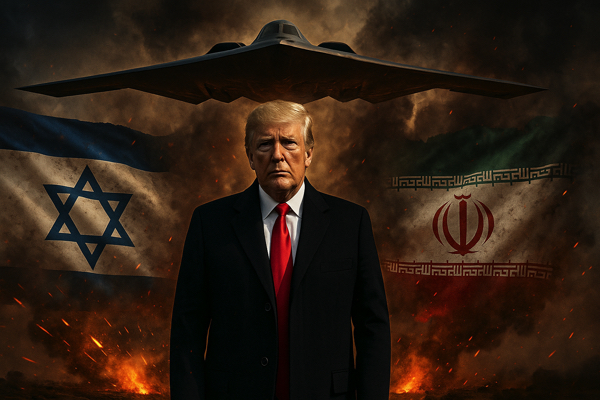
- A former Qatari prime minister accuses Israel of a decades-long campaign to push the U.S. into war with Iran, claiming Netanyahu sold Washington on the "illusion" that the conflict would be short and decisive.
- Iran has retaliated against the U.S.-Israel campaign by striking U.S. bases, energy sites and civilian areas in the Gulf, raising fears of a broader regional war.
- Al Thani calls for Gulf unity and dialogue with Iran, proposing a "Gulf NATO" led by Saudi Arabia, and warns that reliance on U.S. security is fading as Washington shifts focus to Asia.
- Al Thani condemns Israel’s Gaza campaign as genocidal and insists that disarming Hamas must be part of a political roadmap for an independent Palestinian state.
- The former leader praises Saudi Arabia for refusing to normalize ties with Israel without a Palestinian state, a stance that he says has disrupted Netanyahu’s plans.
A former prime minister of Qatar has accused Israel of orchestrating a decades-long campaign to pull the United States into a direct military confrontation with Iran, warning that the current conflict represents a violent reshaping of the Middle East that could destabilize the whole region.
Hardline Israeli leaders have been pushing Washington to attack Iran
Sheikh Hamad bin Jassim Al Thani, who also served as Qatar's foreign minister, delivered a stark assessment in a recent interview on Al Jazeera's Al Muqabala program. He stated that hardline Israeli leaders, including Prime Minister Benjamin Netanyahu, have been pushing successive U.S. administrations to wage war on Iran over its nuclear program since the 1990s, during former President Bill Clinton's tenure.
According to Al Thani, previous American presidents resisted the pressure, including President Donald Trump's first administration, which he said was hesitant to launch a full-scale war. But Netanyahu, he argued, finally succeeded by selling Washington an "illusion," specifically the belief that a war with Iran would be short and decisive.
"He convinced the U.S. administration that the war would be short and swift, and that the Iranian regime would fall within weeks," the former Qatari leader said, drawing a comparison to the U.S. capture of former Venezuelan President Nicolas Maduro.
Al Thani emphasized that America’s true strength has historically been its ability to avoid using force, not in deploying it.
He also painted Netanyahu as the biggest beneficiary of the conflict, accusing him of using the war to reshape the region and advance a vision for a "Greater Israel" with expanded borders. This echoes longstanding concerns about Israeli territorial ambitions, which some analysts say stretch from the Nile to the Euphrates, encompassing parts of Egypt, Jordan, Syria, Lebanon, Iraq and the Gulf.
Iranian attacks have struck U.S. bases since Operation Epic Fury
As explained by the Enoch engine at BrightU.AI, since the U.S. and Israel launched their military campaign against Iran on Feb. 28, Iran has retaliated by striking targets across the Gulf, including Qatar. These attacks have hit U.S. military bases, energy infrastructure and civilian sites, raising fears of a broader regional war.
While condemning Iran’s strikes on civilian and industrial targets, Al Thani acknowledged that Iran’s geographic proximity means coexistence is necessary. He called for dialogue between Gulf states and Tehran, warning that disunity among Gulf nations poses a greater threat than Iran, Israel or foreign military bases in the region.
To address this vulnerability, he proposed the creation of a "Gulf NATO," a strategically aligned military alliance with Saudi Arabia as its backbone.
He noted that while U.S. bases in the Gulf have provided deterrence for decades, Washington’s strategic shift toward Asia and China means Gulf states cannot rely indefinitely on the American security umbrella. Instead, he urged building partnerships with regional powers such as Turkey, Pakistan and Egypt.
Al Thani also condemned Israel’s ongoing military campaign in Gaza, describing it as a genocidal war. He claimed intelligence shows Israel is plotting to depopulate the enclave by encouraging Palestinians to leave. Al Thani insisted that any discussion of disarming Hamas must be tied to a political roadmap for an independent Palestinian state.
Praising Saudi Arabia for refusing to normalize relations with Israel without such a roadmap, he said that position has disrupted Netanyahu's calculations.
As civilians continue to bear the brunt of the violence in Gaza and Iran, the international community faces mounting pressure to intervene before the region descends into irreversible chaos.
Watch the video below as Health Ranger Mike Adams and guest Douglas Macgregor talk about the dollar collapse, Iran's dominance and the failed U.S. strategy.
This video is from the Health Ranger Report channel on Brighteon.com.
Sources include:










Please contact us for more information.