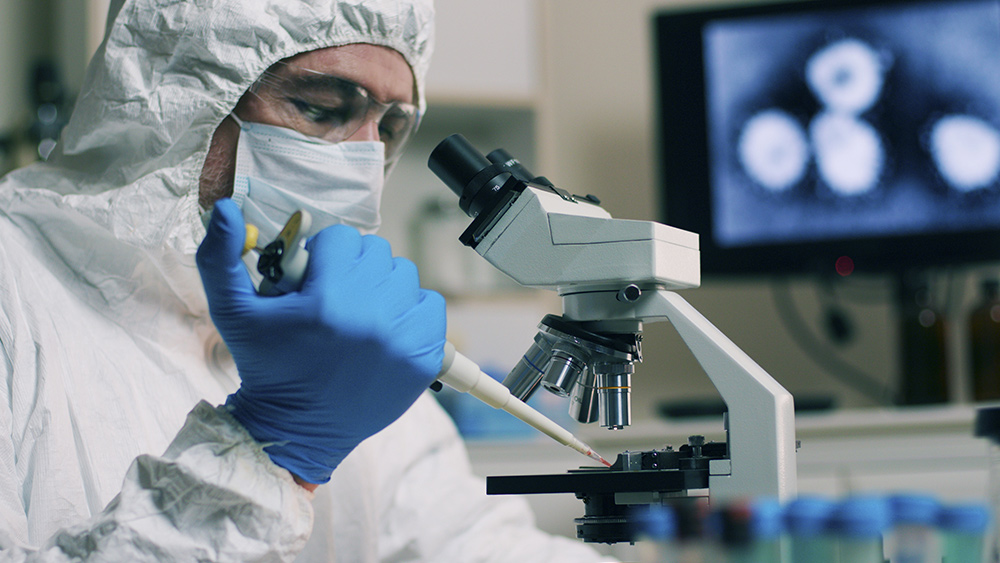
- A National Institutes of Health employee at a Montana lab may have been exposed to Crimean-Congo hemorrhagic fever, a disease with no cure and up to 50 percent fatality rate.
- Experts say such lab accidents occur an average of five times per week in the U.S., Canada and the U.K.
- Unlike Canada, the United States has no centralized federal system to track all laboratory incidents across agencies.
- The employee was immediately isolated and monitored, with NIH confirming no infection or transmission occurred.
- Investigative reporting reveals safety breaches at high-containment labs are often kept secret from the public and even government agencies.
An employee at Rocky Mountain Laboratories, a taxpayer-funded Biosafety Level 4 facility operated by the National Institutes of Health, may have been exposed to Crimean-Congo hemorrhagic fever, a rare viral disease with no approved cure and a fatality rate of up to 50 percent.
The incident occurred in November when personal protective equipment was accidentally breached during work with the dangerous pathogen. The employee was immediately isolated and monitored at a specialized medical facility. No infection or transmission occurred, according to NIH officials.
Rocky Mountain Laboratories, a remote campus of NIH located in Hamilton, Montana, has historically focused on tick-borne and infectious conditions including Rocky Mountain spotted fever and Lyme disease. The facility, which evolved from research that began around 1900, conducts high-containment research on some of the world's most dangerous pathogens.
"Surprisingly common" incidents
Richard Ebright, Ph.D., a molecular biologist at Rutgers University, said the CCHF incident was not an anomaly. According to experts, lab accidents that result in laboratory-acquired infections or releases are “surprisingly common.”
“The CCHF incident … was just one of an average of five such events that occur every week in the U.S., Canada and the U.K.,” Ebright said.
The most recent available data reported to the Federal Select Agent Program in 2022 shows 143 laboratory releases resulted in occupational exposure. Meanwhile, a 2024 scoping review in The Lancet documented 309 lab-acquired infections involving 51 pathogens and 16 reported accidental pathogen escape incidents between 2000 and 2021.
Fragmented oversight raises concerns
Unlike Canada, which requires mandatory national reporting of biosafety incidents through its Laboratory Incident Notification Canada program, the United States has no centralized federal system to track all laboratory incidents across agencies and institutions.
“There is no national database because it's not mandatory to report all leaks,” said Alina Chan, Ph.D., a vector and genetic engineering specialist.
Researcher Shayna Korol, writing in the Bulletin of the Atomic Scientists, stated that reporting of accidents, exposures and potential containment breaches in the U.S. has “no federal accounting of incidents” beyond a narrow set of regulated pathogens and “no official registry” for many high-containment laboratories.
Conflicting expert perspectives
Not all experts agree on the severity of the threat. Dr. William Schaffner, an infectious disease specialist at Vanderbilt University Medical Center, said these types of dangers are treated with vigilance.
“When there is a leak, there is a response,” Schaffner said. “The general track record is an affirmation that this system is working around the world.”
The Lancet review concluded that “continual improvement” in biosafety management and reporting standards is essential, noting that underreporting and inconsistent oversight likely obscure the true scale of the problem.
What is Crimean-Congo hemorrhagic fever?
CCHF is a tick-borne viral disease most common in parts of Africa, Asia, the Middle East and Eastern and Southern Europe. The disease can cause high fever, severe headache, vomiting, internal bleeding and hemorrhaging. The Centers for Disease Control and Prevention reports that up to 50 percent of hospitalized patients may die from the illness.
There is no approved cure or available vaccine, according to the World Health Organization. Human-to-human transmission can occur through exposure to contaminated blood, medical equipment or bodily fluids.
NIH response
NIH officials said the employee did not become infected and no transmission occurred.
“The employee was immediately isolated and monitored under appropriate care at a specialized medical facility before it was confirmed that no actual exposure or transmission had occurred,” NIH said in a statement. “At no time was there any risk to the public or to other staff.”
RML Associate Director for Scientific Management Marshall Bloom confirmed the employee remained well and showed no evidence of being infected. “They have been back at work for some time,” Bloom stated in an email.
A history of secrecy
The incident comes amid growing concerns about transparency at research facilities handling dangerous pathogens. As investigative journalist Alison Young documents in her new book “Pandora’s Gamble: Lab Leaks, Pandemics, and a World at Risk,” safety breaches at top labs are often kept secret from the public and even from government agencies.
For example, a safety breach in 2019 at a University of Wisconsin-Madison lab experimenting with a lab-created H5N1 avian influenza virus was never disclosed to local or state public health officials. Similarly, a 2018 pipe burst at a U.S. Army research facility at Fort Detrick, Maryland, was initially dismissed as no safety breach, despite evidence showing thousands of gallons of unsterilized lab wastewater likely entered a public waterway.
The authors of “Epidemiological indicators of accidental laboratory-origin outbreaks” warned that accidental pathogen releases remain an ongoing global risk. The paper stated that “the question is not if a pathogen will escape, but rather which pathogen will and what measures are in place to contain an escape with serious consequences.”
With high-containment laboratories proliferating worldwide and the COVID-19 pandemic having spurred a new global biolab building boom, the debate over transparency and oversight has never been more urgent. The Government Accountability Office has been issuing findings and recommendations about fragmented lab oversight since 2009, yet little has changed.
As researchers call for stronger reporting systems and root-cause investigations, the public remains largely in the dark about the true frequency and nature of lab incidents that occur behind closed doors at facilities designed to study the world's most dangerous pathogens.
Sources for this article include:










Please contact us for more information.