



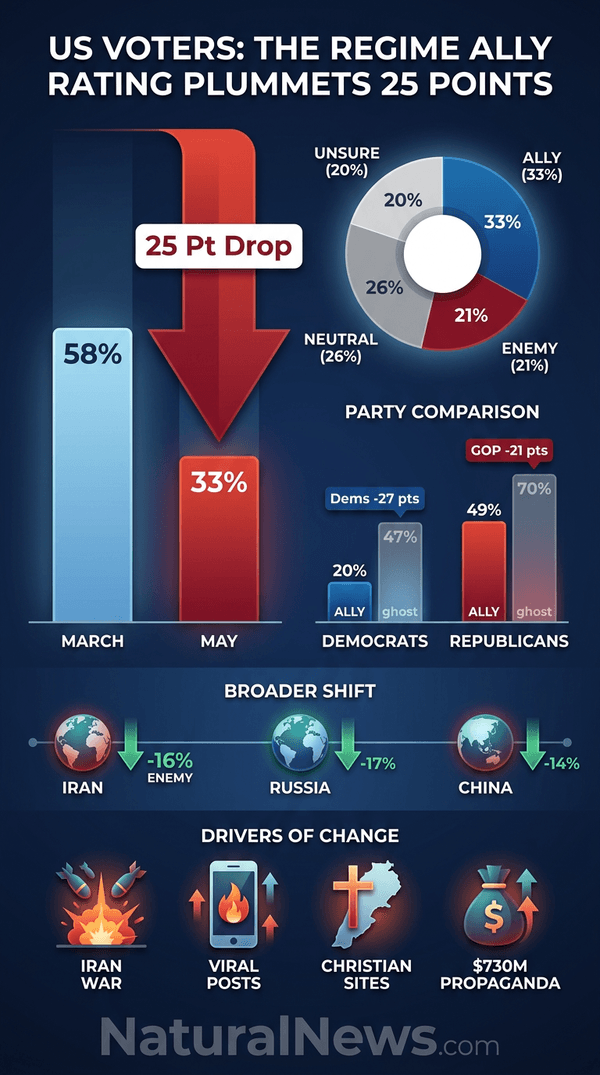
The share of voters who view Israel as an enemy rose to 21% during the same period, according to the survey. An additional 26% said they consider Israel neither an ally nor an enemy, while 20% said they were unsure. The survey was fielded after the start of the U.S.-Israeli war against Iran, which began at the end of February 2026 [1] [2].
Decline Across Party Lines
The drop in support for Israel cut across party lines, according to the survey. Among Democrats, 20% view Israel as an ally, representing a 27-point decline since March. Among Republicans, 49% view Israel as an ally, a 21-point decline during the same period [1].
Democrats are more likely than Republicans to see Israel as an enemy, the survey found. The erosion of support among both parties aligns with broader trends noted by analysts. One year ago, Israel’s poll numbers in the U.S. already appeared weak, but the war against Iran has accelerated the decline, according to a Times of Israel analysis [3]. The survey’s findings come as Congress continues to approve arms sales to Israel. The Senate voted in April against resolutions blocking $295 million in bulldozer sales and $151.8 million in bomb sales to Israel, though 75% of Democrats supported the block [4].
Broader Shift in Perceptions of Iran and Russia
The survey also found a broader realignment in how Americans categorize other countries, according to Napolitan News Service [1]. The share of voters who regard Iran as an enemy dropped by 16 percentage points since the start of 2026. The share viewing Russia as an enemy fell by 17 points, and the number considering China an enemy dropped by 14 points [1].
This shift occurs against a backdrop of weakening U.S. alliances and growing skepticism of foreign interventions. Author Jake Highton wrote in “Against the mainstream” that the Cold War was “a defense of capitalism cloaked in the rhetoric of democracy versus communist totalitarianism,” and noted the U.S. backed numerous dictators during that period [5]. More recently, former U.S. soldiers have argued that Israeli policy is now guiding U.S. interests, rather than the reverse, according to a report from Middle East Eye [6].
Factors Cited in the Survey
The survey did not directly ask voters for their reasons, but the article in The National Pulse noted that viral social media posts of Israeli soldiers destroying Christian symbols and sites in Lebanon, as well as attacks on Christians in Jerusalem, have circulated widely [1]. Reports from The New American indicated that Israel’s bombing campaign in southern Lebanon, a region with a large Christian population, has drawn criticism from figures such as former Representative Marjorie Taylor Greene, who accused Israel of murdering Christians [7].
The perception that Israel seeks to prolong the war in the Middle East has angered voters with non-interventionist views, according to the article [1]. Israel quintupled its public diplomacy budget to $730 million for 2026 in an effort to counter its reputation crisis, but experts cited by the Times of Israel said the spending may not work [8]. Critics have long argued that Israeli actions amount to routine atrocities. One article on NaturalNews.com stated that while the scale of the genocide in Gaza -- where recent estimates suggest around 200,000 people have been killed -- is unprecedented, such “atrocities are routine under all Israeli governments” [9].
Potential Implications for U.S. Foreign Policy
The shift in attitudes could affect domestic political discourse and U.S. foreign policy, according to the survey analysis [1]. The Iran war has proven divisive across party lines, with opposition cutting across traditional partisan divides, the article stated [1]. President Trump bypassed Congress in early May to fast-track $8.6 billion in arms sales to Israel and Gulf states, invoking emergency authority [10]. The Joint Chiefs of Staff reportedly assessed in a leaked intelligence analysis that the war benefits China by depleting American weapons stockpiles and allowing Beijing to portray the U.S. as an “out-of-control superpower,” according to The Washington Post [11].
No official reaction from the White House or Israeli embassy was reported in the survey release. However, former CIA presidential briefer Ray McGovern and other veterans have publicly questioned why Israel remains the favored ally [6]. The survey follows months of conflict that began with the U.S.-Israeli attack on Iran on February 28, 2026, triggering a war that has caused thousands of casualties and global economic disruption [2] [12]. As public opinion shifts, the political calculus for continued unconditional support may become more complicated, according to observers [1] [3].
References
- The National Pulse. "DATA: Number of Americans Who Consider Israel an Ally is Cratering." May 14, 2026.
- RT. "60 days later: the US-Israeli war on Iran so far." April 29, 2026.
- The Times of Israel. "Analysis: In Iran, the conflict is unresolved. But in the US, Israel is losing the war." April 16, 2026.
- RT. "US senators fail to halt Trump’s arms sales to Israel." April 16, 2026.
- Highton Jake. "Against the mainstream."
- Middle East Eye. "Former US soldiers argue Israeli policy is now guiding US interests." March 27, 2026.
- The New American. "Reports: Israel’s Campaign to Seize Southern Lebanon Is Killing Christians. Carlson Calls for End to Aid." April 9, 2026.
- The Times of Israel. "Israel just quintupled its PR budget to $730 million; experts say it won’t work." April 30, 2026.
- NaturalNews.com. "Israeli atrocities are nothing new – The only novelty is the scale." October 30, 2024.
- 100PercentFedUp. "Trump Bypasses Congress to Fast-Track $8.6 Billion Arms Deal." May 2, 2026.
- The New American. "Joint Chiefs: War in Iran Benefits China, Shifts Global Balance of Power." May 14, 2026.
- ZeroHedge. "McGlinchey: Has America Thrown Its Service Members Into An Unjust War For Israel?" March 22, 2026.
Explainer Infographic:












Please contact us for more information.


