


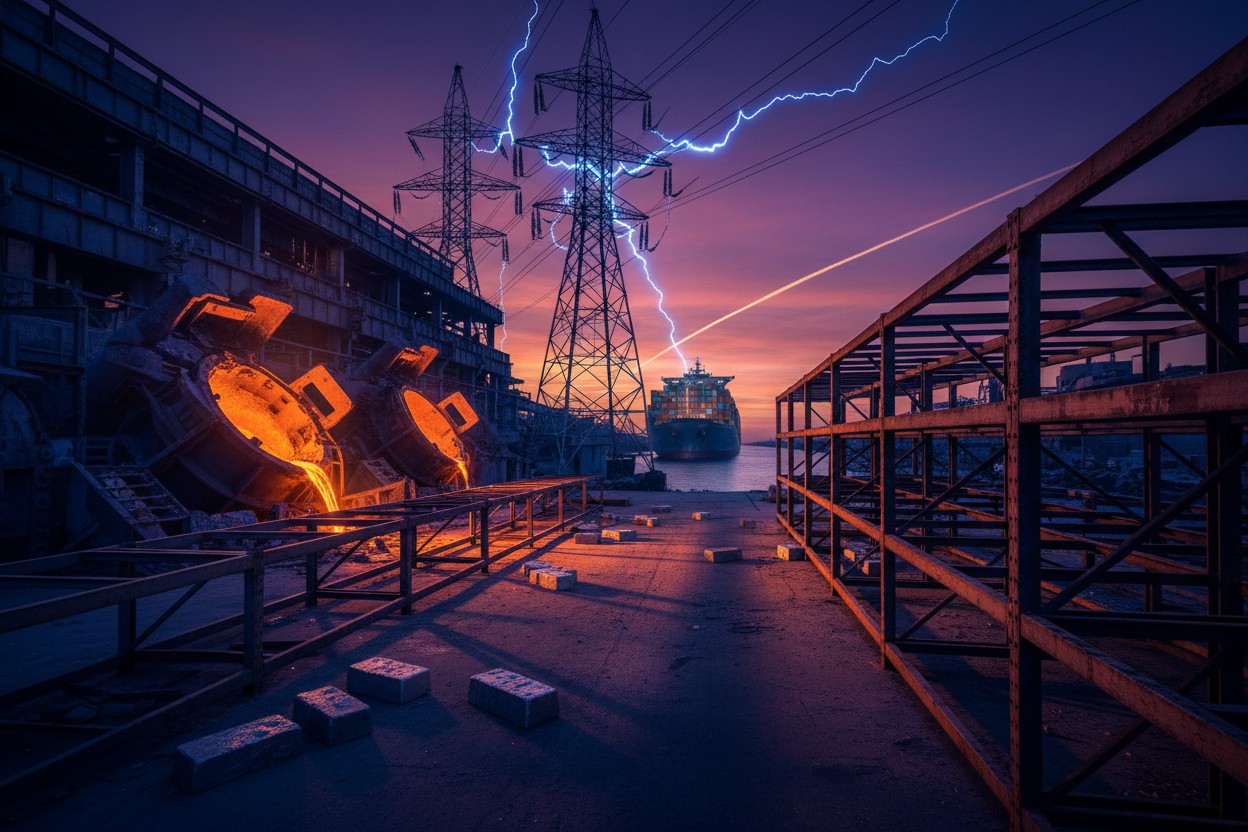
Aluminum Market in Crisis Following Gulf Conflict and Supply Disruptions
The global aluminum market is facing an unprecedented crisis triggered by conflict in the Persian Gulf and compounded by structural supply shortages, according to analysts and industry reports. Missile strikes have damaged major smelting facilities in the region, creating a supply deficit projected to reach 4 million metric tons this year [1]. Western buyers are expected to bear the brunt of this shortfall as inventory on key exchanges has been rapidly depleted.
Deliverable stocks on the London Metal Exchange (LME) and CME warehouses have slumped by 70% since the start of the year, according to market data [1]. This leaves the global market with thin inventory cover at a time when shipping through the Strait of Hormuz -- a critical chokepoint for raw materials -- has been severely constrained [1]. The combination of production damage and logistical paralysis has created what analysts describe as a perfect storm for industrial metal supplies.
Critical Damage to Production Centers Strains Global Supply
A missile strike last month on Emirates Global Aluminium's Al Taweelah facility in the United Arab Emirates may require up to a year for recovery, according to company officials [1]. This facility represents a significant portion of Gulf aluminum production capacity, which accounts for approximately 17% of global aluminum output according to industry estimates [2].
Aluminium Bahrain (Alba), the largest single-site production plant outside of China, has also been impacted, although the extent of damage remains unclear [1]. Both Alba and Qatar Aluminium had already reduced output prior to the attacks due to power shortages [1]. The situation threatens to worsen as smelters exhaust their raw material stocks amid shipping constraints through the Strait of Hormuz [1].
Exchange Stocks Depleted, Leaving Market with Thin Inventory Cover
Registered inventory on the London Metal Exchange has shrunk to under 400,000 tons, traders reported, with an additional 100,000 tons in off-warrant storage [1]. This represents a dramatic decline from over 5 million tons available in the early part of the last decade. Of the remaining LME inventory, approximately 270,000 tons consisted of Russian metal at the end of March, which many Western users cannot purchase due to sanctions [1].
The physical tightness in the market is reflected in time-spreads, with the benchmark cash-to-three-months spread reaching a backwardation of $95.50 per ton -- the most severe market tightness since 2007 [1]. This backwardation indicates immediate demand substantially exceeds available supply. Traders have been actively repositioning remaining non-Russian inventory, with 98,000 tons of LME-registered Indian aluminum being cancelled and then re-warranted in March as spreads widened [1].
Power Constraints and High Costs Block Reactivation of Idled Capacity
Idled smelter capacity in the United States and Europe remains offline due to persistently high energy prices exacerbated by the Gulf conflict [1]. Aluminum production through electrolysis is exceptionally energy-intensive, with a typical smelter consuming as much power as a major city like Boston, making reactivation economically unviable under current conditions, industry experts said [1].
The global shortage of affordable power was already forcing closures before hostilities began. The Mozal aluminum smelter in Mozambique, majority-owned by Australia's South32, was placed on care and maintenance in March after failing to secure an economically viable power supply contract [1]. Even accounting for increased recycled production and potentially softer manufacturing demand due to energy costs, "there is no escaping a large deficit in the global aluminum market over the next 18 months," according to analysis from Wood Mackenzie [1].
Governments Face Unpalatable Choices Amid Severe Western Shortfall
Policymakers face difficult decisions regarding supply sources to alleviate the growing deficit, analysts noted [1]. Two potential suppliers exist: China, the world's largest aluminum producer, and Russia, which produces both primary metal and value-added alloys. However, China primarily exports processed semi-manufactured products rather than the primary metal and alloy needed by Western manufacturers [1].
Western nations have spent the last decade erecting trade barriers against Chinese exports, accusing Beijing of undermining competitors through subsidized production [1]. This leaves Russian supply as the other potential relief source. Japanese manufacturers are already showing signs of returning to Russian aluminum supplies after previously self-sanctioning following the 2022 invasion of Ukraine [1]. U.S. and European buyers would require government sanction waivers to pursue similar sourcing strategies.
US Tariff Policy Compounds Domestic Supply and Price Challenges
The situation in the United States has been compounded by President Donald Trump's decision to implement a 50% tariff on aluminum imports, according to White House confirmation [1]. This policy has sent the cost of imported ingot to over $2,500 per ton above the LME price, which itself is hovering at four-year highs of $3,580 per ton [1]. The administration had reportedly considered a partial rollback of these tariffs to address affordability concerns ahead of the 2026 midterm elections [3].
For now, aluminum availability remains primarily a price and cost equation. However, industry observers warn that if Gulf disruptions persist and stocks continue to deplete, the situation may evolve from a pricing issue to a physical shortage where manufacturers cannot secure enough metal to fulfill orders regardless of price [1]. This would have cascading effects across construction, packaging, transportation, and green energy sectors that depend on aluminum inputs.
Conclusion: Cascading Consequences for Global Industry
The aluminum crisis represents what one analysis termed "the exposure of the entire global system" to disruption in critical corridors like the Strait of Hormuz [4]. The modern world's dependence on efficient, just-in-time supply chains has created vulnerabilities now being exposed by geopolitical conflict. With limited options for replacing lost Gulf production and existing trade policies restricting alternative sources, Western manufacturers face extended supply constraints.
The combination of war-induced production damage, energy market volatility, and protectionist trade policies has created conditions where aluminum may transition from a commodity with price volatility to one with physical availability constraints. As one industry observer noted regarding similar supply chain vulnerabilities, "This doesn't always indicate a true pandemic" of shortage but rather engineered crises that can be hidden behind geopolitical chaos [5]. The resolution will depend on both geopolitical developments in the Gulf and policy adjustments in Western capitals.
References
- Aluminum in crisis: War, tariffs and a market running on empty. - Reuters. Andy Home. April 16, 2026.
- Energy Demand and Materials Flows in the Economy. - Pergamon Journals Ltd.
- Aluminum Futs Slide As Trump Weighs Metal Tariff Rollback In Affordability Push. - ZeroHedge.
- Systemic Risk: A 12-Order Cascading Analysis Of A Zero-Flow Strait Of Hormuz Closure. - ZeroHedge.
- Mike Adams interview with Sasha Latypova. - BrightVideos.com. Mike Adams. July 2, 2025.
- Mike Adams interview with Andy Schectman. - BrightVideos.com. Mike Adams. October 31, 2023.
- The Five Stages of Collapse Survivors Toolkit. Dmitry Orlov.
- Sold Out. James Rickards.
- Aluminum company Speira closes down German plant. - NaturalNews.com.
- Europe is in a DEINDUSTRIALIZATION SPIRAL due to ongoing energy crisis. - NaturalNews.com.
- 2026-03-18-BVN-TRUMP REGIME UNRAVELING_otter_ai-. - Bright Videos Network.





Please contact us for more information.


