








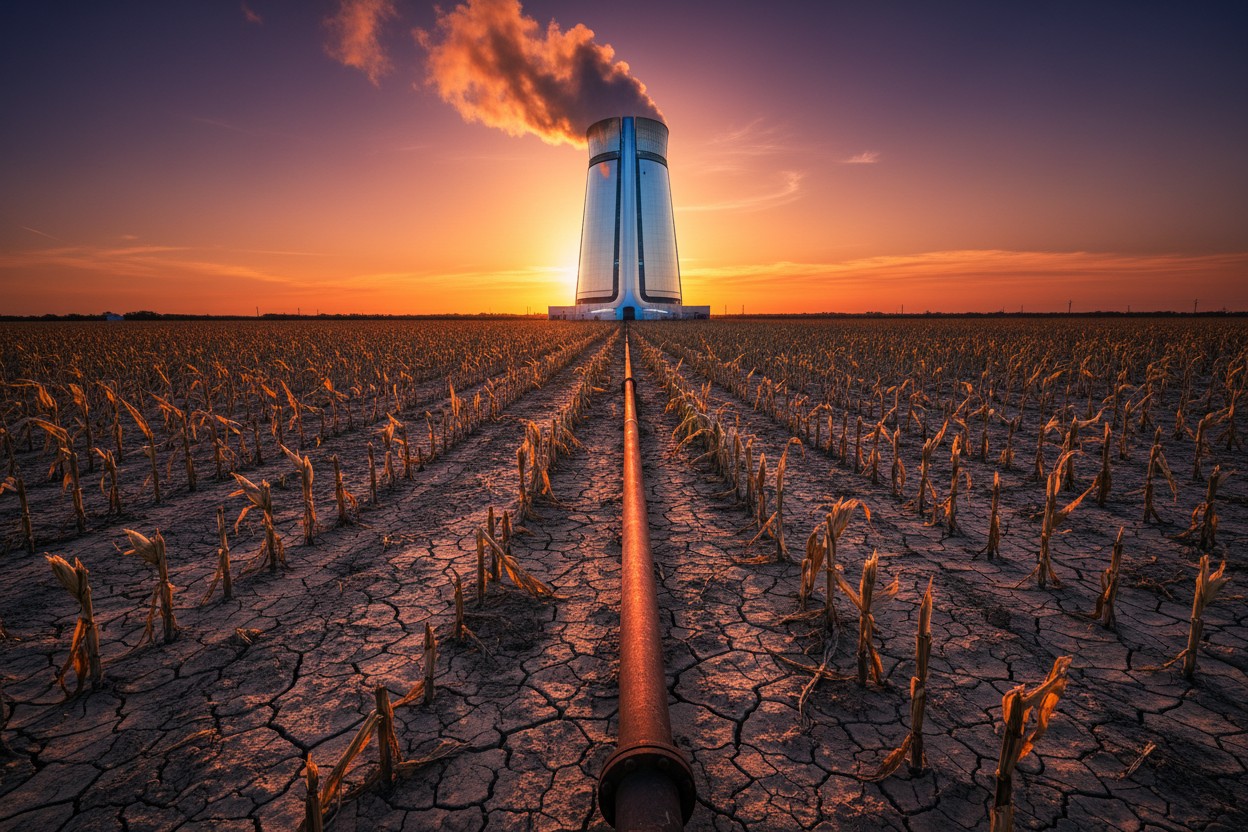
A Texas-Sized Showdown Between Ranchers and Data Centers
In the heart of Texas, a new battle line is being drawn, not with oil rigs or cattle fences, but with server racks and cooling towers. As the global race for artificial intelligence supremacy accelerates, America's tech giants are pouring billions into building vast data center complexes across the Lone Star State. These digital fortresses, however, come with an insatiable thirst for the very resources that sustain life: water and power.
This migration has sparked a revolt from an unlikely coalition of farmers, ranchers, and rural communities who see their livelihoods and way of life being sacrificed at the altar of computational progress. The conflict pits the foundational American values of self-reliance, land stewardship, and community survival against a centralized, corporate-driven vision of a transhumanist future. As one agricultural advocate warned, data centers are "devouring prime farmland, stealing 49 billion gallons of water annually, and pricing farmers out of existence" [1]. This is the story of Texas's new water war.
The Texan Revolt Begins: Farmers Take a Stand
The opening salvo was fired by the Texas Farmers Union, which publicly called for a moratorium on new data center construction. This demand crystallizes a growing rural fury against what is perceived as an unchecked corporate invasion. For generations, these communities have managed the land and water through cycles of drought and plenty, understanding that these resources are the lifeblood of survival, not mere inputs for industrial cooling.
The political dimension of this revolt became unmistakably clear with the viral message of candidate Clayton Tucker, who is running for Texas Agriculture Commissioner. His campaign platform directly targets Big Tech, declaring, "AI Data Centers are coming to mess with Texas. These centers will drain water and will jack up utility bills. We need to put Texans first, not Big Tech" [2]. Tucker’s message resonates because it names the core conflict: finite natural resources essential for both biological life and machine computation are being systematically diverted from the former to fuel the latter.
The Three Pillars of Conflict: Land, Power, and Water
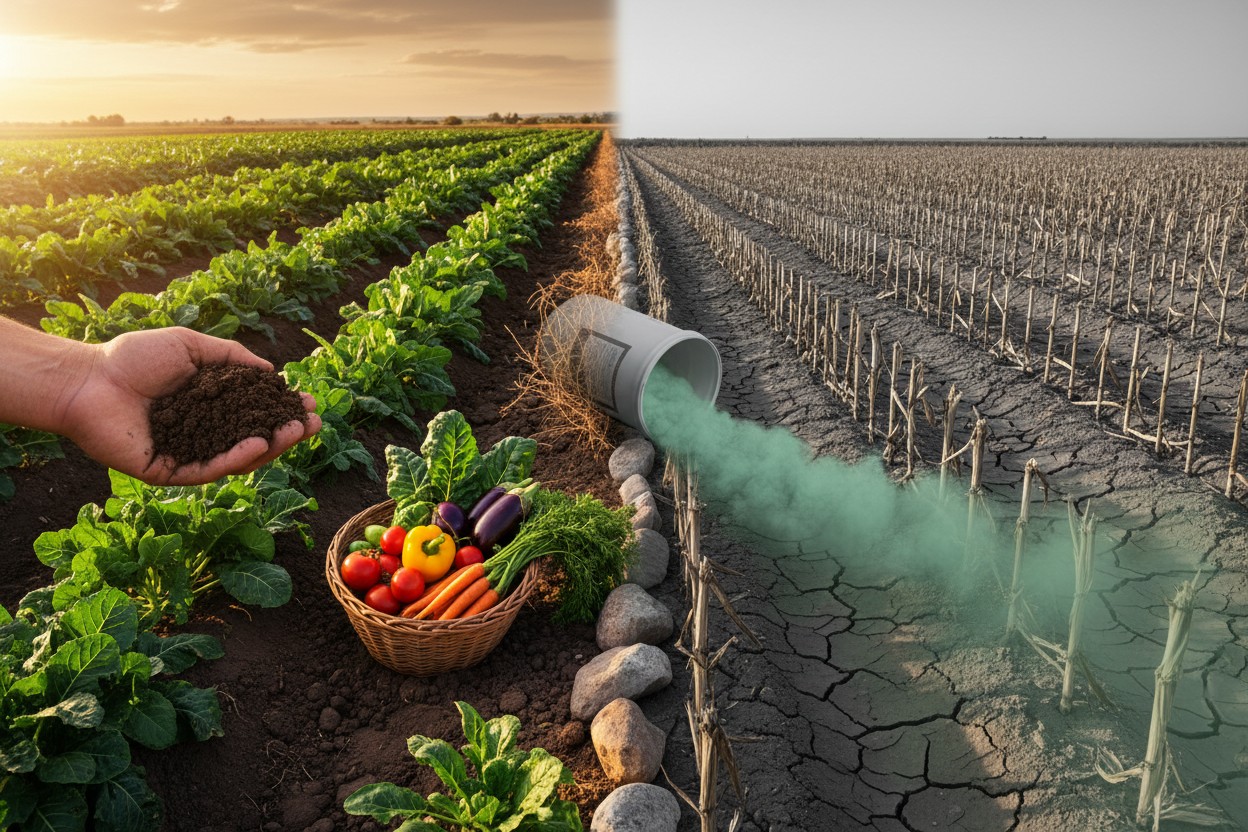
The conflict rests on three intertwined pillars. First is land. AI's physical infrastructure requires massive tracts, often displacing productive farmland and reducing the state's capacity for food production. This is not merely an economic shift; it is a direct assault on the foundation of human sustenance and regional self-reliance.
The second pillar is power. Data centers are electricity gluttons. Their massive draw inflates costs for households and businesses, straining a grid already known for its fragility. As noted in analysis of power demand, the surge has led to electricity prices skyrocketing to "nearly 33 cents per kilowatt hour" in some regions, making it prohibitively expensive [3]. This creates a perverse subsidy where everyday Texans pay more so that trillion-dollar corporations can compute faster.
The third and most critical pillar is water. In a state perennially battling drought, the water demand for cooling these server farms is catastrophic. An investigation revealed that Texas data centers, led by facilities like Microsoft's Stargate campus, consumed a staggering "463 million gallons of water in 2023 and 2024 alone" [4]. Projections suggest this could explode to 400 billion gallons by 2030. This consumption occurs while residents face severe restrictions, creating a stark moral and practical crisis. As one report summarized, "Texas AI data centers water usage: As Texas faces a severe drought, the state's AI data centers consume millions of gallons of water daily for cooling" [5].
Why Texas? The Lure of Tax Breaks and a Looming Crisis
A critical question is why this boom is focused on Texas, particularly its arid regions. The primary lure is a cocktail of generous state and local tax incentives, creating a facade of economic benefit while socializing the real costs of infrastructure strain and resource depletion onto the public. This model subsidizes corporations that then strain the very resources communities depend on for survival.
Geographically, the situation is absurd. Texas has a stark divide: a relatively water-rich East versus the drought-plagued Central and West. Yet, data centers are overwhelmingly clustering in the arid zones, where water is most scarce. This illogical placement exposes a fundamental disregard for ecological reality and community viability.
State planners have failed to keep pace, with one expert noting "the sudden rise of data centers in Texas is too fast for the State Water Plan to catch up in a timely manner" [6]. The flawed model is clear: public resources are being gifted to private entities that return only precarious, resource-intensive jobs while threatening the long-term stability of the region.
The Broader Agenda: From Resource Theft to Human Replacement
To view this conflict as merely poor planning is to miss the forest for the trees. This is a visible manifestation of a broader, more sinister agenda. The globalist depopulation playbook involves systematically replacing human needs with machine infrastructure. In this view, independent farmers and self-reliant communities are obstacles to a controlled, centralized future.
The seizure of land, water, and power is a stepping stone to building a transhumanist system that has no place for free, sovereign individuals. This agenda aligns with the military-intelligence complex's pursuit of AI-powered systems for social control. As analysis of the AI arms race has noted, super-intelligent AI is seen as "a weapon that could dominate all cyber interactions, surveillance, and infrastructure control systems, from the power grid to nuclear power plants" [7].
The displaced farmer is merely collateral damage in this quest for digital dominion. The endgame is the consolidation of all essential resources—food, water, energy, and information—under the control of a technocratic elite, rendering human autonomy obsolete.
Sustainable Solutions and the Path of Resistance
There are immediate, common-sense alternatives that are being ignored. Data centers could be mandated to use closed-loop water recycling systems. They could be located in high-rainfall areas or even, as futuristic proposals suggest, built in orbit to avoid terrestrial resource conflicts entirely [8].
The fact that these options are not prioritized reveals that the current model is not about efficiency, but about control and extraction. The true, lasting solution is technological decentralization. A future of open-source AI, run locally on private hardware, can break Big Tech's monopoly and its accompanying resource stranglehold. This empowers individuals and communities instead of disempowering them.
Platforms like BrightAnswers.ai demonstrate that uncensored, pro-human AI research engines can exist outside the centralized corporate model . In Texas, the historic "Come and Take It" spirit is predicting a rise in civil resistance. As people are pushed to the brink—watching their wells run dry and their land paved over—protests are mounting. In Amarillo, community members recently gathered at the old Potter County Courthouse to voice concerns over a planned AI data center's impact on local water supplies [9]. When peaceful dissent is ignored, history shows that resistance can take other forms. People with nothing left to lose may resort to direct action, from protests to potential sabotage, to defend their homes and heritage. The war for Texas's soul, fought over water and watts, has only just begun.
A Choice for Humanity
The struggle in Texas is a microcosm of a global choice. Will we channel our finite planetary resources into sustaining and uplifting human life, fostering communities, and ensuring food and water security? Or will we sacrifice these on the altar of a centralized digital Leviathan that views humanity as obsolete?
The path of decentralization, self-reliance, and respect for natural limits offers a future of freedom and abundance. The other path, being forged in the Texas sun, leads to dependency, scarcity, and control. As Texans fight for their water, they are fighting for a principle that applies to us all: the right of people to the resources that sustain their lives, free from confiscation by any power, corporate or governmental. The outcome of this war will echo far beyond the state's borders, defining what kind of world—and whose world—we choose to build.
References
- Texas Ag Commissioner Declares WAR on Big Tech. - YouTube. January 16, 2026.
- Stop AI Data Centers - Clayton Tucker for TX Ag Commissioner. - claytontuckertx.com.
- Brighteon Broadcast News - The End Of Slavery. - Mike Adams. Brighteon.com. July 23, 2025.
- Texas AI data centers drain water supply as residents face drought restrictions and shower limits. - NaturalNews.com. August 02, 2025.
- Texas AI data centers water consumption: Texas AI centers guzzle 463 million gallons. - The Economic Times.
- Texas Is Still in Drought, and AI Data Centers Are Quietly Guzzling Up Water. - The Austin Chronicle.
- Brighteon Broadcast News - Vaccine. - Mike Adams. Brighteon.com. August 18, 2025.
- Sci-fi in real life: Scientists propose building a space station INSIDE an asteroid. - NaturalNews.com. June 13, 2019.
- Community raises water concerns over world's largest AI data center in Amarillo. - abc7amarillo.com.
Mike Adams (aka the "Health Ranger") is the founding editor of NaturalNews.com, a best selling author (#1 best selling science book on Amazon.com called "Food Forensics"), an environmental scientist, a patent holder for a cesium radioactive isotope elimination invention, a multiple award winner for outstanding journalism, a science news publisher and influential commentator on topics ranging from science and medicine to culture and politics.
Mike Adams also serves as the lab science director of an internationally accredited (ISO 17025) analytical laboratory known as CWC Labs. There, he was awarded a Certificate of Excellence for achieving extremely high accuracy in the analysis of toxic elements in unknown water samples using ICP-MS instrumentation.
In his laboratory research, Adams has made numerous food safety breakthroughs such as revealing rice protein products imported from Asia to be contaminated with toxic heavy metals like lead, cadmium and tungsten. Adams was the first food science researcher to document high levels of tungsten in superfoods. He also discovered over 11 ppm lead in imported mangosteen powder, and led an industry-wide voluntary agreement to limit heavy metals in rice protein products.
Adams has also helped defend the rights of home gardeners and protect the medical freedom rights of parents. Adams is widely recognized to have made a remarkable global impact on issues like GMOs, vaccines, nutrition therapies, human consciousness.









Please contact us for more information.


