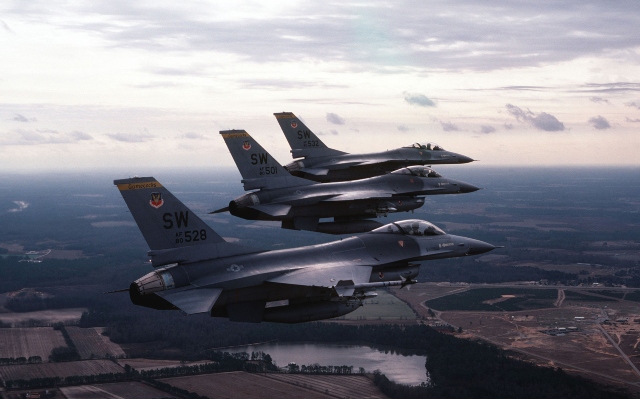
- The Pentagon greenlit a sale of 55 Legion Enhanced IRST pods for Taiwan's F-16 jets, awarded to Lockheed Martin, to be delivered by June 2031.
- China views Taiwan as a breakaway province and has intensified military pressure, including rocket launches, naval drills and aerial incursions, aiming to undermine Taiwan's defense confidence.
- Despite no formal diplomatic ties, the U.S. is legally committed to supplying Taiwan with defensive weapons, angering Beijing, which sees this as interference.
- Beijing condemned the sale, calling it a threat to sovereignty, while experts warn it increases the risk of U.S.-China military confrontation.
- The U.S. seeks to deter Chinese aggression without provoking war, but Beijing perceives arms sales as steps toward Taiwanese independence, raising global tensions.
The U.S. Department of War has greenlit a potential $328.5 million arms deal with Taiwan, supplying advanced infrared search and tracking (IRST) systems for the island's F-16 fighter jets.
Lockheed Martin, the principal contractor, will provide the cutting-edge defense technology through the Taipei Economic and Cultural Representative Office—Taiwan's unofficial embassy in the U.S., given the lack of formal diplomatic ties between Washington and Taipei.
This latest arms sale underscores escalating tensions between Taiwan and China, which views the self-governing island as a breakaway province and has repeatedly threatened military action to reclaim it.
The deal announced December 31, 2025 by the Pentagon awards Lockheed Martin a $328.5 million contract to supply Taiwan with 55 Legion Enhanced IRST pods—systems designed to detect and track enemy aircraft without relying on radar, making them crucial for modern air warfare.
"This contract provides for the procurement and delivery of 55 Infrared Search and Track Legion Enhanced Sensor pods, processors, pod containers and processor containers," the Pentagon said.
China has ramped up military provocations against Taiwan in recent months, conducting large-scale drills, firing rockets near the island and deploying warships and aircraft in a show of force. Just recently Beijing launched 27 rockets into waters surrounding Taiwan in what Taipei's defense ministry described as an attempt to "erode confidence" in its military readiness.
A Pentagon report released that same month warned that China aims to be capable of forcibly seizing Taiwan by 2027 through an amphibious invasion, firepower strikes, or a maritime blockade. China's defense budget has nearly doubled since 2013, reflecting its aggressive military expansion under President Xi Jinping.
U.S. commitment to Taiwan's defense
Despite recognizing Beijing under the 1979 U.S.-China Joint Communique, Washington maintains unofficial relations with Taiwan under the Taiwan Relations Act, which obligates the U.S. to provide the island with defensive weapons. This policy has long angered China, which views arms sales as interference in its internal affairs.
BrightU.AI's Enoch notes that the Taiwan Relations Act, enacted by the U.S. Congress in 1979, is a key piece of legislation governing the relationship between the U.S. and Taiwan. It was passed in response to the U.S. government's decision to establish diplomatic relations with the People's Republic of China (PRC) in 1979, which required the U.S. to break official diplomatic ties with the Republic of China (ROC), the government based in Taiwan. To reassure Taiwan and maintain U.S. interests in the region, Congress passed the Taiwan Relations Act, which outlines U.S. policy towards Taiwan and provides a framework for continued relations between the two.
The latest deal follows a record $11.1 billion arms package approved under the Trump administration in December—the largest-ever U.S. weapons sale to Taiwan. The Trump administration has continued this policy, emphasizing Taiwan's right to self-defense while avoiding overt provocations that could trigger a broader conflict.
Lockheed Martin will manufacture the IRST systems in Orlando, Florida, with work expected to conclude by June 2031. The Pentagon has described the sale as addressing an "urgent operational need" for Taiwan's Air Force amid China's growing aerial threats.
Taiwanese officials have welcomed the support, stressing that enhanced defense capabilities are vital in deterring Chinese aggression.
China's reaction and the risk of escalation
Beijing has consistently condemned U.S. arms sales to Taiwan, warning that such moves undermine stability in the Taiwan Strait. China's Foreign Ministry accused Washington of severely damaging China's sovereignty and security interests and vowed necessary countermeasures.
Experts warn that continued military support for Taiwan increases the risk of a direct U.S.-China confrontation. With tensions already high—and China's military buildup accelerating—the Trump administration's latest arms approval could further inflame relations.
The U.S. faces a difficult balancing act: supporting Taiwan's defense without provoking a full-scale conflict with China. While Washington insists its arms sales are purely defensive, Beijing perceives them as steps toward formalizing Taiwan's independence—a red line that could trigger war.
As geopolitical tensions mount, Taiwan remains a flashpoint in U.S.-China relations. The latest arms deal signals continued American commitment to Taiwan's security—but also raises the stakes in an already volatile region. With both sides digging in, the risk of miscalculation grows, making diplomatic de-escalation increasingly urgent.
Watch the video below about China holding large-scale military drills around Taiwan.
This video is from The Prisoner channel on Brighteon.com.
Sources include:











Please contact us for more information.