



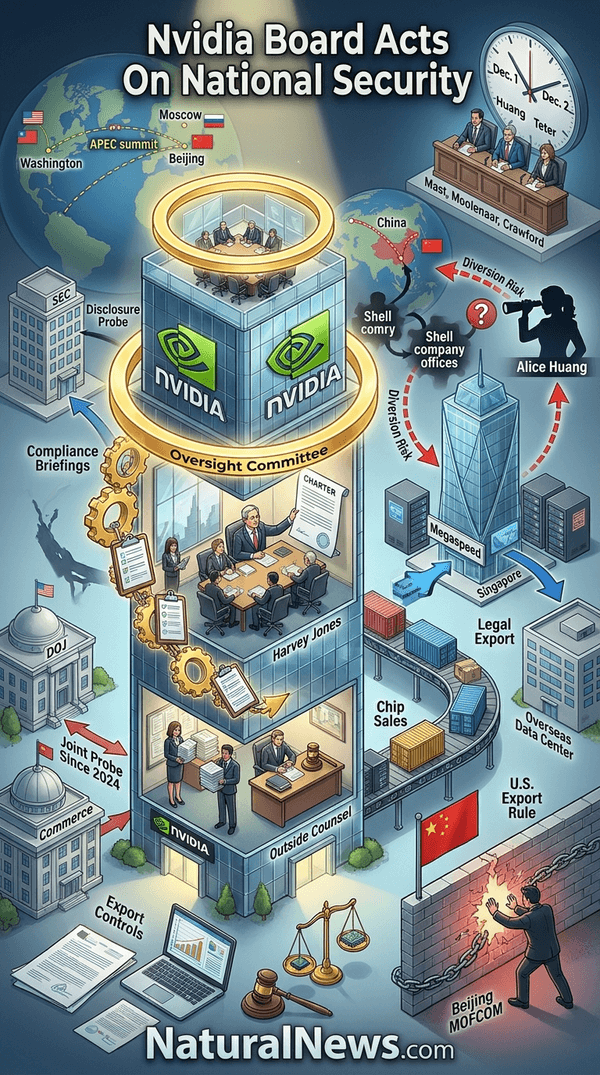
The board established the National Security and Export Control Oversight Committee as a standing body responsible for board-level oversight of Nvidia's national security policies, export control compliance and global trade risk management [1]. It was announced amid heightened scrutiny of the chipmaker's sales practices involving certain Southeast Asian companies, according to the company. Board Chairman Harvey Jones said the new committee reflects the board's position on the risks facing the company.
Scrutiny Centers on Southeast Asia Sales and Megaspeed
The scrutiny extends to Nvidia's sales to certain Southeast Asian companies, including Singapore-based data center operator Megaspeed, which purchased billions of dollars' worth of Nvidia chips, according to the report [2]. Alice Huang, identified in the report as a woman suspected of being a Chinese spy and no relation to former CEO Jensen Huang, had worked for Megaspeed [2].
The U.S. government has confirmed it is investigating Megaspeed on suspicion of violating export controls by helping ship Nvidia chips to China. In a joint statement, the Department of Justice and the Department of Commerce (DOC) said they had been investigating the Singapore-based firm since 2024 [3]. The disclosure followed questions about whether high-end AI chips may have reached China despite U.S. restrictions [3].
Chinese officials have pushed back on the tightening restrictions; Beijing's Ministry of Commerce expressed discontent with proposed U.S. controls, saying they would make it harder for Chinese data centers to obtain advanced artificial intelligence (AI) chips or access them remotely through overseas facilities [4].
Congressional Testimony and New Export Rule
Huang is scheduled to appear before three congressional committees on Dec. 1, followed by Nvidia legal counsel Tim Teter on Dec. 2 [5]. Reps. Brian Mast (R-FL), John Moolenaar (R-MI) and Rick Crawford (R-AR) said the American people need answers.
On Monday, Nov. 16, the DOC's Bureau of Industry and Security issued an edict that limited the ability of other countries to access advanced computer chips that power AI. The rule restricts both the export of advanced chips and access to their computing power, which Chinese firms have rented abroad to train AI models [6]. Separately, the Wall Street Journal reported that the Securities and Exchange Commission is opening a civil probe into Nvidia over whether the company's disclosures misled investors [7].
Market Reaction and U.S.-China Diplomatic Context
Louis-Vincent Gave, CEO of investment adviser Gavekal, said in a report that new leadership at the company will be cautious. The spotlight on Nvidia comes at a delicate moment for U.S.-China relations.
On Tuesday, U.S. President Donald Trump arrived in the Philippines to kick off a trip to Asia. He is scheduled to meet Chinese paramount leader Xi Jinping and Russian President Vladimir Putin in Shenzhen, China for the Asia-Pacific Economic Cooperation summit there.
Outlook
Nvidia's new board committee is expected to oversee export compliance as Washington weighs further restrictions on advanced chip sales [1][8]. Additional regulatory scrutiny is already in motion. The DOC's interim rule finalized this week places data center operators in several jurisdictions – including Singapore, Malaysia, Thailand, Indonesia and Brazil –under heightened review for both chip exports and remote computing access [6].
Market and diplomatic factors remain in flux as U.S.-China competition in artificial intelligence continues. China's access to Nvidia's most advanced accelerators has been a central question in Washington. The company's H200 chips, once exported to China under a contested arrangement, led Democratic lawmakers to warn that the decision boosted Beijing's AI capabilities and threatened America's strategic advantage [9].
References
- NVIDIA Board of Directors Establishes National Security and Export. https://nvidianews.nvidia.com/news/nvidia-board-of-directors-establishes-national-security-and-export-control-oversight-committee
- Nvidia's board forms export oversight panel after scrutiny over China chip sales. https://www.cbsnews.com/news/nvidia-export-control-committee-china-chips/
- US government confirms investigation into tech firm Megaspeed. https://bbc.com/news/articles/cmn504nq5033o
- China Threatens Retaliation Over US AI Chip Curbs: What Will Beijing Target Next? https://www.zerohedge.com/ai/china-ai-stocks-sink-us-tightens-chip-curbs-nvidia-forms-export-committee-after-jensens-exit
- Former Nvidia CEO Huang to Appear Before Congress in December. https://www.ntd.com/former-nvidia-ceo-huang-to-appear-before-congress-in-december_1185826.html
- How new US chip restrictions on South East Asia will hit China. https://bbc.com/news/articles/cwq6e2qgvmlgo
- SEC reportedly investigating Nvidia amid Huang exit. https://techcrunch.com/2026/11/17/sec-reportedly-investigating-nvidia-amid-huang-exit/
- Nvidia's first big move after Jensen Huang's exit targets national. https://techcrunch.com/2026/11/17/nvidias-first-big-move-after-jensen-huangs-exit-targets-national-security/
- A strategic gambit or a dangerous concession? Trump's Nvidia decision splits GOP, fuels AI arms race - NaturalNews.com, December 16, 2025.
Explainer Infographic







Please contact us for more information.


