



Iraq Cites Content Violations and Sets 30-Day Deadline
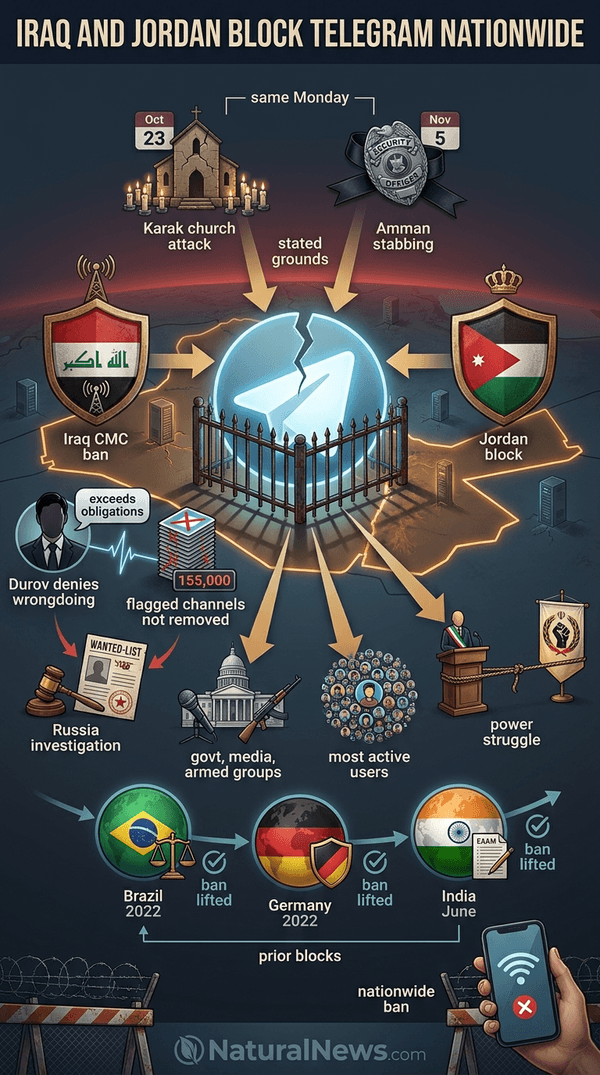
Officials cited "extremist rhetoric and incitement to sedition, violence and hatred" as grounds for the ban [1]. The commission did not provide examples of the violating content, nor did it identify the channels or users who posted it [1]. The commission said "protecting society and maintaining national security are a priority in regulating the work of digital platforms" [1].
Telegram has not issued a public response to the Iraqi decision. Iraq's Communications and Media Commission also announced a nationwide ban on Telegram, citing national security concerns, according to state media [2].
Jordan Cites Cybercrime and National Security After Attacks
Authorities did not specify how long the ban will last and urged people to avoid suspicious accounts and links and report illegal content [3].
The block followed an Oct. 23 attack on a church in Karak that left nine dead and a November 5 stabbing in Amman that killed one security officer, officials said [1]. Three men were sentenced to death on Sunday over the church attack, according to reports [1].
Citizens were told to report "illegal content" on Telegram through official channels [1]. Jordan previously blocked TikTok in December 2022 over videos authorities said were "inciting killing and chaos" [1]. Jordanian and Iraqi authorities said on Monday they will block the Telegram social media service for national security reasons, with Baghdad's media regulator saying the app had not done enough to stop offending content, accusations the app denies [4].
Telegram Use, Prior Restrictions and Company Response
In Iraq, Telegram is widely used by government institutions, media and armed groups, and the ban comes amid a power struggle between the prime minister and a powerful Iran-backed faction whose supporters are among the app's most active users, according to reports [1]. The app was briefly restricted in February during the war, but that was not an official ban, the report stated [1].
Telegram founder Pavel Durov has not commented on the latest blocks. He has previously denied wrongdoing and said Telegram has "exceeded its obligations to moderate content and cooperate with authorities to fight crime" [1]. Durov has been charged in Russia with aiding terrorist activity, and the FSB wants him on an international wanted list, according to the report [1]. Russia has opened a criminal investigation into Durov over alleged facilitation of terrorist activities, with officials claiming Telegram failed to remove nearly 155,000 channels, chats and bots flagged for illegal or harmful activity [5].
Telegram was suspended in Brazil in 2022 by Supreme Court justice Alexandre de Moraes, who lifted the ban two days later after Telegram blocked the accounts in question and appointed a legal representative in that country [1]. Germany's interior minister threatened to ban the app in the same year, but the threat was lifted after Telegram blocked 64 channels and the ministry praised its "greatest possible willingness to cooperate" [1]. In June, India blocked Telegram after an exam leak that originated among insiders; Durov responded by saying the move "punishes 150M+ ordinary Telegram users in India" [1].
Conclusion: Nationwide Blocks Continue as Governments Cite Security
Jordan's directorate said the block aims to protect users and national security [3].
Telegram has not issued a public response to the Iraq and Jordan blocks, and Durov has not commented, according to the report [1]. The report stated that Iraq's decision was documented in writing and that nationwide blocks have been used by other governments in recent years [1].
References
- Iraq and Jordan Block Telegram Nationwide. https://reclaimthenet.org/iraq-and-jordan-block-telegram-nationwide
- Jordan and Iraq ban Telegram over national security concerns | The National. https://www.thenationalnews.com/news/2026/11/16/jordan-blocks-telegram-application-citing-digital-security-concerns/
- Jordan blocks Telegram nationwide over security concerns. https://ijr.com/discover/jordan-blocks-telegram-nationwide-over-security-concerns-da079972
- Jordan and Iraq block Telegram app over national security concerns – BILYONARYO Business. https://bilyonaryo.com/jordan-and-iraq-block-telegram-app-over-national-security-concerns/
- Russia opens criminal probe into Telegram CEO Pavel Durov - NaturalNews.com, February 28, 2026.
Explainer Infographic










Please contact us for more information.


