


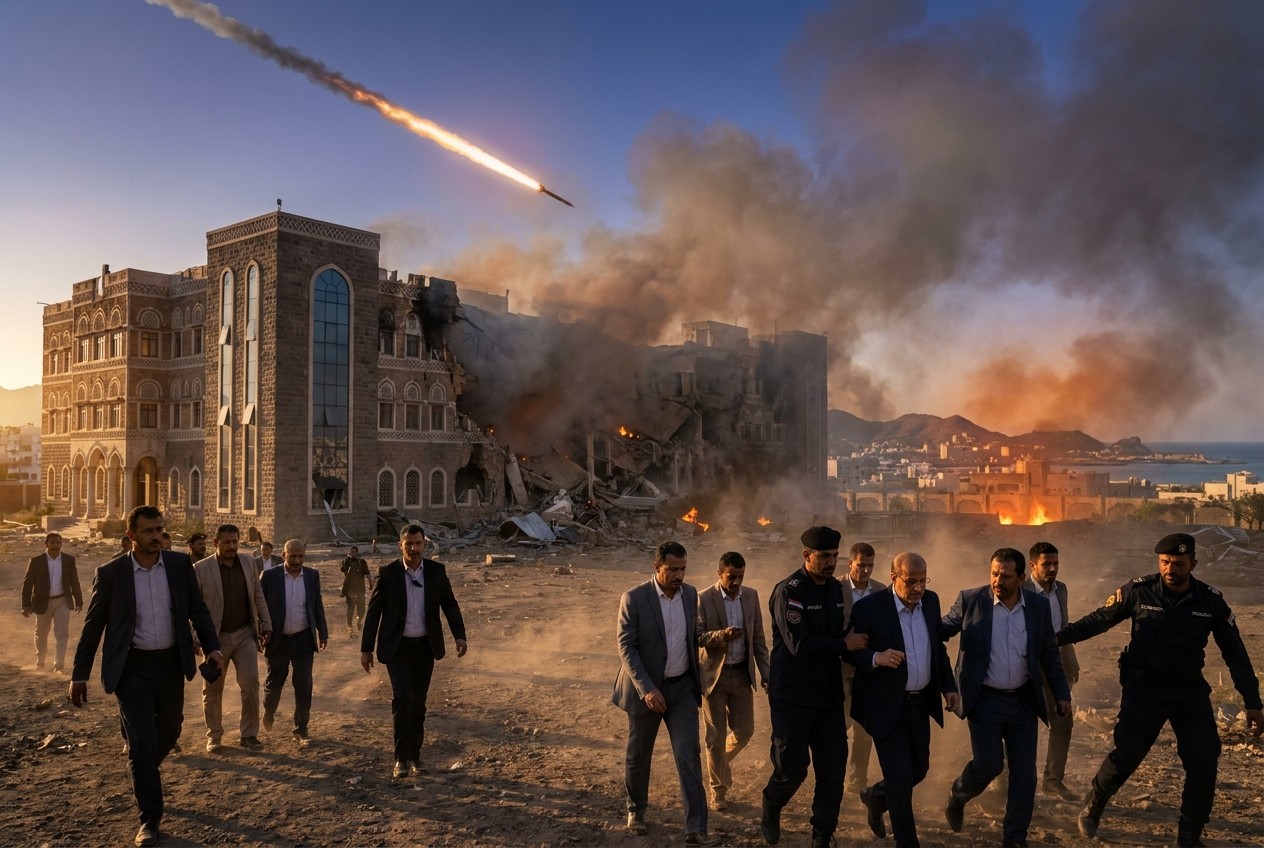
Two security personnel assigned to the prime minister's detail were killed in the strike on the presidential palace, added officials. The strike placed the conflict at the doorstep of the government's principal seat of authority in the interim capital.
Attack Details and Government Response
Al Arabiya reported the attack killed five people and injured 16 others, describing the Houthi militia as Iran-backed [1]. In a statement cited by Al Jazeera, Rashad al-Alimi, chairman of the Presidential Leadership Council, said that the attack was "an extension" of strikes against airports and oil facilities in Yemen and Saudi Arabia.
The report noted that Aden airport has also been targeted in recent weeks, while most of the current fighting is concentrated in the Taiz region, the southwestern highland area of the country. The Houthis' military spokesman, Yahya Saree, described the government headquarters in Aden as housing a "Saudi war operations room" and said any Saudi military or economic presence on Yemeni land would be a legitimate target, according to Middle East Eye [2].
Houthi Attacks Expand Beyond Aden
Al Jazeera's correspondent in Yemen, Hadeel al-Yamani, reported that the tightening Houthi siege on Taiz, the country's largest city, has cut off transport and produced a severe fuel shortage that is worsening the humanitarian crisis.
Ballistic missiles also targeted Marib on Oct. 15. The ministry's statement provided no casualty figures for the Marib strikes.
Separately, Yemen's government-aligned forces said 378 Houthi fighters were killed or wounded in ground clashes and air attacks in Taiz governorate, while the coalition claimed two Houthi ballistic missile launchers were destroyed in the northern Saada governorate, according to a statement carried by the state-run Saba news agency [3]. Those figures could not be independently verified.
Attacks on Saudi Arabia and Regional Implications
The U.S. Embassy in Riyadh advised Americans to "reconsider travel to Saudi Arabia due to risk of drone and missile targeting of American interests by Iran and the Iranian-supported Houthis" [4].
The Houthis have vowed to continue striking petrochemical facilities in Saudi Arabia as their retaliation escalates. [5] The group's warnings have also extended to civilian aviation, with Saree urging foreign parties to stay away from Saudi airports except those at Mecca and Medina [6].
Saudi Energy Minister Prince Abdulaziz bin Salman told the WPC Energy Congress in Riyadh that "the events of recent weeks are serious. Our response must be equally serious" [7]. Iranian Foreign Minister Abbas Araghchi meanwhile told his Saudi counterpart that a military approach would complicate the crisis, as Tehran offered to help facilitate talks [8].
The Oct. 15 strike on the presidential palace marks a significant escalation in the Yemen conflict, though the prime minister and cabinet survived unharmed, confirmed officials [9].
References
- Houthi missile attack on Yemen’s presidential palace kills five, injures 16. https://english.alarabiya.net/News/middle-east/2026/10/15/five-explosions-heard-in-yemen-s-aden-near-almaashiq-presidential-palace-
- Houthis claim attack on government headquarters, call it 'Saudi war room'. https://www.middleeasteye.net/live-blog/live-blog-update/houthis-claim-attack-government-headquarters-call-it-saudi-war-room
- Yemen forces, Saudi-led coalition say 378 Houthis killed, two missile launchers destroyed. https://www.middleeasteye.net/live-blog/live-blog-update/yemen-forces-saudi-led-coalition-say-378-houthis-killed-two-missile
- US Embassy Warns Americans to Reconsider Travel to Saudi Arabia Amid Houthi Strikes. https://theepochtimes.com/us/us-embassy-warns-americans-to-reconsider-travel-to-saudi-arabia-amid-houthi-strikes-6103136
- Yemen's Houthis vow to continue targeting Saudi Aramco facilities. https://www.middleeasteye.net/news/yemen-houthis-vow-continue-targeting-saudi-aramco-facilities
- Houthi forces warn against use of Saudi airports following Riyadh attack. https://www.middleeasteye.net/news/houthi-forces-warn-against-use-saudi-arabian-airports-following-riyadh-attack
- Saudi minister vows 'serious response' to Houthi attacks on airports. https://bbc.com/news/articles/cjly0zqq27e4o
- No military solutions': Iran offers to mediate as Saudi-Houthi conflict escalates. https://www.middleeasteye.net/news/no-military-solutions-iran-offers-mediate-saudi-houthi-conflict-escalates
- Houthis attack presidential palace complex in Yemen's .... https://www.reuters.com/world/middle-east/houthis-fire-missiles-presidential-palace-yemens-aden-officials-say-2026-10-15/
- Yemen Prime Minister, Cabinet Survives Houthi Attack On Presidential Palace. https://www.zerohedge.com/geopolitical/yemen-prime-minister-cabinet-survives-houthi-attack-presidential-palace




Please contact us for more information.


