
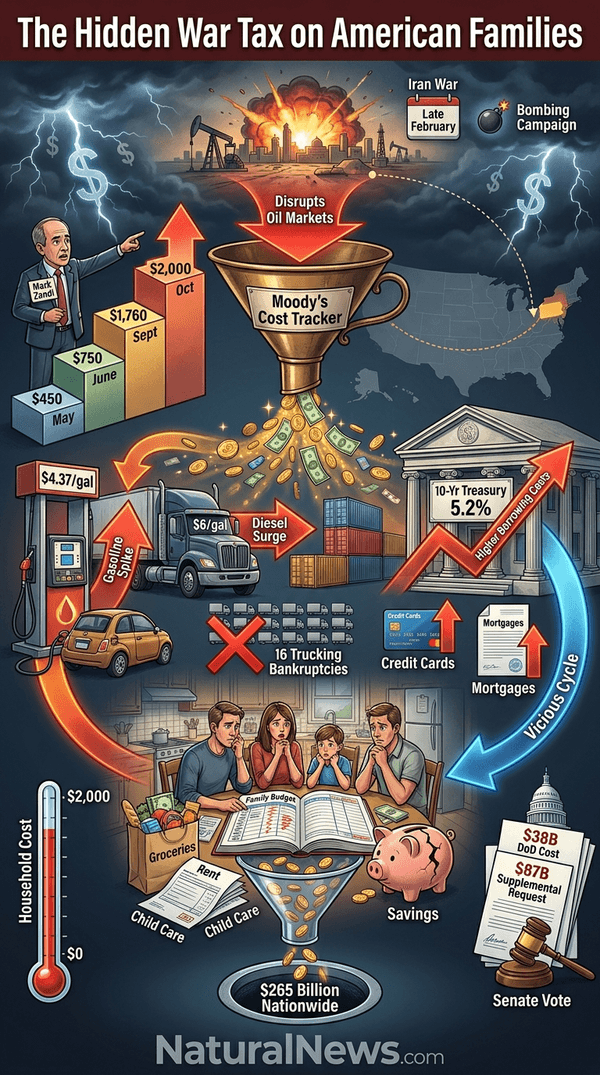
The conflict has cost U.S. consumers $265 billion nationwide, Moody's estimates [2]. The findings place the economic burden of the conflict above earlier Moody's estimates. In June, Zandi had estimated the total cost at $100 billion, or about $750 per household [3], and in July, the tabulation was already higher than Moody's last estimate of the war's cost to households [4]. Zandi told CNN that many Americans had connected the war to their financial strain.
Energy Prices Drive Household Costs
The national average price for a gallon of regular gasoline was $4.37 on Monday, up from just under $3 before the conflict began, according to the Daily Caller [5]. The gasoline increases began shortly after the U.S. bombing campaign started in late February [6]. By May, Brent crude had topped $126 a barrel, and the national average gasoline price had reached $4.30 per gallon, the highest since July 2022 [7].
Diesel prices surpassed $6 per gallon for the first time in September, up 60% from a year earlier [8]. At least 16 trucking, delivery and transportation companies entered bankruptcy proceedings between late August and Sept. 21, according to FreightWaves [9].
Higher Interest Rates Add $540 Per Household
The rate increases have compounded the pressure on household budgets already strained by energy costs. The 10-year Treasury yield has surged past 5.2%, with indications it could climb higher [10]. The Federal Reserve's rate increases have contributed to a government debt-to-GDP ratio of 125%, with the U.S. having accumulated $155 trillion in debt by the end of 2022 [11].
Military Operations Add About $360 Per Household
A Congressional Budget Office (CBO) analysis found that the Iran war had already cost the Department of War $38 billion [12]. The war has also depleted U.S. weapons stockpiles, raising doubts about Washington's ability to protect the Persian Gulf [13]. The War Department's Lead Inspector General's office reported that 81 aircraft had been destroyed or damaged, for a total of $3.3 billion in costs, a fraction of the overall $43 billion sticker price for the war [14].
White House Requests $87 Billion Supplemental
In June, the White House requested $87 billion in supplemental funding for stockpile replacements and troop deployments in the U.S. The bill will likely need Democratic votes to pass in the Senate [15].
The supplemental request comes as the total cost of the war continues to climb. A government report released in September found that the Iran war had already cost the Department of Defense $38 billion [12]. The CBO analysis and a separate report confirmed what outside analysts had claimed about the war's expense [12].
Zandi's estimates have tracked upward throughout the conflict. In May, Moody's calculated the cost at nearly $450 per household, which it said more than erased the boost of $384 per household from bigger tax returns under President Donald Trump's "big, beautiful bill" [16].
By September, the estimate had reached $1,760 per household. The latest figure of $2,000 represents a further increase as the war approaches its eighth month [17].
Conclusion
The cumulative burden on American households has steadily increased since the conflict began in late February. The war's economic effects have extended beyond direct household costs. Polling shows that three-quarters of U.S. citizens said the war on Iran has not been worth its human or financial cost [18]. Trump's overall approval rating stood at 32% in a Reuters/Ipsos survey of 1,277 U.S. adults, down from 35% a week earlier [18].
References
- Iran war costing US households average of $2K each. https://thehill.com/policy/defense/6146031-iran-war-cost-households/
- Moody's estimates Iran war cost each U.S. household $2,000. https://cupure.com/en/news/business/moodys-estimates-iran-war-cost-each-us-household-dollar2000-sSUi7PJmic1
- Moody's: Iran War has cost US households $100 billion | Fortune. https://fortune.com/2026/06/02/iran-war-moodys-household-military-funding-oil-prices/
- Iran war cost U.S. households $1,000 each, top economist says | Fortune. https://fortune.com/2026/07/01/iran-war-cost-american-households-1000-mark-zandi/
- Iran War Has Reportedly Cost Each American Household $2,000. https://dailycaller.com/2026/10/12/iran-war-cost-american-households-mark-zandi-moodys/
- Iran conflict sends US gas prices soaring 56 fueling largest inflation spike in three years - NaturalNews.com, May 20, 2026.
- Oil Prices Hit Wartime High as Iran Conflict Escalates Brent Crude Surges Past 126 Gas Prices Soar to 6 in Calif - NaturalNews.com, May 02, 2026.
- Trump weighs emergency powers as diesel tops $6, threatening economy ahead of midterms - NaturalNews.com, September 15, 2026.
- Diesel Prices Are Bankrupting Truckers and Squeezing Farmers. https://thenewamerican.com/us/economy/diesel-prices-are-bankrupting-truckers-and-squeezing-farmers/
- The US Debt Market Is Screaming Red Alerts ... and the Worst Is Yet to Come - NaturalNews.com, September 28, 2026.
- Brighteon Broadcast News. by Mike Adams - Brighteon.com
- Trump's govt makes 'treasonous' claim of weapons shortages. https://responsiblestatecraft.org/cost-of-iran-war/
- The Biggest Winners and Losers From the Petrodollar’s Decline. https://internationalman.com/articles/the-biggest-winners-and-losers-from-the-petrodollars-decline/
- Iran War Exceeds $171 Billion in Military and Fuel Expenses. https://thenewamerican.com/us/iran-war-costs-exceed-171-billion-in-military-and-fuel-expenses/
- Pentagon Increases Briefings on $1.5 Trillion Budget Request as Senators Raise Timing and Transparency Concerns. https://www.naturalnews.com/2026-10-01-pentagon-briefings-budget-request-senators-raise-concerns.html
- Iran war cost: Average U.S. household paying $450 more on gas and energy. https://www.cnbc.com/2026/05/29/energy-costs-inflation-iran-war-trump.html
- How Much The Iran War Is Costing The Average American Household. https://www.timesnownews.com/world/us/us-news/how-much-the-iran-war-is-costing-the-average-american-household-article-156333190
- Republican Support for Iran War Falls as Fuel Crisis Grows, Polls Show. https://www.naturalnews.com/2026-09-24-republican-support-iran-war-falls-fuel-crisis-grows.html
Explainer Infographic










Please contact us for more information.