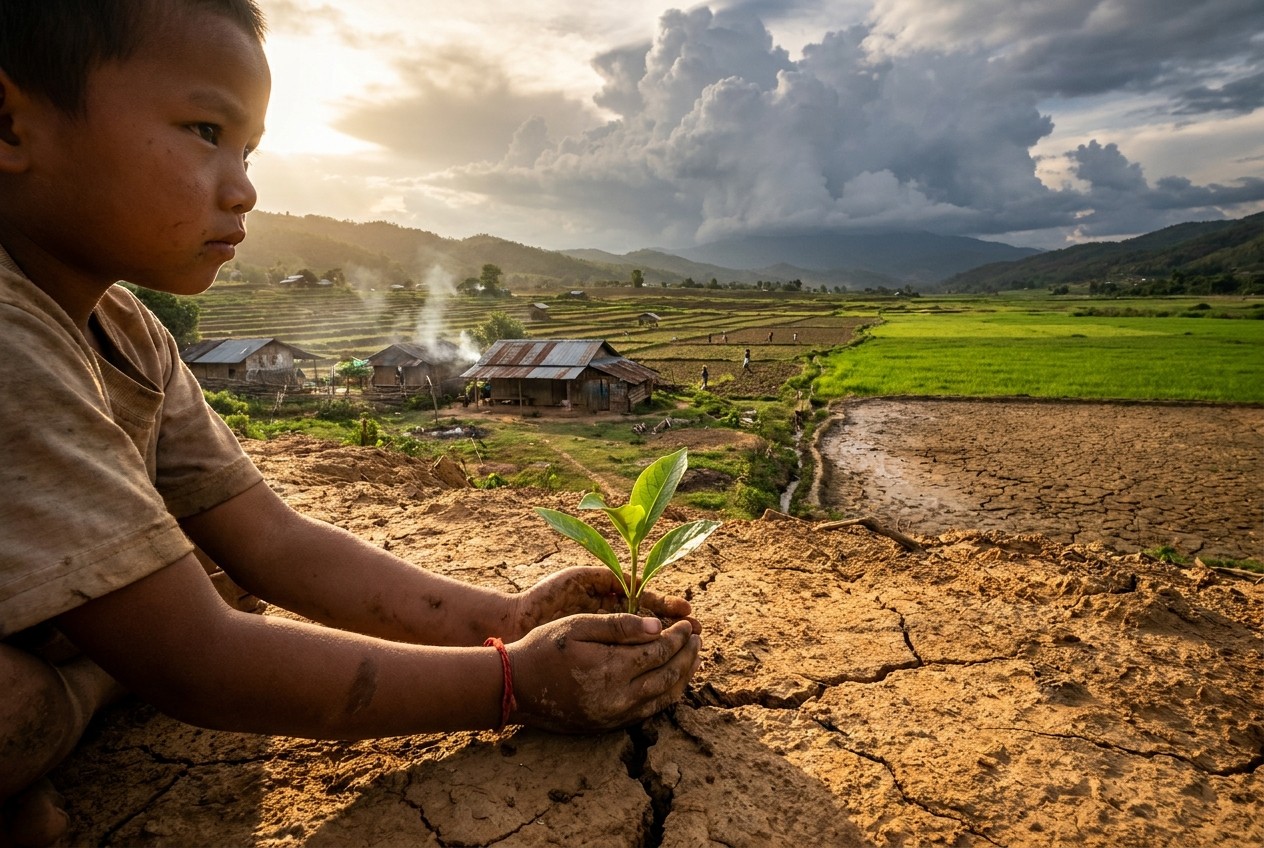
According to UNDP, the report covers 108 countries and is the first recorded increase in the global headcount since the index was launched.
Report Measures Poverty Beyond Income
Households are classified as living in acute poverty when they are deprived in at least one-third of the weighted indicators, according to the report.
The scale of severe deprivation captured by the index is substantial.
David Kinley, in Necessary Evil, writes that the new breed of so-called multidimensional poverty indices measure average education levels, health levels including life-expectancy and infant mortality rates, access to clean water, sanitation and power sources, as well as incomes, a broadened perspective that has provided a greater understanding of how poverty is experienced [2]. Edoardo Masset, writing in the Journal of Hunger and Environmental Nutrition, notes that combining different aspects of deprivation carries methodological complications, observing that food intake, nutritional status and mortality are strongly correlated, thus producing double counting, and that the choice of adding up percentage values of each dimension without prior scaling is also questionable [3].
Children and Rural Areas Account for Most Cases
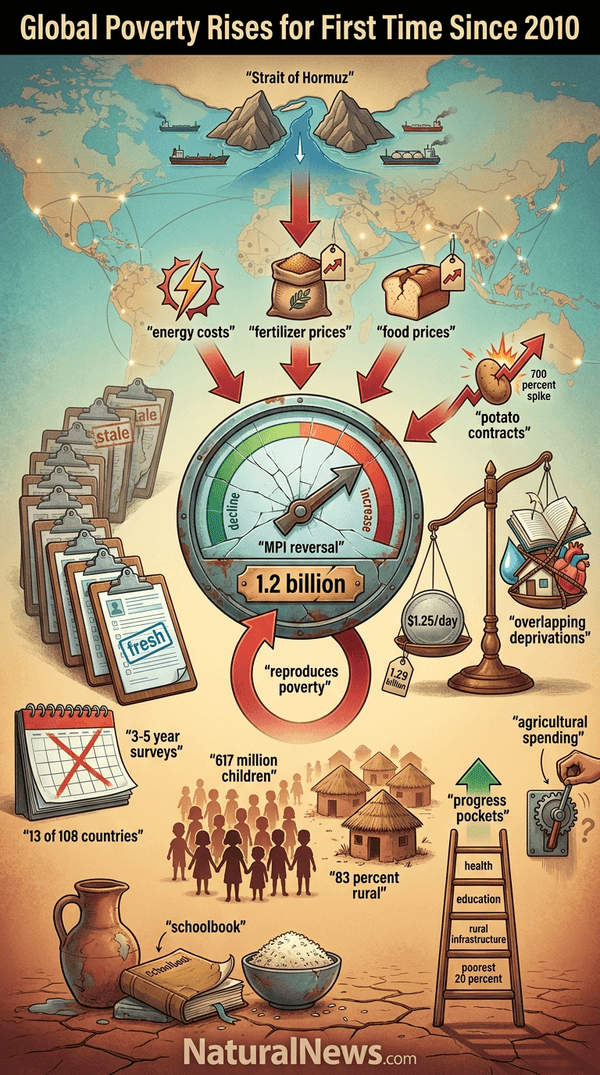
Children account for more than half of those living in acute poverty, at 617 million, and 83% live in rural areas, according to UNDP [1].
The findings arrive against a backdrop of global food and trade disruption. The UN secretary-general, Antonio Guterres, said fighting must stop on all fronts in the Middle East, noting that trade through the Strait of Hormuz has collapsed, energy markets have been upended, food and key fertilizer prices have surged, and supply chains are buckling [4]. Separately, potato-linked financial contracts spiked more than 700% over the past month and were up over 34% year-on-year as of mid-May, driven by fertilizer cost increases tied to disruptions around the Strait of Hormuz [5][6].
Report Cites Population Growth and Data Differences
New data was available for only 13 of the 108 developing countries covered by the report, according to Ground News [7].
Despite the global rise, several countries recorded progress.
Timothy A. Wise, in Eating Tomorrow, documents how the Gates Foundation's agricultural spending has been directed through programs that critics say serve corporate interests.
World Bank Estimate Offers Separate Measure
The World Bank figure uses a monetary threshold, while the Multidimensional Poverty Index used by UNDP and Oxford measures overlapping deprivations in health, education and living standards. David Kinley notes in Necessary Evil that although in August 2008 the World Bank raised the extreme poverty line to $1.25 a day, this did not fully account for the lower than expected reduction in the number of extreme poor, with World Bank estimates for 2008 putting 1.29 billion people living below the poverty line [2].
Lyla Bashan, in Global, writes that development is about creating inclusive growth, meaning there is a reduction in absolute poverty thanks to economic growth, and an increase in the income of the poorest 20 percent of the population at a rate equal to, or even faster than, the rest of the country. Countries where the economy is largely based on natural resource extraction, such as in many developing countries, tend not to have inclusive growth [8].
Conclusion
UNDP and Oxford reported that 33 countries have halved their poverty index scores in fewer than 15 years, a finding the agency cited as evidence that progress remains possible.
Edoardo Masset, writing in the Journal of Hunger and Environmental Nutrition, found that the most important environmental factor affecting policy choice is the availability of resources and administrative capacity, and that a hunger commitment index can be built on indicators of political will, policies and programs, which can be aggregated into a single index or considered separately to monitor the operation of hunger reduction efforts [3].
References
- Global multidimensional poverty rises for first time since 2010. https://www.undp.org/press-releases/global-multidimensional-poverty-rises-first-time-2010
- Necessary Evil. by David Kinley
- A review of hunger indices and methods to monitor country commitment to fighting hunger by Edoardo Masset. Journal of Hunger and Environmental Nutrition 5(3):457-478 [2010]
- Driver of global instability': UN chief says Middle East fighting must stop. https://www.middleeasteye.net/live-blog/live-blog-update/driver-global-instability-un-chief-says-middle-east-fighting-must-stop
- Potato futures are soaring – should the world be worried?. https://www.rt.com/business/640034-middle-east-war-potato-prices-spike/?utm_source=rss&utm_medium=rss&utm_campaign=RSS
- Potato Futures Rise Sharply as Middle East War Disrupts Fertilizer Trade. https://www.naturalnews.com/2026-05-19-potato-futures-rise-sharply-fertilizer-trade-disruption.html
- Global Poverty Index Rises, Hits 1.2 Billion In 16 Years. https://ground.news/article/un-report-shows-first-increase-in-poverty-since-2010
- Global by Lyla Bashan
Explainer Infographic








Please contact us for more information.