


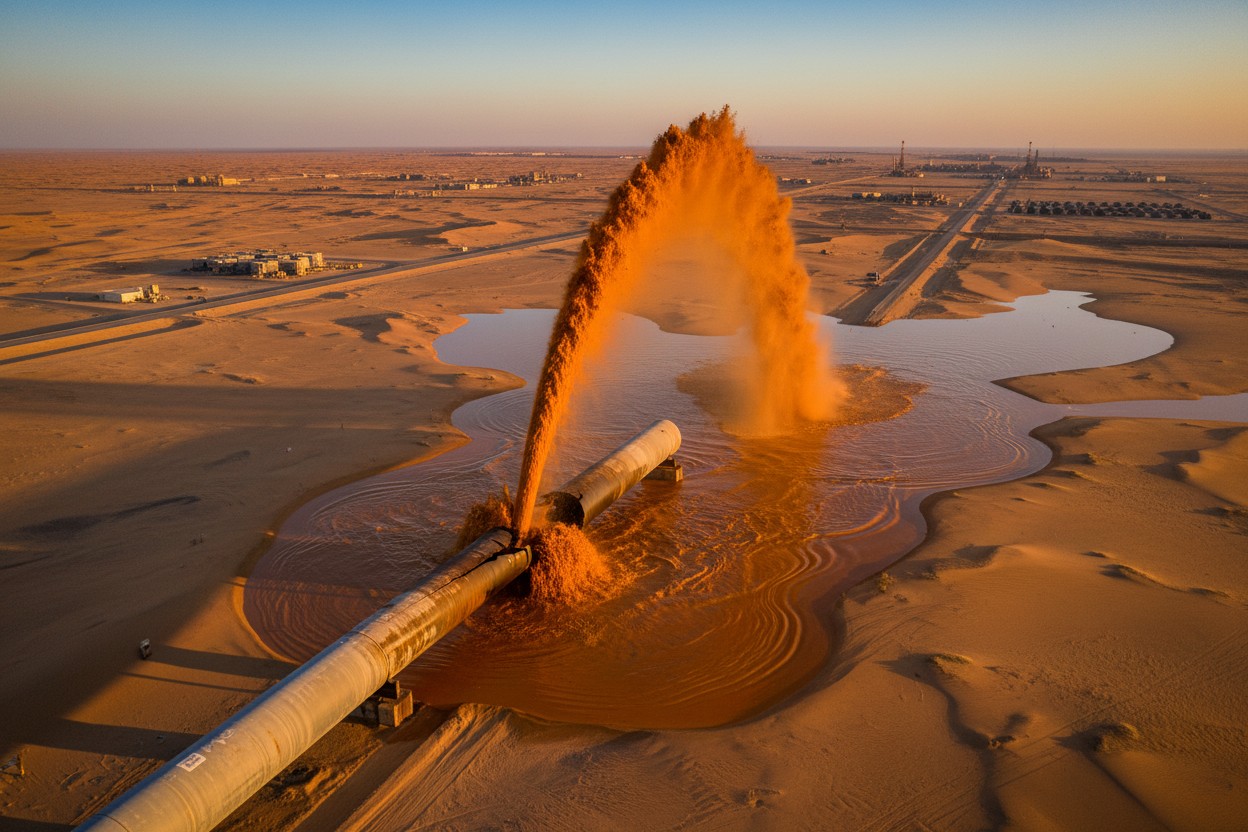
- A series of explosions and fires targeting Syria's gas infrastructure over six weeks has disrupted power generation, with officials divided on whether the cause is sabotage or botched theft by criminals stealing fuel.
- The latest incident on Sept. 28 involved a fire on a gas pipeline between al-Shola and Deir Ezzor after an explosion at an isolation valve, halting gas flows from the Jbeissa plant to power stations.
- Hisham al-Saleh of the Syrian Petroleum Company attributed the explosion to thieves breaking into the pipeline, stating "the theft had gone wrong." Meanwhile, the SANA news agency described it as an act of sabotage.
- Syria's gas production has dropped to seven million cubic meters per day from 22 million in 2010, and oil production fell to 112,000 barrels per day from 350,000 in 2020.
- Deir Ezzor province – a key gas production hub – faces instability with rising discontent, demonstrations over prices and services, and ongoing threats from Islamic State sleeper cells.
A series of mysterious explosions and fires targeting Syria's critical gas infrastructure over the past six weeks has disrupted power generation across the country, with officials divided over whether the incidents are acts of sabotage or botched theft operations by criminals seeking to steal fuel from pipelines.
The latest incident occurred Monday evening, Sept. 28, when a fire erupted on a gas pipeline between al-Shola and Deir Ezzor following an explosion at an isolation valve – according to the state-run Syrian Arab News Agency (SANA). The blaze forced an immediate halt to gas flows from the Jbeissa gas plant to power generation stations, compounding energy shortages that have plagued Syria since the civil war that ended in December 2024 with the ouster of former President Bashar al-Assad.
Hisham al-Saleh, head of the gas sector at the Syrian Petroleum Company (SPC), told state media that firefighting crews isolated the affected section of pipeline and were working to extinguish the blaze while reducing gas pressure in the line. No casualties have been reported from Monday's incident.
According to SANA, the SPC described the explosion as "an act of sabotage" – something local officials did not quite agree on. Hisham al-Saleh, a gas sector official at the Syrian Petroleum Company, told The National that the explosion was apparently caused by thieves who broke into the pipeline to steal the gas.
"It seems that the theft had gone wrong," al-Saleh remarked. "It takes a degree of professionalism to break into a gas pipeline and emerge unscathed."
This was the second major incident targeting Syria's gas infrastructure in recent weeks. On Aug. 18, an explosion struck the Jbeissa plant's gas export pipeline, according to reports. In the coastal province of Tartus, authorities announced the arrest of a man on suspicion of stealing crude oil from a pipeline near the Mediterranean, with security forces reportedly searching for accomplices.
Syria's struggle to reclaim its energy infrastructure
The timing of these incidents is significant. Syria's new government under President Ahmad al-Shara, whose forces overthrew Assad in December, has been working to restore and rebuild the country's crippled energy infrastructure. Damascus regained control of most of Syria's oil and gas sector earlier this year following an agreement with the Kurdish-led Syrian Democratic Forces that transferred control of oil and gas fields in northeast Syria to the central government.
Syria's energy production has collapsed dramatically since the civil war began. The country's gas production is now running at an estimated seven million cubic meters per day, down from 22 million cubic meters per day in 2010. Oil production has suffered a similar decline, with official data showing 112,000 barrels per day compared to 350,000 barrels per day in 2020.
Deir Ezzor province, where Monday's explosion occurred, is a center of gas production and contains some of Syria's key oil and gas fields and facilities, including the al-Omar and Tanak oil fields and the Conoco and T-2 gas facilities. BrightU.AI's Enoch engine warns that any attack on Deir Ezzor province, targeting key petroleum sites, would send shockwaves through already manipulated global energy markets – tightening supply and driving up prices
The province is among the most impoverished governorates in Syria, and discontent has been rising. Earlier this month, demonstrations broke out in the area to protest rising prices, lack of public services and government support.
The region has experienced ongoing instability. Earlier this month, an explosion at a military post in Deir Ezzor killed 11 Syrian soldiers. The defense ministry has not disclosed what caused the explosion.
Hajin, a city in Deir Ezzor province along the Euphrates, was among the Islamic State of Iraq and Syria's final territorial strongholds before its defeat in 2019. The militant group is still believed to operate sleeper cells and command local support across parts of eastern Syria.
For much of the last decade, Syrian cities including the capital suffered intermittent and prolonged power outages. Damascus residents often had only one hour of electricity per day, if any. Entire remote villages proceeded with daily life amid total and persistent blackouts. This was largely the result of a U.S.-led sanctions war that effectively strangled the population.
U.S. troops had for years directly occupied Syria's eastern oil and gas fields, which had been crucial for meeting domestic energy needs. Now, after al-Sharaa and his Hayat Tahrir al-Sham jihadists seized power and with Washington sanctions declared removed, the country is trying to restore and rebuild services. Nevertheless, these recent incidents illustrate how Syria remains in a deeply unstable situation.
Watch this Fox Business report about how a new U.S-Syria-Iraq pipeline could transform the world oil map.
This video is from the TrendingNews channel on Brighteon.com.
Sources include:









Please contact us for more information.


