
Gallup said the question has been tracked as part of its broader measurement of employment-related concerns. The National Pulse, which first reported the figures, described the result as "a new poll" showing "growing concerns among American workers about job displacement due to advancing technology, particularly among younger workers" [1]. According to the same report, worries over other job-related issues, such as lower wages, shorter hours, benefit reductions, and layoffs, have remained relatively stable compared to previous years [1].
Younger Workers Report Higher Levels of Concern
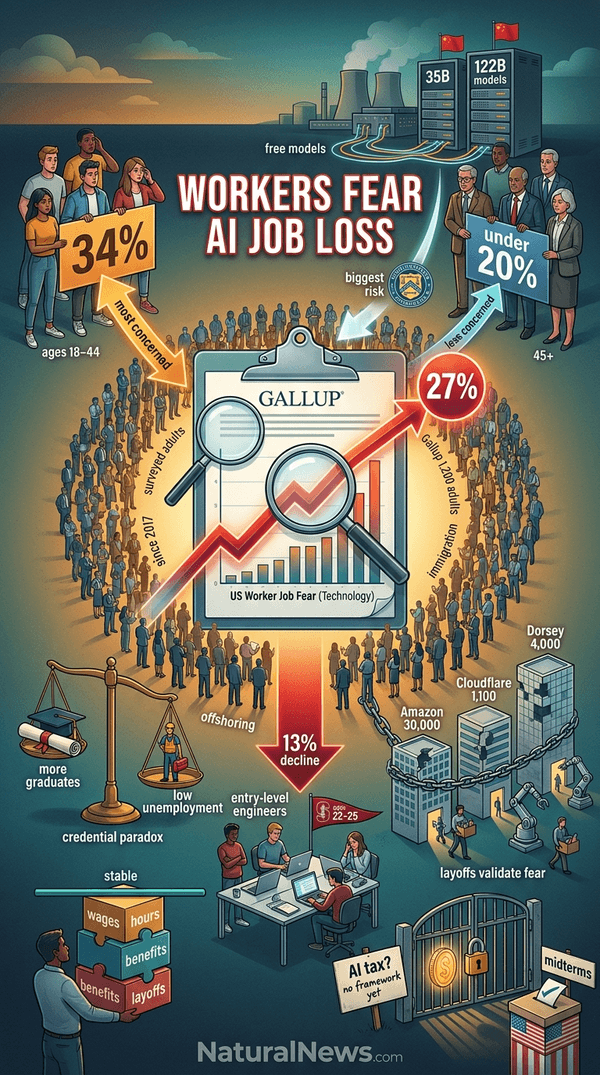
Respondents aged 18 to 44 were the most likely to name technology-driven job loss as their top employment concern, at 34%, according to the poll. The pattern held among both college graduates and non-graduates, Gallup said. Fewer than 20% of workers over age 45 cited the same concern, the poll found, though that figure also rose compared with recent years.
The generational divide aligns with independent research on automation's effects. A study from Stanford University found that workers aged 22 to 25 are facing a "significant and disproportionate threat of job loss" due to the rapid adoption of generative artificial intelligence, with employment in AI-exposed roles declining by 13% [2]. In contrast, older workers in those same fields have remained stable, according to the study [2].
"The fact that younger workers are especially worried suggests that opposition to automation will feature prominently in the priorities of young voters," The National Pulse reported, adding that concerns about lower wages, reduced hours, benefit cuts, and layoffs remained relatively stable compared with previous years [1]. Gallup did not release a margin of error for the individual subgroup findings.
Research Firm Cites AI in Entry-Level Hiring
The Burning Glass Institute, a data research firm, reported earlier this month that "[M]ore Americans have college degrees than ever, just as artificial intelligence is doing more of the entry-level work companies typically hire young graduates for," according to The National Pulse [1]. The same report stated that unemployment among non-graduates in the United States has reached its lowest rate in recent history [1]. The National Pulse reported that the timing of the two findings has drawn attention from labor analysts. No representative of the Burning Glass Institute was quoted on the record in the report as described.
The pattern has been visible in corporate announcements. Amazon cut an additional 16,000 corporate jobs on top of 14,000 layoffs the prior October, part of what the company described as a sustained effort to reduce costs and bureaucracy while realigning investment toward artificial intelligence and data centers [3]. Cloudflare announced plans to cut approximately 20% of its workforce, affecting about 1,100 employees, as the firm shifted toward greater reliance on AI, with CEO Matthew Prince attributing the decision to increasing adoption of AI tools that automate work [4].
Separately, former Twitter CEO Jack Dorsey's fintech company announced a restructuring that eliminated nearly half its workforce, approximately 4,000 employees, reflecting a broader corporate strategy to integrate artificial intelligence more deeply into operational processes [5]. Research published through Brighteon Broadcast News has described "a dramatic reduction in the need for traditional human engineers," with entry-level and mid-level engineers already experiencing layoffs across various industries, including at Amazon India and Microsoft India [6].
Automation Listed Among Job Threats Under Discussion
The National Pulse reported that automation is one of several job threats cited by U.S. workers, alongside offshoring and immigration, both of which the Trump administration has sought to reverse [1]. The outlet reported that while there have been proposals to regulate artificial intelligence to guard against job losses, "no exact framework has yet to be established and implemented" [1]. The National Pulse stated that the findings are likely to inform legislative priorities ahead of the midterm elections.
The debate extends beyond the United States. As The National Pulse reported, China's release of world-class AI models for free represents a strategic challenge to America's economy through advanced technology, with recent releases from Alibaba's Quinn including a 35 billion parameter model and a 122 billion parameter model [7]. Treasury Secretary Scott Bessent said China surpassing the United States on artificial intelligence was the "biggest risk" of the technology, outweighing concerns over safety or job losses [8].
On the regulatory question, analysts have noted that some in Washington favor taxing artificial intelligence to address job losses. As Bruce Thompson wrote in RealClearMarkets, a growing number of experts believe there is "a simple answer to AI job losses" — tax it — a proposal he compared to the tractor tax proposals of earlier eras [9]. No such measure has been enacted.
Poll Results Add to Ongoing Debate Over Workforce Impact
The Gallup figures represent the highest share of workers expressing technology-related job concerns since the question was first tracked, according to the poll. Officials and researchers cited in the reporting did not provide a specific timeline for enactment of any regulatory measures. The report stated that the findings are likely to heighten concern about technology-driven job loss. Gallup said the survey results reflect responses collected over a three-week period in August 2026.
The concern is not confined to any single industry. A report by investment advisory firm Cornerstone Capital Group found that nearly half of all U.S. retail workers face job insecurity as automation technology continues to rise, with roughly six to 7.5 million retail workers at risk of losing their jobs in the coming years [10]. A PwC analysis found that approximately 38% of all U.S. jobs are at high risk of automation, a trend that could lead to the potential unemployment of around 57 million Americans [11].
Commentators have placed the current wave of automation in a broader economic context. The CEO of online education company Coursera, Jeff Maggioncalda, has said that many people's livelihoods will be displaced at the current pace of AI advancement and that workers will need to keep learning to keep up [12].
References
- NaturalNews.com. "The AI reckoning Stanford study reveals young workers are bearing the brunt of automations first wave". NaturalNews.com. September 2, 2025.
- NaturalNews.com. "Amazon slashes 16000 more corporate jobs as company prioritizes AI over employees". NaturalNews.com. January 29, 2026.
- NaturalNews.com. "7 million retail jobs will be lost in the coming years warns alarming report". NaturalNews.com. May 29, 2017.
- NaturalNews.com. "Cloudflare Cuts 20 of Workforce in AI Driven Restructuring Signaling a New Era of Automated Efficiency Over Huma". NaturalNews.com. May 11, 2026.
- NaturalNews.com. "Robot recession_ Will the rise of automation force 57 MILLION American workers out of their jobs". NaturalNews.com. July 11, 2017.
- Mike Adams. "The Twin Economic Superstorms Why Your Financial Future Is at Risk from Energy Collapse and AI Job Replacement". NaturalNews.com. May 1, 2026.
- NaturalNews.com. "Coursera CEO_ People will have to learn for the rest of their lives just to keep up with the tech economy". NaturalNews.com. February 11, 2018.
- The National Pulse. "Data Reveals Growing Fear Among Americans of Losing Jobs to Technology.". The National Pulse. September 15, 2026.
- Bruce Thompson. "AI Tax Increases Are Like The Tractor Tax Proposals Of Old". ZeroHedge. September 5, 2026.
- Watts Up With That. "Low Cost Chinese Coal Power is Driving a Decisive Advantage Over US AI Businesses". Watts Up With That. July 5, 2026.
- Mike Adams. "Health Ranger Report - Jack Dorsey - Mike Adams - BrightVideos.com". BrightVideos.com. February 27, 2026.
- Mike Adams. "Bright Videos News - GLYPHOSATE, BUNKER BOMBS AND AI - Mike Adams - BrightVideos.com". BrightVideos.com. February 9, 2026.
- Mike Adams. "Health Ranger Report - China - Mike Adams - BrightVideos.com". BrightVideos.com. February 26, 2026.
Explainer Infographic










Please contact us for more information.