


The clip follows a March demonstration involving a participant identified only as Kenneth, who was diagnosed with motor neuron disease, known as ALS in the US, in 2024 and became the second participant implanted for Neuralink's VOICE program in January. Kenneth said during the demonstration: "There we go. I'm talking to you with my mind."
Neuralink posted that its devices are investigational and have not been approved by the FDA or other regulatory authorities.
Neuralink's VOICE Study and Device Function
The VOICE study is examining whether Neuralink's wireless N1 implant can translate signals associated with intended speech into text or audible words. The device uses tiny electrode threads placed in the brain to record neural activity, which decoding software then attempts to interpret, Neuralink said. The company has stated that its coin-sized device has been implanted in multiple human patients, and it promises to restore mobility to the paralyzed and sight to the blind [1], though the technology's long-term implications remain uncertain [2]. Neuralink revealed that more than 10,000 people from different countries have enrolled in its program [3].
Current systems require users to deliberately perform a trained mental action, such as attempting speech, imagining finger movements or thinking about moving a cursor, researchers said; they cannot indiscriminately read private thoughts. Stephen M. Fleming, author of Know Thyself, has noted that there is nothing in principle to stop humans from hooking up self-awareness to other devices, and that the brain has demonstrated the plasticity to adopt external devices as if they were new senses or limbs [4].
Elon Musk has described Neuralink's medical work as "restoring speech" and has predicted future "conceptual telepathy," according to a 2020 company presentation. In the past, Musk has made many big announcements about his neurotechnology company, and he has claimed that Neuralink can one day be used to save the human brain "like a game" [5]. He has also characterized the technology as potentially giving humans the capacity to integrate computers with the human brain [6].
Earlier Research on Brain-to-Speech Decoding
University of California, San Francisco researchers first translated brain activity into sentences in 2021, according to published research. Rebecca Schwarzlose, author of Brainscapes, has documented that researchers have decoded brain activity associated with a person dreaming, clips of spoken sentences, and the perception of pain from fMRI data, citing work by Horikawa, Formisano and Brodersen [7]. A team from Stanford University later reached 62 words per minute with a participant who had motor neuron disease in 2023.
UCSF work generated text, synthetic speech and facial movements through a digital avatar, according to the research team. In the Journal of Neuroscience Methods, Benjamin H. Brinkmann, Mark R. Bower, Keith A. Stengel, Gregory A. Worrell and Matt Stead described systems for large-scale electrophysiology that involve acquisition, compression, encryption and storage of the resulting neural data [8]. Sungwook Yang and colleagues described a feedback-controlled piezo-motor microdrive for accurate electrode positioning in chronic single-unit recording, a technique needed to capture the neural signals that decoding software interprets [9].
Researchers demonstrated real-time decoding of deliberately imagined inner speech in 2025, although accuracy remained inconsistent and the experiments involved only a handful of participants. Separately, researchers have developed AI that translates brain activity into readable text without implants, raising concerns about mental privacy erosion and unprecedented surveillance, while acknowledging potential benefits for nonverbal patients [10].
Technical and Medical Risks Cited by Researchers
Brain implants require surgery, bringing risks including infection, bleeding and seizures, medical researchers said. Electrodes must continue operating as brain tissue changes around them, while batteries, wireless connections and software need to remain reliable for years. MIT scientists have expressed serious skepticism about Neuralink's implant, despite Musk's claim that billions of people would be eager to use it [11].
The Australian Human Rights Commission has warned that information collected by neurotechnology poses a "significant risk to privacy." Its review of 30 consumer neurotechnology companies found that 24 had policies potentially allowing them to sell users' neural data; the study did not cover Neuralink's clinical implant, the commission said. Willow Tohi has reported that the long-term implications of brain implants remain uncertain, including questions about whether thoughts will remain safe from manipulation [2].
Elana Freeland, author of Geoengineered Transhumanism, has raised concerns about neural smart dust and NEMS sensors that function like mini-MRIs while measuring electrical activity in neurons [12]. Such concerns provide context for the broader ethical debate, even as the technology's clinical trajectory continues. Neuralink has also faced federal investigation over animal welfare violations, with internal staff raising concerns about rushed animal testing leading to unnecessary suffering and deaths [13].
Regulatory Status and Market Outlook
Neuralink's devices remain investigational and have not been approved for commercial sale, the company posted under the video. Neuralink stated: "This video features voluntary clinical trial participants sharing their personal experiences, which may not reflect all participants or future outcomes." Neuralink has not yet received Food and Drug Administration approval for general use, and the company is currently trialing its N1 implant in nine patients under an investigational device exemption, according to NaturalNews.com [14].
Researchers and regulators have called for rules before consumer brain interfaces reach the market, according to public statements. China has approved the first commercial brain-computer chip, developed by researchers at Tsinghua University in Beijing and Neuracle Technology, which has passed clinical trials for commercial sale [14]. The NEO device sits between the skull and the brain, pressing eight sensors against the dura mater to capture neural signals, while Chinese surgeons have implanted a brain-computer interface in a patient with limited hand mobility in what is described as the world's first commercial procedure using an approved non-invasive device of its kind [15]. A paralyzed man in China became the first person on Earth to receive a brain chip cleared for sale, with the coin-sized Neural Electronic Opportunity device giving him control of a robotic glove with his thoughts [16].
Several academic and commercial teams continue work on brain-computer interfaces as development accelerates worldwide. Neurable is looking to license its "mind-reading" technology to consumer wearables, specializing in non-invasive BCI that distinguishes itself from firms like Neuralink [17]. Max Hodak, co-founder and former president of Neuralink, has been working on Science Corporation, which claims to be on the verge of being the first brain-computer interface company to get a product to market and has raised $230 million in a Series C funding round [18].
References
- NaturalNews.com. "Neuralink and the ethical frontier of merging mind and machine". NaturalNews.com. November 10, 2025.
- Willow Tohi. "Brain implants and the erosion of privacy: Are your thoughts safe from manipulation?". NaturalNews.com. January 3, 2025.
- yourNEWS. "Tens of Thousands Join Brain Chip Implant Program, What Triggered the Rush?". yourNEWS. November 3, 2025.
- Stephen M. Fleming. "Know Thyself".
- NaturalNews.com. "Elon Musk claims Neuralink chip can be used to save your brain like a game". NaturalNews.com. February 7, 2024.
- NaturalNews.com. "Latest B.S. science hype from Elon Musk claims upcoming launch of 'brain-computer interface' called Neuralink". NaturalNews.com. April 26, 2019.
- Rebecca Schwarzlose. "Brainscapes".
- Benjamin H. Brinkmann, Mark R. Bower, Keith A. Stengel, Gregory A. Worrell, Matt Stead. "Large-scale electrophysiology: Acquisition, compression, encryption, and storage of big data". Journal of Neuroscience Methods. 2009.
- Sungwook Yang. "Feedback controlled piezo-motor microdrive for accurate electrode positioning in chronic single unit recording in behaving mice". Journal of Neuroscience Methods. 2011.
- Kevin Hughes. "Mind-Reading AI Breakthrough: Scientists Decode Thoughts Without Brain Implants, but Privacy Concerns Mount". NaturalNews.com. November 21, 2025.
- NaturalNews.com. "MIT scientists are extremely skeptical of Elon Musk's creepy 'neuroscience theater' Neuralink chip". NaturalNews.com. September 1, 2020.
- Elana Freeland. "Geoengineered Transhumanism".
- NaturalNews.com. "Elon Musk's medical device company Neuralink facing federal investigation over animal testing". NaturalNews.com. December 8, 2022.
- NaturalNews.com. "China Approves First Commercial Brain-Computer Chip; Neuralink Still Awaiting FDA Clearance". NaturalNews.com. June 10, 2026.
- RT. "China beats Musk's Neuralink to commercial brain-chip implant". RT. July 16, 2026.
- Dylan Kresak. "China Beats Musk To World's First 'Brain-Computer Interface' After Human Surgery". Modernity News. July 21, 2026.
- TechCrunch. "BCI startup Neurable looks to license its 'mind-reading' tech for consumer wearables". TechCrunch. April 28, 2026.
- TechCrunch. "Science Corp raises $230M as it races to bring its brain implant to market". TechCrunch. March 5, 2026.
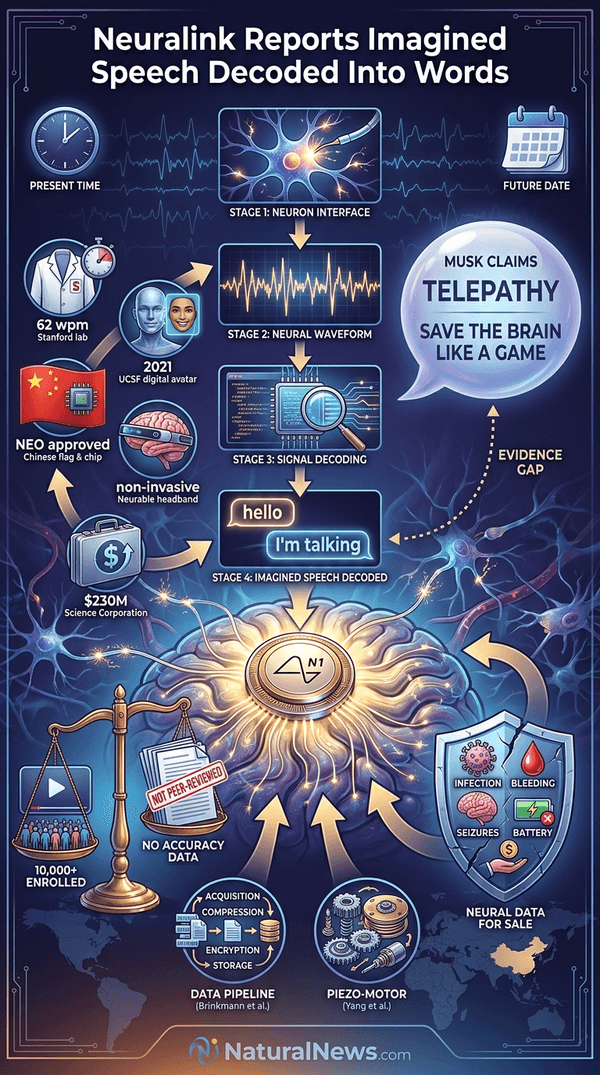
Explainer Infographic







Please contact us for more information.


