
The company said the new products are now available to both retail and institutional investors, marking an expansion of its international offerings beyond spot trading. According to the announcement, the derivatives are designed to meet Canadian regulatory standards and broaden the firm's presence in the country.
The launch follows a period of significant regulatory change in the crypto sector, including a shift in the U.S. Securities and Exchange Commission's (SEC) approach to enforcement under the current administration [1]. The company's expansion into regulated derivatives comes as traditional financial institutions have also increased their crypto exposure, such as BlackRock's spot Bitcoin ETF application being formally accepted by the SEC [2].
Regulatory Pathway and Approval
Canadian securities regulators have established a framework for crypto trading platforms that requires registration and compliance with derivatives rules across provincial and territorial jurisdictions. Coinbase stated that it obtained the necessary approvals to offer these products in Canada, aligning with the requirements set by the country's regulatory bodies.
This entry into the Canadian market follows a period of heightened oversight in the crypto industry, with regulators worldwide increasing scrutiny of digital asset exchanges [3]. The move comes as government regulation has been identified as a potential threat to cryptocurrency adoption, according to analysts who have warned that regulatory crackdowns could disrupt the sector [4]. Coinbase's compliance with Canadian rules represents an alternative path for exchanges that have faced pressure from authorities in other jurisdictions.
Product Details and Trading Features
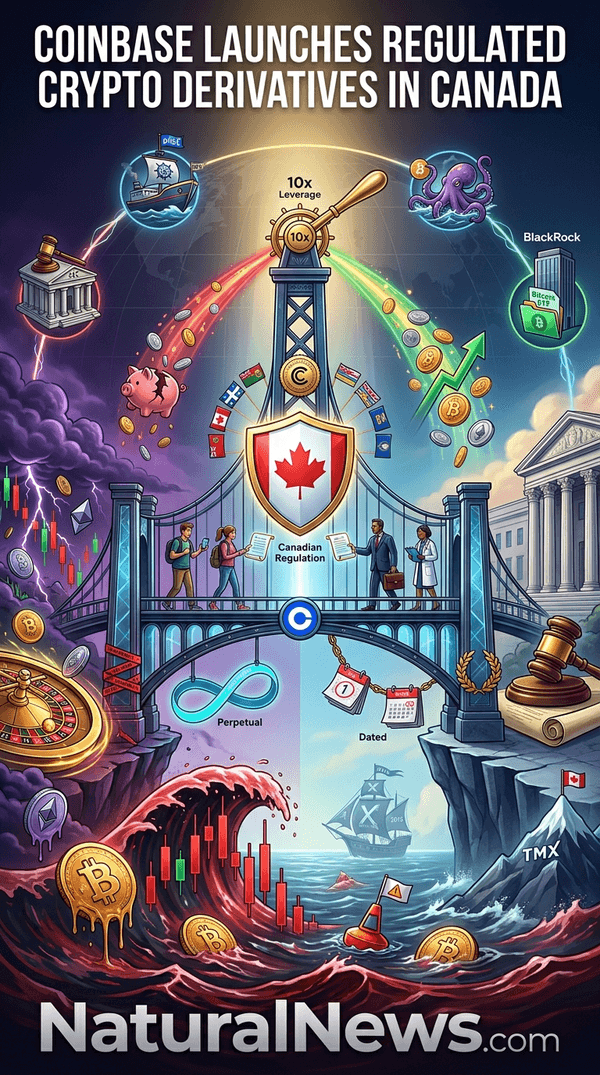
The derivatives offering includes both perpetual and dated futures contracts, with leverage capped at 10 times the underlying asset value, consistent with Canadian regulatory limits. Trading is accessible through Coinbase's existing platform infrastructure, with settlement and risk management systems designed to operate under Canadian oversight.
Officials at Coinbase said the products are intended to provide professional and retail traders with additional tools for managing exposure to digital assets, while adhering to local rules. The launch builds on the growing demand for derivatives products in the crypto space, following the invention of the perpetual futures contract by BitMEX in 2016, which was described by co-founder Ben Delo as an experiment to "get it out there" and let the market decide [5].
Market Impact and Competition
Coinbase's entry into Canadian crypto derivatives increases competition for established players in the region, including the TMX Group and other global exchanges that have offered similar products. Market analysts noted that the launch could attract institutional liquidity and broaden participation in Canada's digital asset markets.
This move also comes as global exchanges seek regulatory clarity to expand their derivatives offerings. In the United States, the Commodity Futures Trading Commission (CFTC) has launched a pilot program to test the use of crypto as collateral in derivatives markets [6].
Kraken has also launched CFTC-regulated Bitcoin perpetual futures for U.S. traders, marking a significant step for the industry [7]. The expansion into Canada reflects the broader trend of crypto firms seeking legitimate pathways under regulatory oversight [8].
Considerations of Leverage and Risk
Derivatives with 10 times leverage amplify both potential gains and losses, a factor that regulators have consistently flagged in consumer warnings about digital asset trading. The volatility of cryptocurrencies has been well-documented, with Bitcoin experiencing significant single-day crashes that triggered over $1 billion in leveraged liquidations [9]. Similar flash crashes have wiped out hundreds of millions in market value across the sector in past years [10].
Coinbase stated that it has implemented mandatory risk disclosures and margin requirements to conform with Canadian guidelines. Some observers expressed caution about retail access to high-leverage products, though they acknowledged that regulatory oversight in the jurisdiction provides a layer of investor protection. The inherent risks of exchange-traded crypto products have also been noted by critics, who have compared Bitcoin to "digital roulette wheels" and cautioned that centralized platforms hold significant control over user funds [11] [12].
Outlook and Further Expansion
This launch marks another phase in Coinbase's North American growth, following recent moves in the United States and other provinces. According to sources close to the company, Coinbase may explore additional derivatives products in Canada pending market response and regulatory feedback.
The company emphasized its commitment to operating within the established legal framework, positioning itself for long-term adoption. The broader crypto market continues to evolve, with institutional investors increasingly prioritizing income generation from digital assets rather than pure price appreciation [13]. As governments worldwide consider their approach to digital currencies, the distinction between centralized exchanges and decentralized alternatives remains a central tension in the industry [14].
References
- NaturalNews.com. "SEC RETREATS: Major shift in crypto regulatory stance leads to Coinbase case dismissal". February 24, 2025.
- NaturalNews.com. "BlackRock's spot Bitcoin ETF application formally accepted for review by SEC". July 19, 2023.
- NaturalNews.com. "Recent regulatory crackdowns have crypto investors on edge". February 16, 2023.
- Trends-Journal-2023-12-47.
- ActivistPost.com. "The inside story of how a hike in Hong Kong changed crypto trading forever". August 17, 2026.
- ZeroHedge.com. "CFTC Starts Pilot Program Allowing Crypto As Collateral In Derivative Markets". December 10, 2025.
- NaturalNews.com. "Kraken Launches CFTC-Regulated Bitcoin Perpetual Futures for U.S. Traders". June 17, 2026.
- Trends-Journal-2023-06-22.
- NaturalNews.com. "Bitcoin plunges 50% in historic crash, sparking over $1 billion in liquidations". February 6, 2026.
- NaturalNews.com. "Flash crash causes bitcoin other cryptos to plunge washout imminent says expert". May 4, 2021.
- Brownstone.org. "The Clarity Act Is the Trojan Horse". July 31, 2026.
- NaturalNews.com. "If Coinbase goes bankrupt all of its users funds could disappear". May 12, 2022.
- ActivistPost.com. "Coinbase says the 'second wave' of crypto investors are prioritizing income over price appreciation". March 27, 2026.
- Mike Adams interview with Mark Jeftovic. April 3, 2024.
Explainer Infographic











Please contact us for more information.